Dominance at the protein level
Mendel’s laws say how alleles are passed on, but not why one allele hides another. The answer comes from what genes do: most code proteins, as Chapter 12 showed, and dominance depends on how much working protein a cell makes.
Wild-type and mutant alleles
For any gene, the allele that is most common in a population is its wild-type allele. A wild-type allele usually codes a protein made in the right amount that works properly. Alleles changed by mutation are mutant alleles, and they tend to be rare.
Many mutations damage a gene so that it makes less of its protein, or a protein that works poorly or not at all. These are loss-of-function alleles, and many of them are recessive.
Why one working copy is often enough
Take pea flower color. The color gene codes an enzyme, protein P, that turns a colorless molecule into purple pigment.
The heterozygote makes only half as much enzyme as the PP plant, but that half still makes enough pigment for fully purple flowers. A PP plant makes far more enzyme than it needs. So P is dominant: one working copy covers for the broken one.
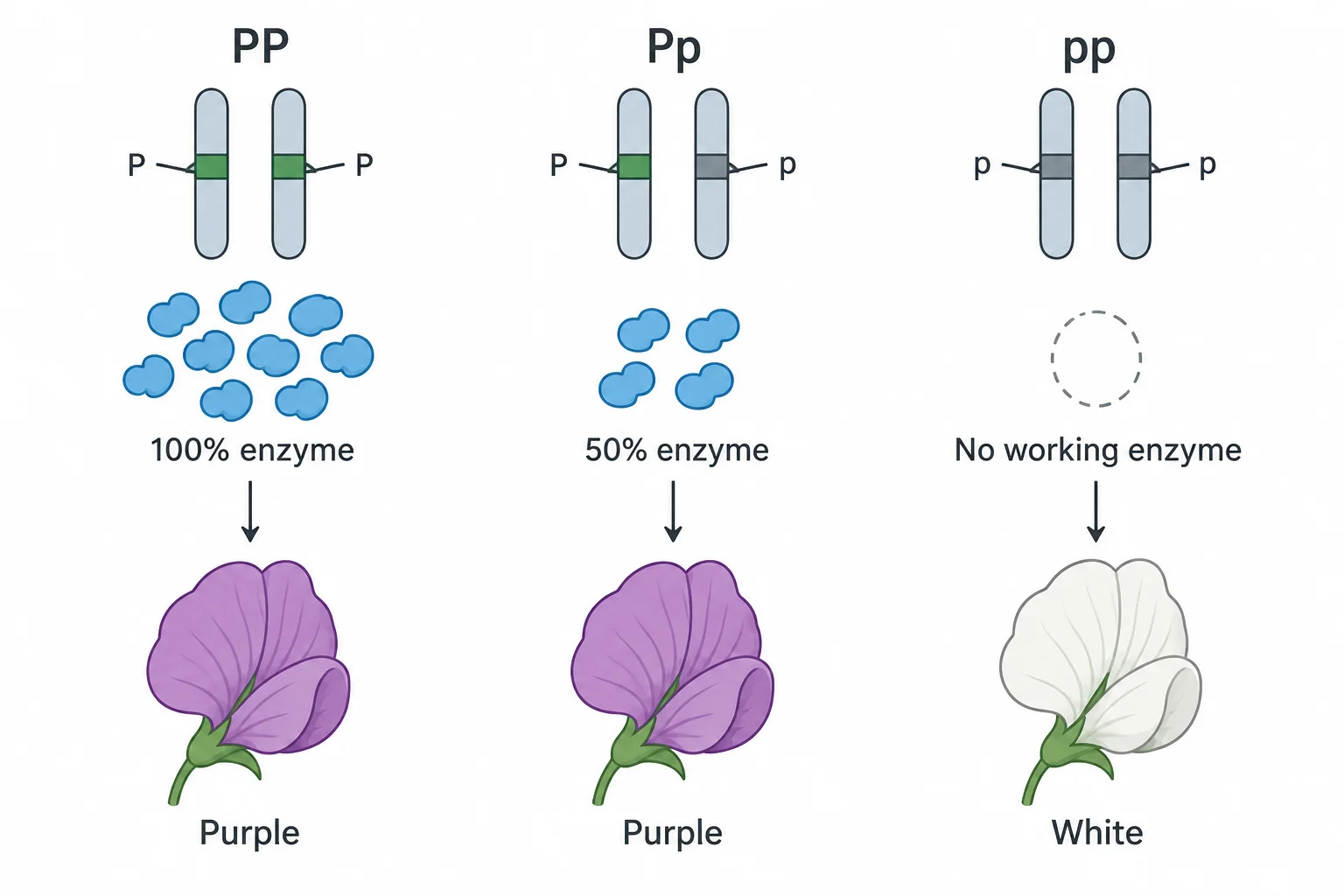
Sometimes a heterozygote does better than 50%. Through gene regulation, the cell can turn up the working allele to make up for the broken one.
Check yourselfIn a plant species, most individuals have hairy leaves, but a rare true-breeding form has smooth leaves. If one gene controls this, which form is more likely homozygous recessive?
The smooth form. Recessive alleles are usually loss-of-function alleles, and losing a function is more likely to remove a feature (the hairs) than to create one.
Many inherited diseases are recessive
The loss-of-function idea explains most human genetic diseases. Thousands of disorders are caused by mutations in single genes, and most of those mutations are recessive: a person is affected only when both copies fail to make an active protein.
| Disease | Missing working protein | Main effect |
|---|---|---|
| Phenylketonuria (PKU) | Enzyme that breaks down the amino acid phenylalanine | Phenylalanine builds up and harms development unless the diet avoids it |
| Cystic fibrosis (CF) | Chloride-ion transporter | Ion and water imbalance, thick lung mucus, lung infections |
| Tay-Sachs disease | Enzyme that breaks down certain lipids | Paralysis, blindness, early death |
| Sickle cell disease | β-globin, part of hemoglobin | Anemia, blocked circulation, pain |
Not every recessive allele is harmful. The recessive alleles behind blue eyes and light skin, for instance, cause no disease.
One gene, many effects
When a gene is mutated, the effects often show up in many parts of the body. A single gene affecting several different traits is called pleiotropy, and nearly all genes are pleiotropic to some degree. It happens for three main reasons:
- One protein can affect a cell in more than one way. A faulty microtubule protein, for example, could disrupt both cell division and cell movement.
- A gene can be expressed in several cell types.
- A gene can be expressed at several stages of development.
Cystic fibrosis is a clear case. Its gene codes the transporter that moves chloride ions (Cl⁻) across membranes, and water follows those ions. When the transporter fails, the effects spread:
- Lungs: too little water leaves the cells, so the mucus turns thick and sticky.
- Pancreas: thick mucus blocks the ducts that carry digestive enzymes, so food is poorly absorbed and weight gain is slow.
- Sweat glands: salt can’t be recycled back into the skin, so sweat is unusually salty, which is the basis of a common test for CF.
Check yourselfA single mutant gene causes both skeletal defects and heart defects. What is this called, and give one reason it can happen.
Practice questions
1 of 3
A mutation leaves a gene unable to make any working protein. What is this kind of allele called?
2 of 3
Which recessive human disease results from lacking a working enzyme to break down the amino acid phenylalanine?
3 of 3
Which of these is a reason a single gene can affect several different traits?