Epistasis and polygenic traits
So far, each character has been controlled by one gene. In reality, nearly every trait is shaped by many genes. Height alone depends on genes for growth hormones, cell division, nutrient uptake, and more.
How Mendel saw one gene at a time
Mendel could still study a single height gene because he chose tall and short strains that differed at only one of the many genes that affect height. If a tall strain is TT and a short strain tt, but both carry identical alleles at every other height gene, then only the T gene varies in their offspring. Holding everything else constant let the effect of one gene show through.
When two or more genes affect a single character, the genes are said to show gene interaction. Two kinds matter here: one gene masking another, and many genes adding up.
Epistasis: one gene masks another
Sweet peas gave a surprise. Two different true-breeding white-flowered strains, crossed together, produced F₁ plants that all had purple flowers. When those F₁ plants fertilized themselves, the F₂ came out about 9 purple : 7 white.
The explanation is two genes, C and P, each with a dominant allele needed for purple. A plant needs at least one C and at least one P to be purple. Being cc or pp makes it white regardless of the other gene. When the alleles of one gene mask the effect of a different gene like this, the interaction is epistasis.
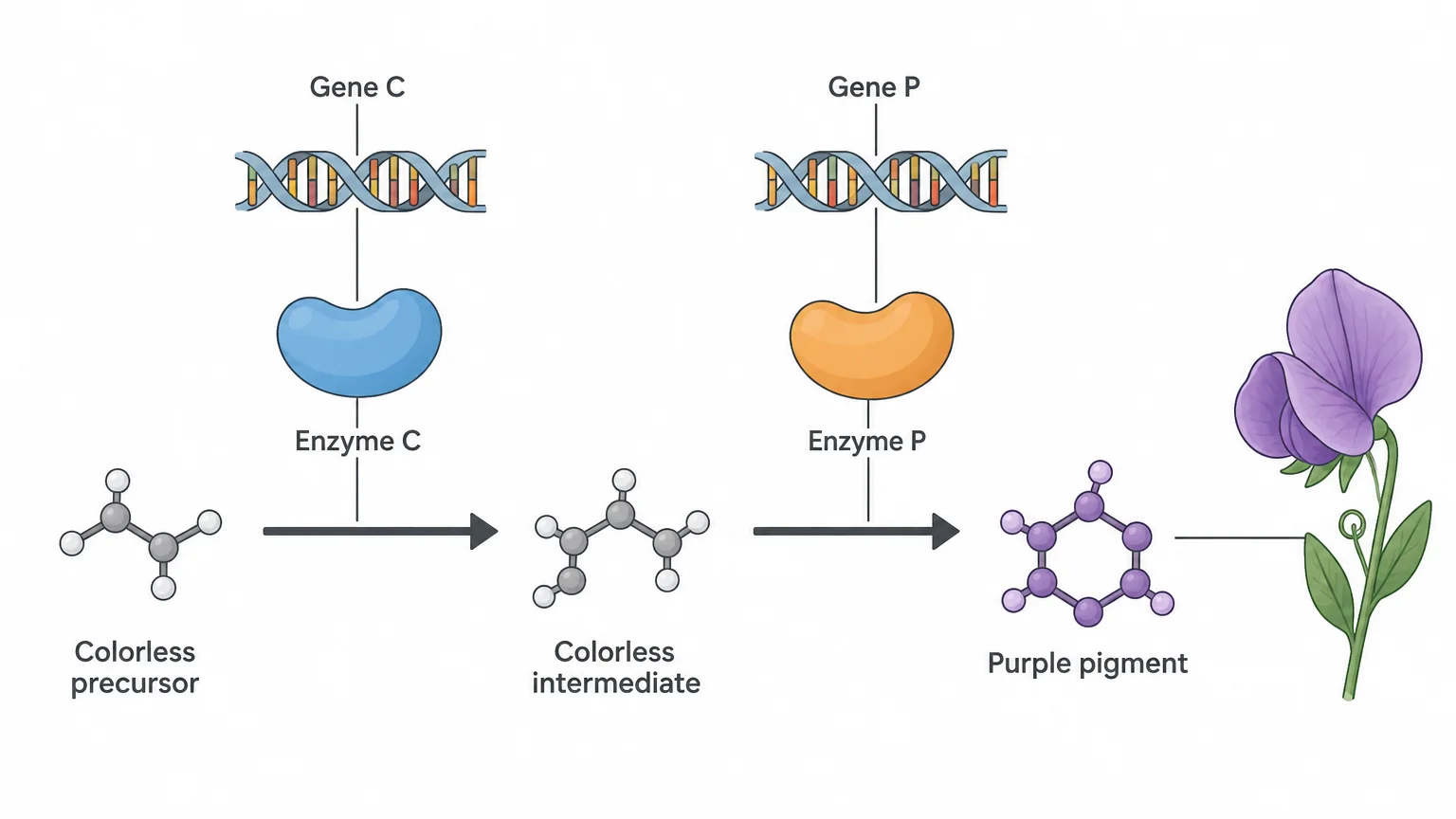
The molecular reason is a two-step pathway. Enzyme C, coded by gene C, turns a colorless starting molecule into a colorless intermediate, and enzyme P, coded by gene P, turns that intermediate into purple pigment. The recessive alleles c and p are loss-of-function alleles, so whichever enzyme is missing, the pathway stalls and no pigment forms.
| Genotype | Enzyme C | Enzyme P | Flowers |
|---|---|---|---|
| C_P_ | Works | Works | Purple |
| C_pp | Works | Missing | White |
| ccP_ | Missing | Works | White |
| ccpp | Missing | Missing | White |
(The blank ”_” means either allele.) Of the 16 F₂ combinations, 9 have at least one C and one P, and the other 7 are white. The two white parent strains were CCpp and ccPP, so their F₁ offspring, CcPp, had both enzymes.
Check yourselfA sweet pea is ccPP. Its P gene works, so why are its flowers white?
Polygenic traits and continuous variation
Mendel’s characters were discrete traits: each plant fell clearly into one category, round or wrinkled. Most traits don’t sort that neatly. Height, weight, skin color, and the milk a cow produces vary smoothly over a range. Traits like these are quantitative traits.
Quantitative traits are usually polygenic, controlled by several genes, and often the genes act in an additive way: each contributing allele adds a little to the phenotype. In wheat grain color, for example, three genes each have a red allele that makes pigment and a white allele that doesn’t. The more red alleles a plant has, the redder its grain.
When many genes add up, intermediate combinations are the most common, since many different genotypes give a medium total. Plants with all red or all white alleles are rare. The phenotypes form a smooth, unbroken range, called continuous variation, and graphed they make a bell-shaped curve.
The environment shifts that curve. Richer soil and more sunlight make the same set of genotypes produce more pigment, moving the whole curve toward red.
Check yourselfWhy does human height show a smooth range of values instead of a few distinct categories?
The patterns side by side
| Pattern | What happens | Underlying cause |
|---|---|---|
| Simple Mendelian | Dominant allele masks recessive | 50% of working protein is enough |
| X-linked | Recessive traits more common in males | Males have one X, with no backup allele |
| Incomplete dominance | Heterozygote is intermediate | 50% of working protein isn’t enough |
| Codominance | Heterozygote shows both alleles | The two alleles’ proteins work differently |
| Epistasis | One gene masks another | Both genes are needed for one phenotype |
| Continuous variation | Smooth range of phenotypes | Several genes add up, plus environment |
Practice questions
1 of 3
Many genes affect the height of pea plants. How could Mendel follow the effect of just one height gene?
2 of 3
Identical twins carry the same alleles at every height gene, yet the twin raised with better nutrition grows several centimeters taller. What does this show about height?
3 of 3
When two or more different genes affect the same character, such as flower color, what is this called?