Chromosomes explain Mendel's laws
Mendel described how alleles behave without knowing where genes are. Decades later, biologists watching cells divide noticed that chromosomes behave exactly the way Mendel’s alleles do. That match became the chromosome theory of inheritance: inheritance patterns are explained by how chromosomes are passed on during gamete formation and fertilization.
Principles of the chromosome theory
The theory rests on the meiosis you met in Chapter 16. Homologs carry the same genes in the same order, but not always the same alleles. Meiosis I separates the homologs of each pair, meiosis II separates sister chromatids, and fertilization joins two haploid gametes to restore the pairs.
The modern version of the theory has five principles:
- Chromosomes contain DNA, the genetic material, and genes are found within chromosomes.
- Chromosomes are copied and passed from parent to offspring, and from cell to cell as an organism develops.
- A diploid nucleus has two sets of chromosomes in homologous pairs. The maternal and paternal sets are functionally equivalent, each carrying a full set of genes.
- At meiosis, the two members of each pair go to different nuclei, and different pairs segregate independently of each other.
- Haploid gametes combine at fertilization to form a diploid cell, each gamete contributing one set of chromosomes.
The place on a chromosome where a gene sits is its locus (plural, loci). Both homologs carry the same gene at the same locus. In a Tt plant, one homolog has T at that spot and the other has t.
Segregation is homologs separating
Follow a Tt plant through meiosis. Because each homolog is copied before meiosis begins, the T homolog becomes two T chromatids and the t homolog two t chromatids.
That is Mendel’s law of segregation in physical form. Each gamete gets one homolog, and so one allele.
Check yourselfA cell is heterozygous Aa. After meiosis, what fraction of the haploid cells carry A?
Independent assortment is random lineup
Now follow two genes on different chromosomes in a YyRr plant. At metaphase I, each homologous pair lines up on the metaphase plate, and which way it faces is its own coin flip, independent of the other pair.
- In one lineup, Y and R face the same side, so the cells get YR and yr.
- In the other, equally likely lineup, Y faces the same side as r, so the cells get Yr and yR.
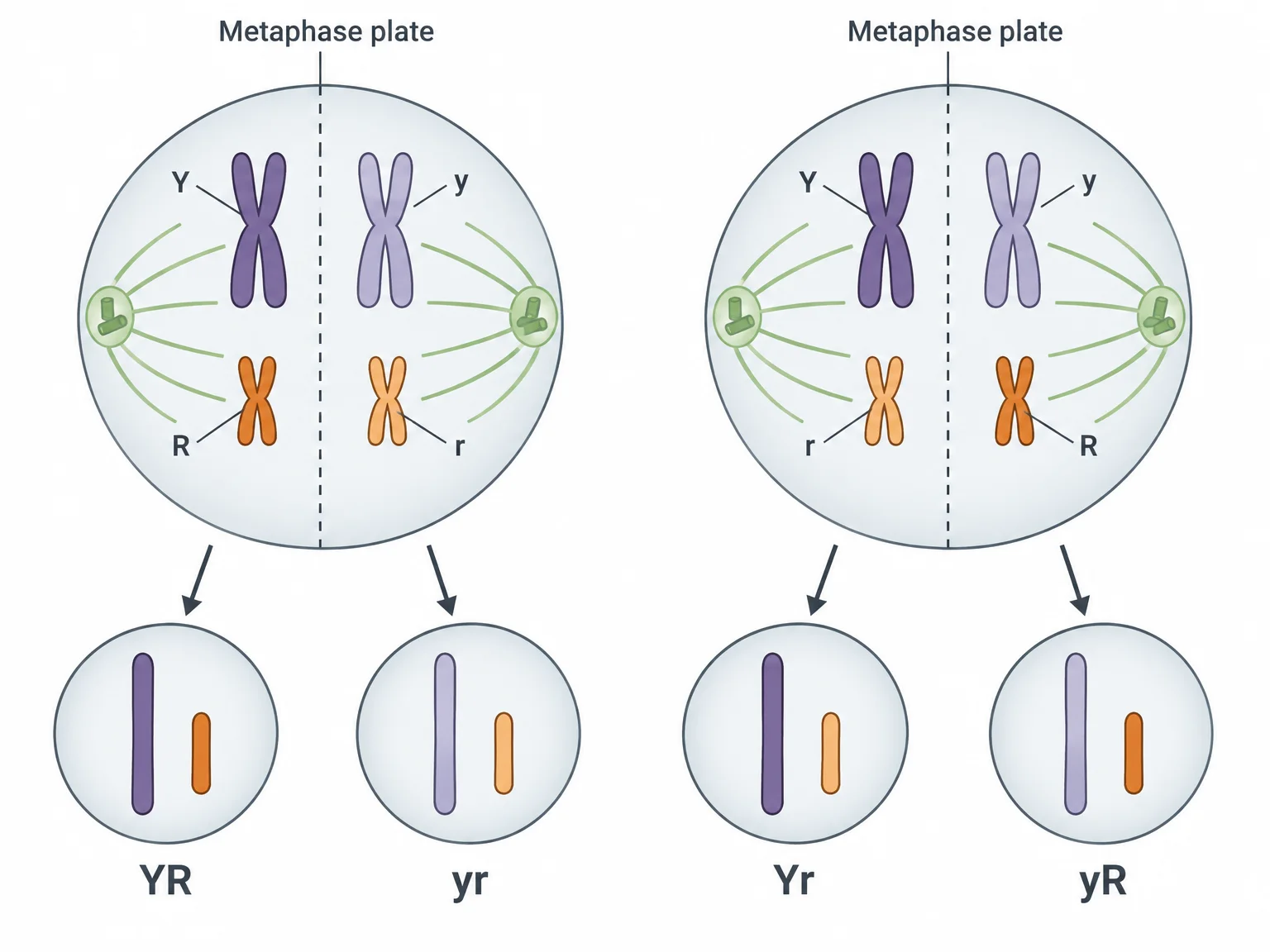
That is independent assortment, and it is why a YyRr plant that fertilizes itself gives a 9:3:3:1 ratio.
The more genes, the more combinations. Random lineup gives 2ⁿ chromosome combinations (Chapter 16), so a plant heterozygous for genes on n different chromosome pairs can make 2ⁿ kinds of gametes. A cell heterozygous for three genes on three different chromosomes (Aa, Bb, Cc) can line up in four distinct ways and make 2³ = 8 kinds of gametes.
Check yourselfA plant is AaBb, with the genes on different chromosomes. One of its gametes carries A and b. What event in meiosis made that combination possible?
Practice questions
1 of 3
According to the chromosome theory of inheritance, how do the chromosome set you got from your mother and the set you got from your father compare?
2 of 3
The chromosome theory of inheritance explains Mendel’s patterns by how chromosomes behave during which processes?
3 of 3
In a heterozygous Tt plant, where are the T and t alleles located?