Mendel's peas and the law of segregation
Chapter 12 showed how a gene’s DNA is turned into a protein. This chapter asks a different question: how do genes travel from parents to offspring, and why do traits show up in children in such predictable proportions? The basic rules were worked out by Gregor Mendel, who bred pea plants and counted the offspring. Those rules are called Mendel’s laws, and they apply to people as well as peas.
Why pea plants were a good choice
Before Mendel, most people assumed traits from two parents blended together like paint. Mendel showed instead that inheritance works through separate units that stay intact from one generation to the next. Garden peas let him see this clearly, for three reasons.
- Clear variation. Peas come in many varieties. Mendel followed seven general features, such as flower color, seed shape, and plant height. A general feature like this is called a character. Each of his characters came in just two clear-cut versions, or traits: flower color, for example, was either purple or white.
- Self-fertilization. A pea flower holds both male and female parts, so it normally fertilizes itself. A plant that fertilizes itself for generations and keeps showing the same trait forms a true-breeding line.
- Easy crosses. The flowers are big enough to handle. Mendel could remove the pollen-making parts (the stamens) of one flower before they ripened, so it couldn’t fertilize itself, and dust it with pollen from a different plant.
Mating two different individuals is a cross. When the two parents differ in a character, the cross is called hybridization, and the offspring are hybrids.
Following one character for two generations
Mendel started with crosses that tracked a single character, such as height. A cross that follows just one character is a single-factor cross. The generations get standard names:
- The P generation (parental) is the two true-breeding parents, here a tall plant and a short plant.
- The F₁ generation (first filial) is their offspring. Because the parents differ in one character, the F₁ plants are called monohybrids.
- The F₂ generation is the offspring of the F₁ plants, made by letting them fertilize themselves.
Every F₁ plant was tall. There was no medium height and no sign of shortness. Then, in the F₂ generation, short plants came back: about three-fourths were tall and one-fourth short, a 3:1 ratio. Mendel got the same pattern for all seven characters.
Dominant and recessive traits
The trait that shows up in the F₁ generation is dominant. The trait that is hidden in the F₁ but reappears in the F₂ is recessive. Tall is dominant over short, and purple flowers are dominant over white.
Because short plants reappeared unchanged in the F₂, the factor for shortness can’t have been blended away. It was carried silently through the F₁ and passed on intact. Mendel called these factors “unit factors.” Today we call them genes.
Genes come in versions called alleles
Mendel proposed that every individual carries two copies of the gene for each character, one inherited from each parent. A gene can exist in different versions, called alleles. The height gene in peas has a tall allele and a short allele.
Alleles are written with a letter. The dominant allele gets the uppercase letter and the recessive allele the same letter in lowercase, so T is the tall allele and t is the short allele. A true-breeding tall plant is TT, a true-breeding short plant is tt, and every F₁ plant from crossing them is Tt. One T is enough to make a plant tall.
Check yourselfA true-breeding purple-flowered pea is crossed with a true-breeding white-flowered pea, and all the offspring have purple flowers. Which trait is dominant, and why did no white flowers appear?
The law of segregation
How does a Tt parent pass on only one allele? Mendel concluded that the two alleles separate, or segregate, when the parent makes gametes. This is Mendel’s law of segregation: the two alleles of a gene separate during the process that gives rise to gametes, so every gamete receives only one allele.
So a Tt plant makes two kinds of gametes in equal numbers: half carry T and half carry t. At fertilization, gametes combine at random. That gives four equally likely combinations, as the figure shows.
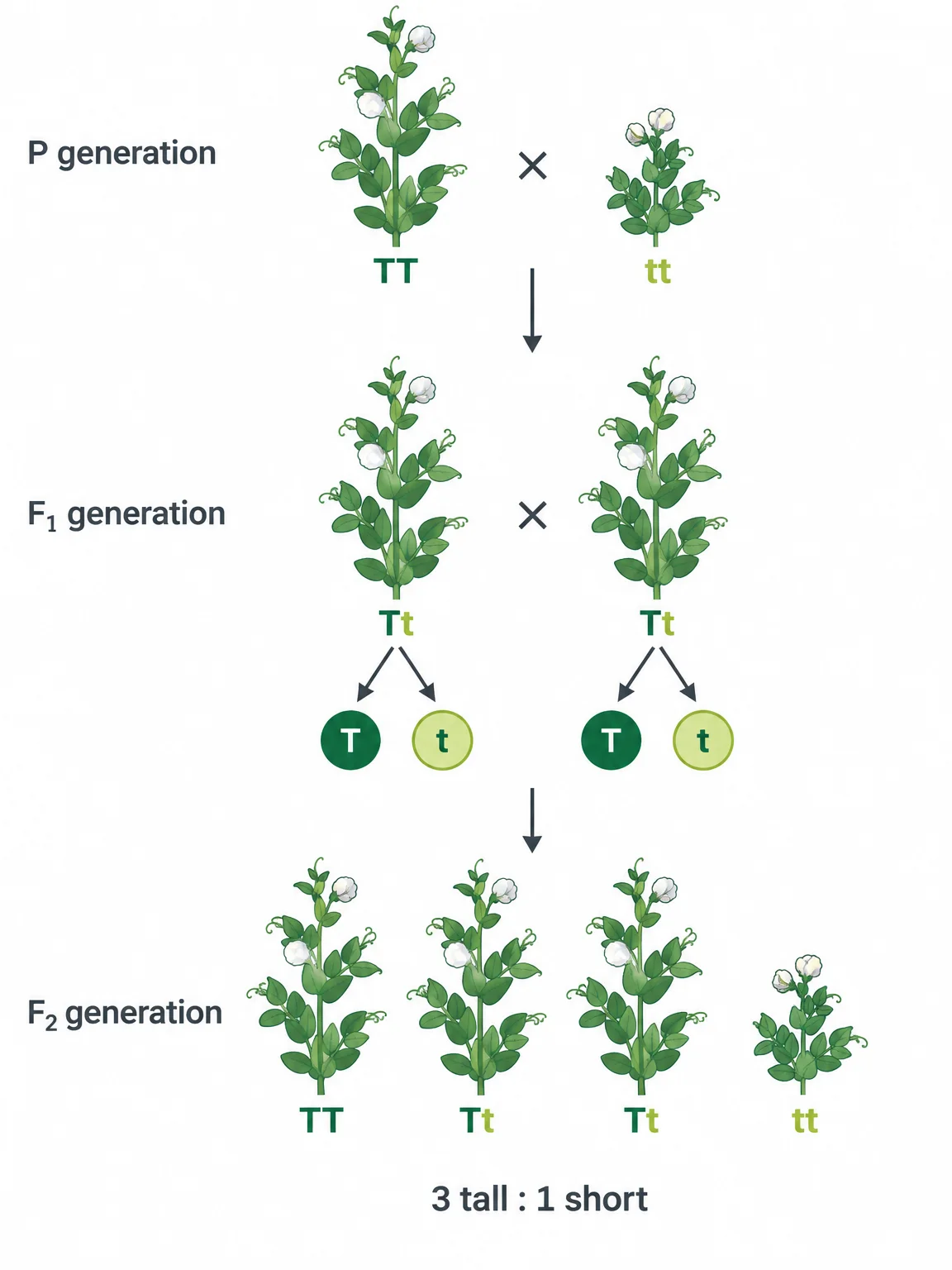
Tt turns up twice as often as TT or tt because it can form two ways: T from the egg and t from the sperm, or the reverse. TT and Tt plants are both tall, so the 1:2:1 mix of allele combinations shows up as 3 tall : 1 short.
Practice questions
1 of 4
Before Mendel, many people thought the traits of two parents mixed together like paint. Which result of his tall-by-short crosses argued most strongly against this idea?
2 of 4
True-breeding tall pea plants are crossed with true-breeding short pea plants. What do their F₁ offspring look like?
3 of 4
In the genotype Tt, what does the uppercase T stand for?
4 of 4
A Tt pea plant makes thousands of pollen grains. About what share of them carry the t allele?