Incomplete dominance, codominance, and the environment
In all of Mendel’s characters, one allele fully masked the other. Many genes don’t work that way. Their alleles still segregate and assort just as Mendel’s laws say, but the heterozygote looks different, so the offspring ratios change.
Incomplete dominance: a heterozygote in between
In some flowers, crossing a red-flowered plant with a white-flowered one gives all pink offspring. When the heterozygote’s phenotype falls between those of the two homozygotes, the pattern is incomplete dominance.
Because neither allele is dominant, they’re written with superscripts instead of upper- and lowercase letters: Cᴿ for red and Cᵂ for white.
| Genotype | Flower color |
|---|---|
| CᴿCᴿ | Red |
| CᴿCᵂ | Pink |
| CᵂCᵂ | White |
When the pink F₁ plants fertilize themselves, the F₂ is 1/4 red, 1/2 pink, and 1/4 white. That’s a 1:2:1 phenotype ratio, matching the genotype ratio, instead of Mendel’s 3:1. Every genotype now has its own look.
The protein explanation is the flip side of the last segment. The Cᴿ allele makes an enzyme for red pigment, and Cᵂ is a nonfunctional allele. Here, the 50% of enzyme a heterozygote makes is not enough for full red, only for pink.
Check yourselfTrue-breeding red-fruited and yellow-fruited plants are crossed, and every offspring has orange fruit. What do you expect from crossing two orange plants?
1 red : 2 orange : 1 yellow. This is incomplete dominance: the heterozygote is intermediate, so each genotype has its own phenotype.
Multiple alleles and the ABO blood types
A diploid individual carries only two alleles of a gene, but a population can hold three or more. A gene with three or more versions in a population has multiple alleles. Human ABO blood types are the classic example.
Red blood cells carry surface antigens: substances, here carbohydrate chains attached to membrane lipids and proteins (glycolipids and glycoproteins), that the body can recognize as foreign.
One gene with three alleles controls them. Iᴬ makes antigen A, Iᴮ makes antigen B, and i makes neither. The i allele is recessive to both others. The table also lists the antibodies each type makes: immune proteins that attack antigens the body doesn’t carry itself.
| Blood type | Genotypes | Antigens on cells | Antibodies made |
|---|---|---|---|
| O | ii | Neither | Against A and B |
| A | IᴬIᴬ or Iᴬi | A | Against B |
| B | IᴮIᴮ or Iᴮi | B | Against A |
| AB | IᴬIᴮ | A and B | None |
An IᴬIᴮ person makes both A and B antigens on every red blood cell. When a heterozygote fully expresses both alleles, the pattern is codominance.
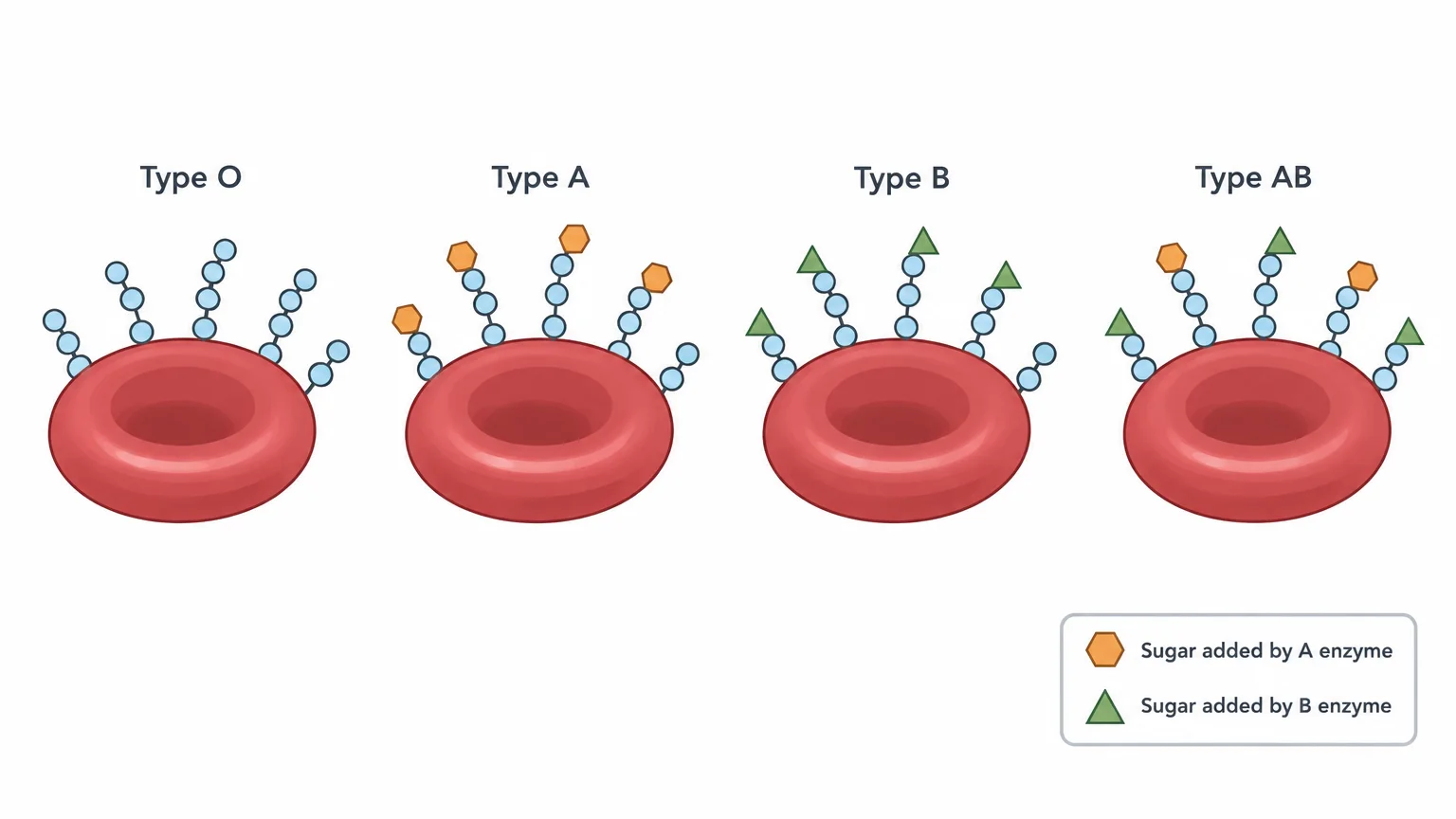
At the molecular level, the gene codes an enzyme that attaches one more sugar at a particular spot on the carbohydrate chain. The Iᴬ and Iᴮ enzymes have slightly different active sites, so each adds a different sugar, and an IᴬIᴮ heterozygote makes both versions. The i allele is a loss-of-function allele, so type O chains are left one sugar shorter.
| Pattern | Heterozygote’s phenotype | F₂ phenotype ratio |
|---|---|---|
| Simple dominance | Same as the dominant homozygote | 3:1 |
| Incomplete dominance | In between the two homozygotes | 1:2:1 |
| Codominance | Shows both alleles’ traits fully | 1:2:1 |
Check yourselfA mother has genotype Iᴬi and a father has genotype Iᴮi. What blood types could their children have?
All four. The children could be IᴬIᴮ (AB), Iᴬi (A), Iᴮi (B), or ii (O), each with a 1/4 chance.
The environment shapes phenotype too
Genes provide the plan for a phenotype, and the environment provides the materials and conditions to carry it out. Neither works alone.
The range of phenotypes that individuals with the same genotype show across different environments is their norm of reaction. To measure it, you need genetically identical individuals, such as members of a true-breeding strain, raised under different conditions. Genetically identical plants grown at different temperatures, for example, reach very different heights, tallest at a moderate temperature and shorter when it is colder or hotter.
Check yourselfTo measure a norm of reaction for leaf size, would you collect wild plants from many sites or grow cuttings of one plant in different conditions?
Grow the cuttings. A norm of reaction compares individuals with the same genotype across environments, and wild plants differ genetically, so their differences could come from their genes.
Practice questions
1 of 4
A biologist wants to measure how temperature alone changes the size of a plant’s fruit. Why should she use plants from one true-breeding strain rather than plants collected from the wild?
2 of 4
The ABO blood-type gene has three alleles in the human population. How many of them does any one person carry?
3 of 4
Which surface antigens are on the red blood cells of a person with type O blood?
4 of 4
Pink snapdragons look like a blend of red and white parents. Which observation shows that the red and white alleles did not actually blend?