Why cells communicate
A cell has no eyes or ears, yet it constantly reacts to its surroundings: sugar appearing nearby, a change in light, a message from a neighboring cell or a distant organ. Every living cell depends on this.
Signals, receptors, and responses
Anything that can change a cell’s properties or behavior is a signal. Many signals are molecules, but physical factors such as light count too.
To notice a signal, a cell needs a detector: a protein. Proteins are large molecules made of folded chains of amino acids, and they do most of a cell’s work. A protein that recognizes a particular signal is a receptor. When the signal attaches, or binds, to its receptor, the receptor changes shape, which sets off changes inside the cell.
Whatever the cell does as a result, such as making new proteins, speeding up a chemical reaction, or moving, is its cellular response. The whole process of detecting a signal, interpreting it, and responding to it is cell communication, also called cell signaling.
Signaling runs both ways: cells respond to incoming signals and send out their own. Sunlight is an incoming physical signal. Ultraviolet (UV) light prompts skin cells to make more melanin, a pigment that shields them from UV damage.
Two reasons cells signal
The first reason is to keep up with a changing environment, where temperature, light, water, and nutrients rise and fall and toxic chemicals can appear.
Yeast cells show how. A yeast cell with no glucose (a simple sugar) nearby isn’t set up to use it. When glucose appears, some of it acts as a signal, binding to receptors in the plasma membrane, the thin, oily skin around the cell.
The cell responds by making more glucose transporters, proteins that carry glucose inside, and more of the enzymes that break glucose down. (Enzymes are proteins that speed up specific chemical reactions.) Here the signal and the food are the same molecule.
The second reason is to share information with other cells, which lets the cells of a plant or animal coordinate their activities. This is cell-to-cell communication.
A houseplant bending toward a window is an example. Cells at the shoot tip sense which side the light comes from, and a signaling molecule called auxin passes from cell to cell until it builds up on the shaded side. There it makes cells lengthen, so the shaded side outgrows the lit side and the shoot curves toward the light. Growth toward light is phototropism.
Five ways to reach another cell
Cell-to-cell signals are sorted by how they travel, which mostly comes down to distance. In every case, one cell sends the signal and another, the target cell, receives it. Three of the five types involve secreting the signal, which just means releasing it from the cell.
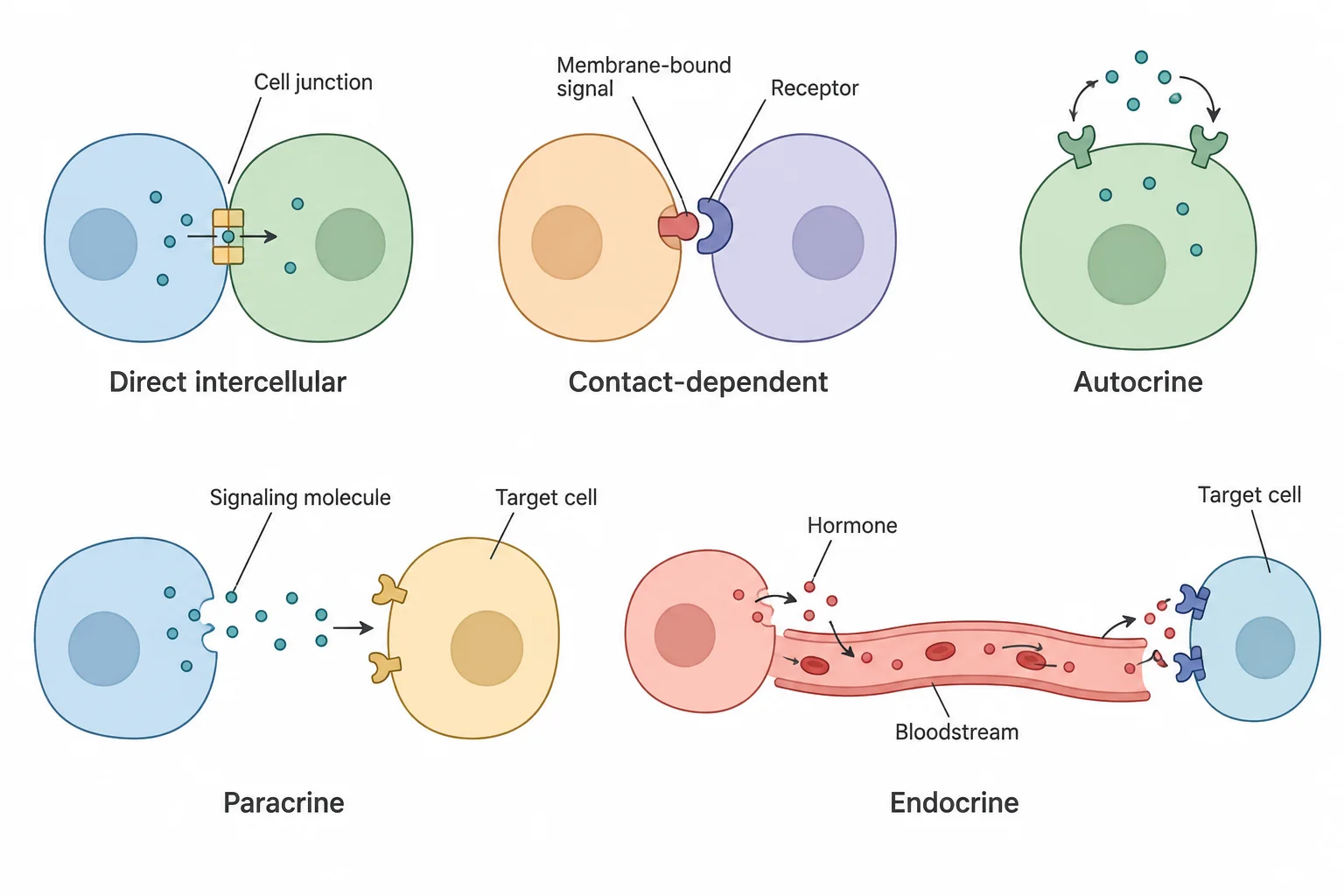
- Neighboring cells can be linked by cell junctions, openings that join the cytosol (the fluid inside a cell) of one cell to that of the next. Ions (atoms or molecules carrying an electric charge) and small signaling molecules pass straight through. This is direct intercellular signaling.
- A signaling molecule can stay attached to the outer surface of the cell that made it. A receptor on another cell detects it only when the two cells touch. This is contact-dependent signaling.
- A cell can secrete a signal that binds receptors on its own surface and on nearby cells of the same type. This is autocrine signaling. It lets a group of cells sense how crowded they are: more cells release more signal, and at high levels the signal can stop further growth.
- A cell can secrete a signal that acts on nearby target cells but not on itself. This is paracrine signaling. Paracrine signals are short-lived, broken down before they can travel far.
- A cell can secrete a signal that travels a long way to reach distant cells. This is endocrine signaling, and the long-distance signals are hormones. In mammals, hormones ride the bloodstream to almost any cell in the body; plant hormones move through the plant’s plumbing (its vascular tissue) and between cells, and a few are gases. Having farther to go, hormones generally last longer than autocrine or paracrine signals.
Telling the five apart
| Type | Do the cells touch? | Who responds | Example |
|---|---|---|---|
| Direct intercellular | Yes, joined by junctions | The adjacent cell | Ions flow through gap junctions between heart muscle cells, so the cells contract together |
| Contact-dependent | Yes, surface to surface | The cell making contact | Immune cells bind each other when they detect a foreign substance, a step toward making antibodies, which fight viruses and bacteria |
| Autocrine | No | The sender and same-type neighbors | Crowded cells slow their own growth |
| Paracrine | No | Nearby cells only | A nerve cell’s signaling molecule, a neurotransmitter, crosses a synapse, the narrow gap to the next cell |
| Endocrine | No | Distant cells | Hormones travel in the blood; ethylene gas speeds fruit ripening |
Check yourselfWhy do endocrine signals usually last longer than paracrine signals?
Check yourselfA cluster of identical cells releases a signal that binds receptors on those same cells. As the cluster gets crowded, the cells stop dividing. What type of signaling is this?
Autocrine signaling. The cells respond to their own signal, so the more cells there are, the more signal builds up, until it halts further growth.
Practice questions
1 of 4
When ultraviolet (UV) light strikes skin cells, the cells make more melanin, a pigment that protects them from UV damage. In this example, what is the UV light?
2 of 4
Cells signal either to respond to changes in their environment or to communicate with other cells. Which example is cell-to-cell communication?
3 of 4
A yeast cell growing without glucose has few glucose transporters. Soon after glucose is added to its surroundings, it has many more. What does this change show?
4 of 4
A mutation causes one of an animal’s hormones to be broken down within seconds of its release, as quickly as a typical paracrine signal. What is the most likely result?