The three stages of cell signaling
Most signaling molecules never enter the cell they’re signaling. They bind a receptor at the surface, and the message still has to reach the parts of the cell that will act on it. Cells handle this with the same three-stage sequence over and over.
Receive, relay, respond
In most cases, a signal’s effect unfolds in three stages.
- The signaling molecule binds to its receptor on the target cell, and the receptor changes shape in a way that switches it on. This is receptor activation.
- The activated receptor sets off a series of changes in proteins inside the cell, and along the way the original signal is converted into a different signal. This is signal transduction.
- The cell changes what it’s doing, for example by switching on an enzyme or turning on genes. This is the cellular response.
The shape change in stage 1 has its own name. A protein’s three-dimensional shape is its conformation, so a change in shape is a conformational change. When a signaling molecule binds, the receptor’s conformation changes, and that change is what activates it. (Some signaling molecules shut a receptor off instead, but the examples in this chapter all switch receptors on.)
To transduce something is to convert it from one form into another, the way a microphone turns sound into an electrical signal. The group of proteins that converts the signal in stage 2 and passes it along is a signal transduction pathway. In some pathways, one of the steps is making a small signaling molecule inside the cell.
No single molecule produces the response. It takes the signal, the receptor, and a series of proteins acting together, which makes cell signaling a clear example of the core concept of systems: interacting parts that accomplish what no part could alone.
Why the signal needs a relay
Most signaling molecules can’t cross the plasma membrane, the oily skin around the cell, because they’re too large or too water-loving to slip through it. All they can do is change the shape of a receptor at the surface. The signal transduction pathway carries that change inward to the proteins that will produce a response.
Some receptors are exceptions. They sit inside the cell and bind signaling molecules that can cross the membrane on their own, such as the hormone estrogen. These receptors cause the response directly, with no signal transduction pathway.
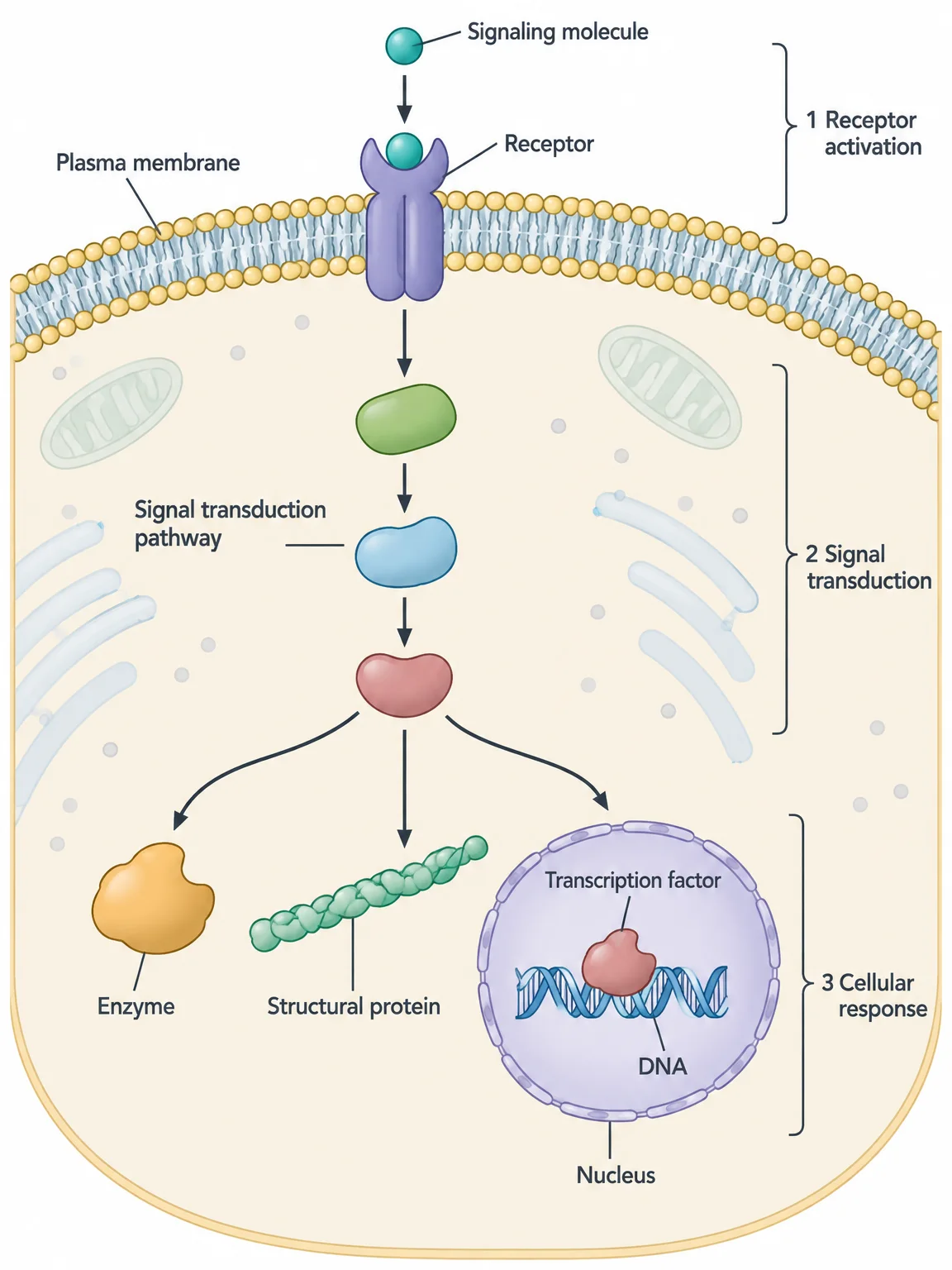
Three kinds of response
Cellular responses often come down to changing one of three common kinds of protein. Two of them need a quick introduction:
- Structural proteins give a cell its shape and let it move. Many of them build the cytoskeleton, the network of protein fibers inside the cell; actin filaments are one type of fiber.
- A gene is a stretch of DNA carrying the instructions for making a protein, and transcription is copying those instructions, the first step toward making the protein. Proteins that control which genes are transcribed, turning genes on or off, are transcription factors.
| Protein type | What it normally does | A response a signal can cause |
|---|---|---|
| Enzymes | Speed up specific chemical reactions | Hormones that signal a need for energy switch on enzymes that break down carbohydrates |
| Structural proteins | Shape the cell and move it | Signals rearrange actin filaments so a cell moves in the right direction, as when an amoeba heads toward food |
| Transcription factors | Turn specific genes on or off | Sex hormones activate genes that produce traits such as breast development or beard growth |
Check yourselfA signaling molecule is too large to cross the plasma membrane. How can it still change which genes a cell turns on?
It binds a receptor at the cell surface and changes the receptor’s shape. The activated receptor starts a signal transduction pathway inside the cell, and the pathway can end by activating transcription factors, which turn genes on.
Practice questions
1 of 3
Which sequence lists the three stages of cell signaling in the order they usually happen?
2 of 3
A large protein hormone binds a receptor on a cell’s surface, yet it changes the activity of enzymes deep inside the cell. What makes this possible?
3 of 3
When an amoeba moves toward food, signals cause its actin filaments to rearrange. Which kind of protein is this cellular response changing?