How a growth factor tells a cell to divide
A signal transduction pathway is easiest to understand by following one from start to finish. This one begins at a receptor on the cell surface and ends with genes switching on in the nucleus, telling the cell to divide. When it goes wrong, the result can be cancer.
Growth factors and their receptors
A signaling molecule that makes cells divide is a growth factor. Plants and animals make many kinds, which coordinate cell division throughout the body. In vertebrates (animals with backbones), epidermal growth factor (EGF) is secreted by endocrine cells into the blood and stimulates epidermal cells, such as skin cells, to divide.
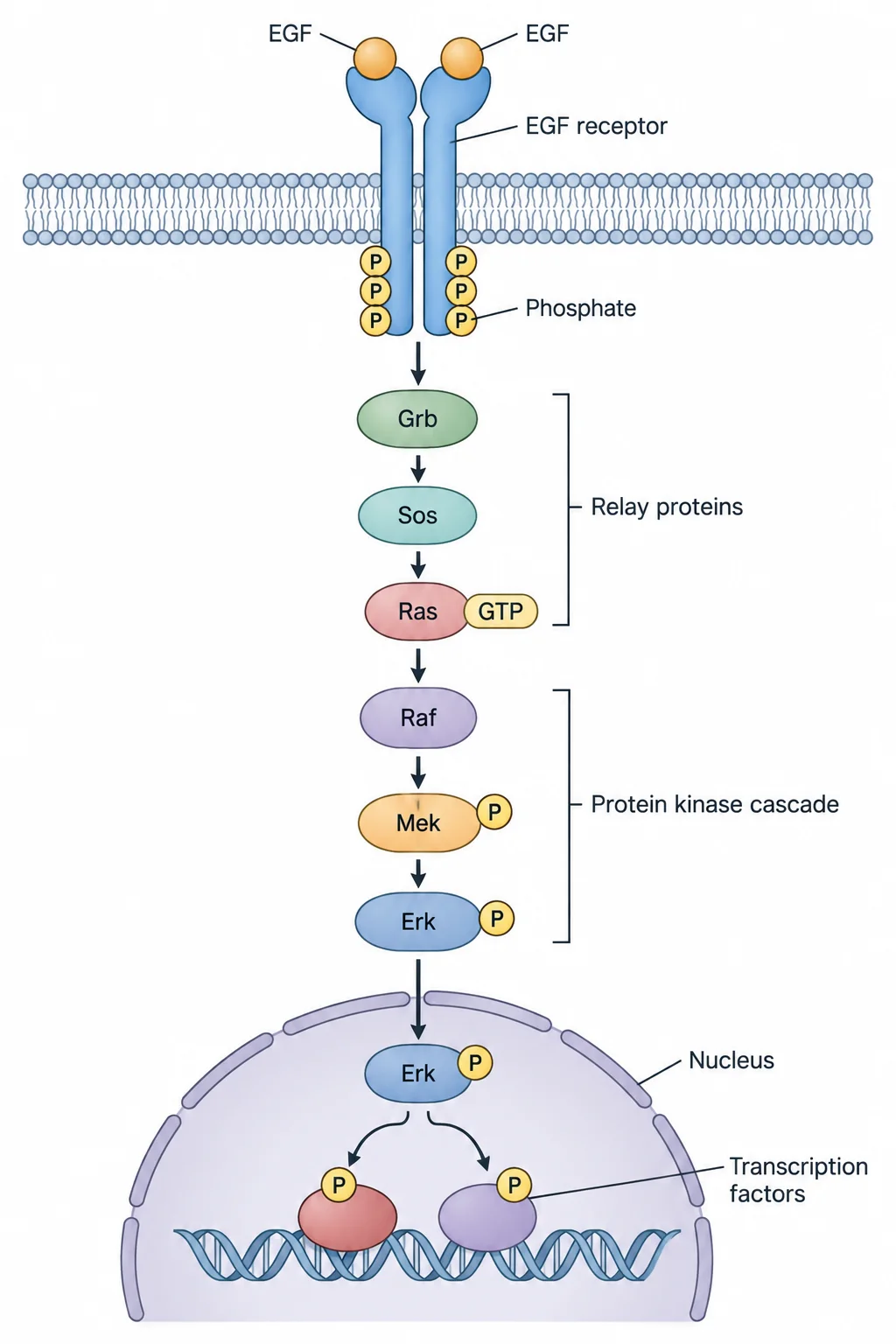
EGF binds the EGF receptor, a receptor that is also an enzyme. Its inner region is a kinase, an enzyme that moves a phosphate group from ATP (the cell’s energy carrier) onto a protein, changing the protein’s shape and activity. This kinase adds phosphates to the amino acid tyrosine, so receptors like it are called receptor tyrosine kinases.
Receptor tyrosine kinases are found in animals and their closest single-celled relatives, but not in bacteria, archaea, plants, or fungi. Humans have about 60 genes for them.
From the membrane to the nucleus
Once the receptor is active, the signal passes through three parts of the pathway. First, relay proteins hand it along, one to the next, until they switch on a protein kinase cascade: a chain of kinases in which each kinase activates the next by phosphorylating it. Second, the cascade phosphorylates transcription factors, the proteins that turn genes on or off. Third, those transcription factors switch on genes, here the genes for cell division.
- Two EGF receptor subunits each bind an EGF molecule. The subunits pair up (dimerize) and phosphorylate each other on tyrosines, which activates the receptor.
- A relay protein called Grb recognizes the phosphorylated receptor and binds it. Grb changes shape and binds a second relay protein, Sos.
- Sos causes a third relay protein, Ras, to release GDP and bind GTP (molecules like ADP and ATP but made with guanine). Ras holding GTP is active.
- Active Ras binds Raf, the first kinase of the cascade. Raf phosphorylates Mek, and Mek phosphorylates Erk.
- Phosphorylated Erk enters the nucleus and phosphorylates transcription factors such as Myc and Fos.
- Myc and Fos turn on genes whose proteins promote cell division. Once those proteins are made, the cell divides.
A relay that multiplies
The kinase cascade does more than pass the signal along. It multiplies it.
Because each kinase acts on many molecules, one signal at the surface ends up changing a large number of proteins inside, producing a bigger cellular response. This is signal amplification, and it’s one advantage of a kinase cascade. The effect can be broad: in mammals, a growth factor such as EGF can quickly ramp up the activity of up to about 100 genes.
When the switch sticks
Ras normally turns itself off. It hydrolyzes its GTP, splitting it into GDP and phosphate, and Ras holding GDP is inactive. Some mutations change Ras so it can’t hydrolyze GTP, or so it binds GTP more readily.
Either way, Ras spends too much time in its active, GTP-bound form, so the pathway keeps telling the cell to divide when it shouldn’t. Uncontrolled cell division is cancer. Mutations that make other proteins in growth factor pathways overactive can have the same result.
Each step depends on the one before it, so blocking any protein in the chain stops the signal. That’s how some anticancer drugs work: they inhibit a step in a growth factor pathway, such as the receptor, Ras, or one of the kinases. A drug aimed at a G-protein-coupled receptor wouldn’t help, because this pathway doesn’t use one.
Check yourselfA mutant Ras protein can bind GTP but can’t hydrolyze it. Why would cells carrying this mutation divide too much?
Ras would stay in its active, GTP-bound form, so it would keep switching on the Raf, Mek, and Erk cascade. Erk would keep activating transcription factors that turn on cell-division genes, even with no EGF present.
Practice questions
1 of 2
Why does a protein kinase cascade such as Raf, Mek, and Erk amplify a signal?
2 of 2
Epidermal growth factor (EGF) stimulates skin cells to divide. What is the general name for signaling molecules that promote cell division?