Amplifying, ending, and combining signals
A single hormone molecule can change thousands of proteins in a cell within seconds, and the effect fades soon after the hormone is gone. Second messengers such as cAMP, small molecules that carry a signal through the inside of the cell, make both possible. Links between pathways add one more layer, letting a cell respond to combinations of signals.
Amplification and speed
Second messengers give signaling two big advantages, and the first is signal amplification: at several steps, one active molecule acts on many others, so one signal at the surface produces a large response inside. It works like a phone tree, where each person calls several more and the message soon reaches hundreds of people.
Take the epinephrine pathway. One active adenylyl cyclase, the membrane enzyme a G protein switches on, makes many cAMP molecules. That cAMP activates many molecules of PKA, the kinase cAMP controls, and each PKA phosphorylates many target proteins. One hormone molecule can end up altering hundreds or thousands of proteins.
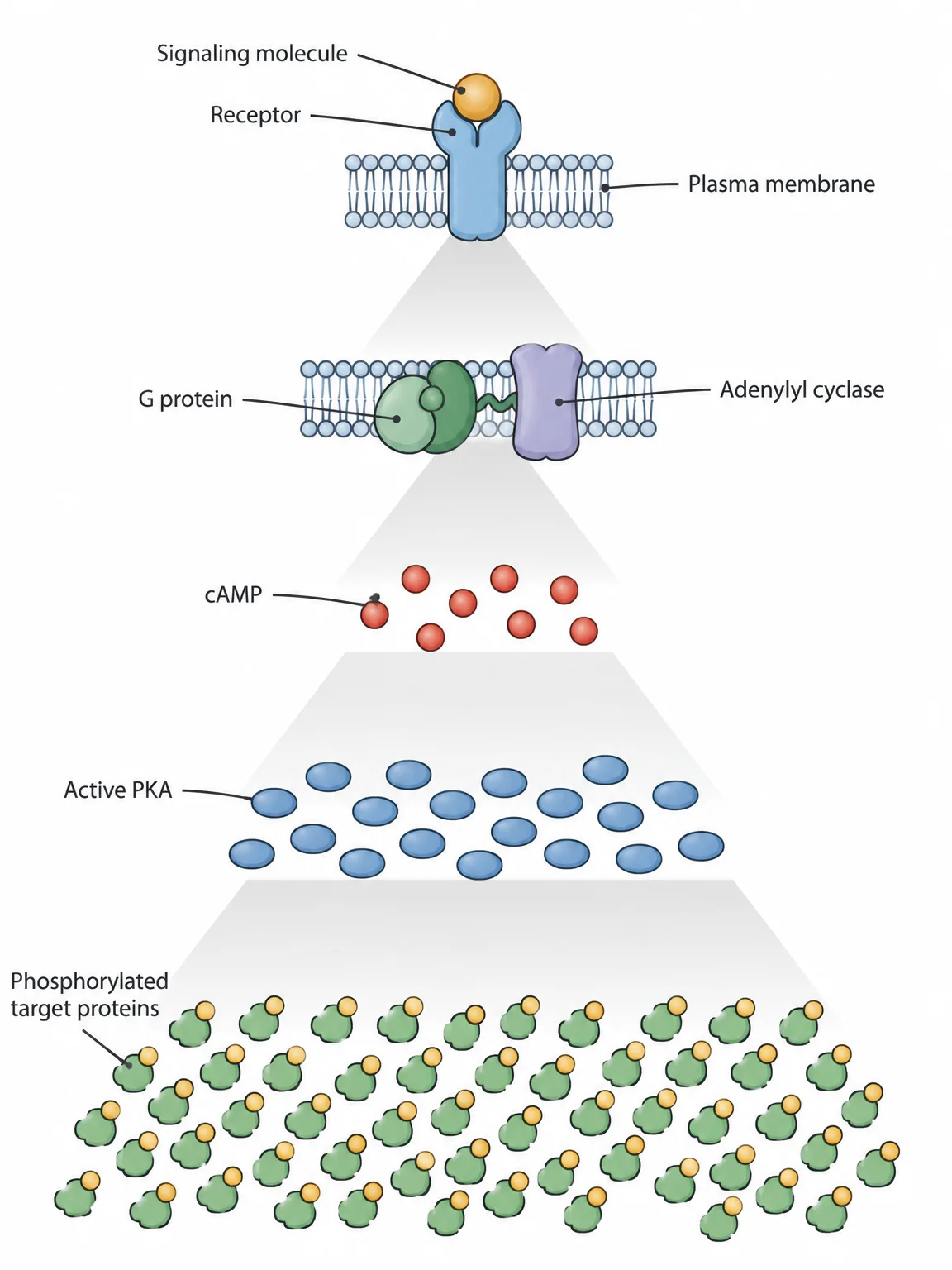
The second advantage is speed. Second messengers are small and water soluble, so they spread quickly through the cytosol, the fluid inside the cell. In one experiment, a nerve cell was exposed to serotonin, a signaling molecule that acts through a G-protein-coupled receptor. Within about 20 seconds, the cAMP it triggered had spread throughout the cell.
Switching the signal off
Second-messenger signals are brief because every step can be reversed. When the hormone is no longer being released and its concentration falls, the pathway unwinds:
- The hormone comes off its receptors, and the receptors become inactive.
- Each G protein’s α subunit hydrolyzes its GTP to GDP and rejoins the β/γ dimer, so the G protein is inactive again.
- Phosphodiesterase converts cAMP to AMP, and cAMP levels drop.
- PKA’s regulatory subunits release cAMP and rejoin the catalytic subunits, shutting PKA down.
- Enzymes that remove the phosphate groups PKA added, called protein phosphatases, return the target proteins to their original state.
Kinases and phosphatases are opposites. A kinase adds a phosphate group to a protein, and a phosphatase takes it off. Together they work like an on-off switch for many proteins.
Crosstalk
A cell carries many kinds of receptors and often receives several signals at once. Its pathways aren’t sealed off from each other. When one or more components of one signal transduction pathway affect a different pathway, it’s called crosstalk.
Think of pathways as roads joined by ramps: traffic from one road can merge into another and add to its flow, or a backup on one can slow another. In the same way, crosstalk lets one pathway boost or hold back another, so a cell can respond to a combination of signals differently than to any one alone.
In a simple example, a cell responds to three hormones, X, Y, and Z. Each binds its own receptor and starts its own pathway, leading to response 1, 2, or 3. Now add two links: a protein in Y’s pathway also activates a protein in X’s pathway, and a protein in Z’s pathway inhibits a protein in Y’s pathway.
- Y alone triggers response 2 and, through crosstalk, response 1 as well.
- X and Y together give the strongest response 1, because both push it.
- Z triggers response 3 and, through crosstalk, holds back response 2.
Check yourselfIf a muscle cell’s protein phosphatases stopped working, what would happen after epinephrine was gone?
The target proteins would stay phosphorylated. Glycogen phosphorylase would stay active and glycogen synthase inactive, so the cell would keep breaking down glycogen and wouldn’t rebuild it, even though the signal had ended.
Practice questions
1 of 4
What are the two main advantages of signaling through second messengers such as cAMP?
2 of 4
Suppose the cAMP made after one epinephrine molecule binds its receptor activates 30 PKA molecules, and each PKA phosphorylates 200 target proteins. How many target proteins end up phosphorylated?
3 of 4
Inside a cell, a protein in one signal transduction pathway activates a protein in a different pathway, so the cell’s response depends on which signals arrive together. What is this called?
4 of 4
In a cell, hormone P triggers response 1 through one pathway, and hormone Q triggers response 2 through another. A protein in Q’s pathway also inhibits a protein in P’s pathway. What happens when both hormones are present?