How apoptosis is triggered
Apoptosis, programmed cell death, works like any other cellular response: a signal starts a pathway, and the pathway produces the response. What’s unusual is the response itself. The cell destroys itself, using enzymes that cut up proteins.
Caspases do the demolition
An enzyme that digests other proteins is a protease. The proteases that carry out apoptosis are caspases. Each caspase is made in an inactive form, called a procaspase, and becomes active when part of it is cut away.
Caspases come in two kinds. Those that start the process, by activating other caspases, are initiator caspases. Those that do the destruction, by digesting the cell’s proteins, are executioner caspases, also called effector caspases.
The extrinsic pathway
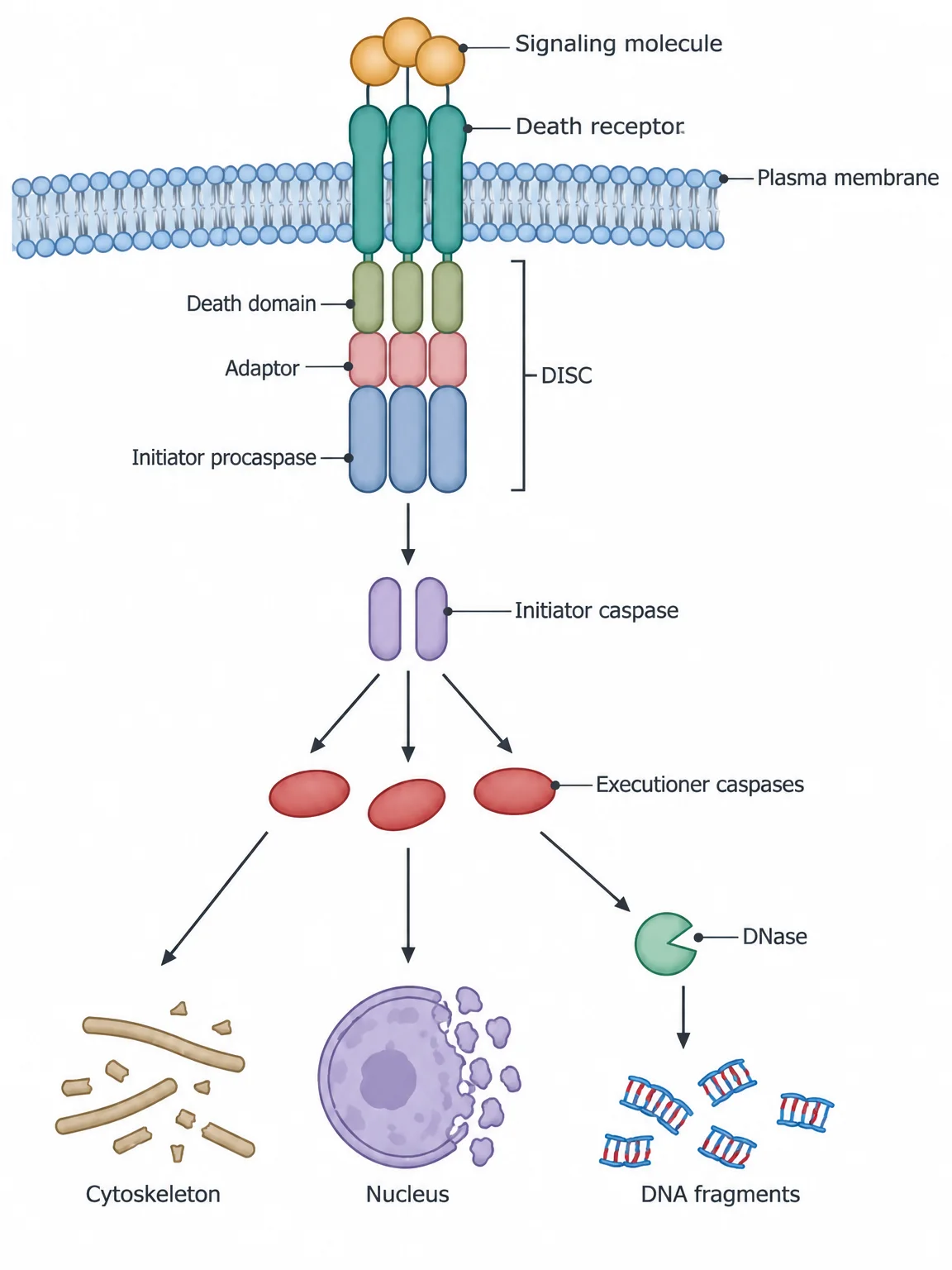
When the signal to die comes from outside the cell, the route is the extrinsic pathway. The signal binds proteins on the cell surface called death receptors. A typical signal is a protein built from three identical subunits. Immune cells release these signals after spotting an abnormal cell, such as one infected by a virus, to order its death.
- The signaling molecule binds three death receptors, pulling them together into a group of three (a trimer).
- The receptors change shape, exposing a region on their inner side called the death domain.
- The death domain binds adaptor proteins, which then bind an initiator procaspase. Together, the death receptors, adaptors, and initiator procaspase form the death-inducing signaling complex (DISC).
- Inside the DISC, the initiator procaspase is cut into an active initiator caspase, which is released from the complex.
- The initiator caspase activates many executioner caspases.
- The executioner caspases digest the cell’s proteins, and the cell comes apart.
The executioner caspases attack the cytoskeleton (the cell’s framework of protein fibers), the nuclear lamina (a mesh of protein that supports the nucleus from inside), and proteins that copy and repair DNA. That’s what makes the cell shrink and break into blebs. Caspases also switch on DNase, an enzyme that chops the cell’s DNA into small pieces. In a cell infected by a virus whose genes are made of DNA, this destroys the viral DNA along with the cell’s own.
The intrinsic pathway
The intrinsic pathway, also called the mitochondrial pathway, starts inside the cell. It’s triggered by DNA damage that could lead to cancer. Mitochondria (the organelles that make most of a cell’s ATP, its energy carrier) release a small protein, cytochrome c, into the cytosol. There it joins with other proteins to form a complex called the apoptosome, which activates caspases.
| Extrinsic pathway | Intrinsic pathway | |
|---|---|---|
| What triggers it | A signal from outside, often made by immune cells | DNA damage inside the cell |
| Where it starts | Death receptors on the cell surface | Mitochondria releasing cytochrome c |
| What activates the caspases | Death-inducing signaling complex (DISC) | Apoptosome |
Check yourselfHow do the roles of initiator and executioner caspases differ in the extrinsic pathway?
The initiator caspase is activated in the DISC when the cell receives a death signal, and its job is to activate other caspases. The executioner caspases carry out the destruction, digesting the cytoskeleton, the nuclear lamina, and proteins that copy and repair DNA.
Practice questions
1 of 3
What kind of enzyme is a caspase?
2 of 3
An immune cell releases a signal that binds death receptors on the surface of a virus-infected cell, and the infected cell undergoes apoptosis. Which pathway is this?
3 of 3
During apoptosis, caspases switch on a DNase that chops the cell’s DNA into small fragments. Why is this especially useful in a cell infected by a virus?