The Calvin cycle
The light reactions leave the stroma, the fluid around the thylakoids, stocked with ATP and NADPH. The Calvin cycle spends them to pull carbon out of the air and build it into sugar.
What the cycle makes, and what it costs
The Calvin cycle (also called the Calvin-Benson cycle) is a loop of enzyme-driven reactions that takes carbon from CO₂ and builds it into carbohydrate. In plants and algae it runs in the stroma of chloroplasts. In photosynthetic bacteria, it runs in the cytoplasm.
The carbohydrate it makes does two jobs. It’s the raw material for building nearly all of a cell’s other organic molecules, and it’s a stable store of energy, one the plant taps in the dark and an animal taps when it eats the plant.
Building carbohydrate is expensive. For every 6 CO₂ built into a carbohydrate such as glucose, the cycle uses 18 ATP (each broken down to ADP and phosphate) and 12 NADPH (each giving up its electrons).
The cycle doesn’t make glucose directly. Its product is glyceraldehyde-3-phosphate (G3P), a three-carbon sugar. Plant cells use G3P as the starting material for glucose and other molecules, including sucrose (table sugar). Glucose can be linked into long chains of starch and stored in the chloroplast, while sucrose is shipped out of the leaf to the rest of the plant.
Three phases
The cycle runs in three phases, and each turn ends by rebuilding the molecule that accepts CO₂ at the start.
- Carbon fixation. An enzyme called rubisco attaches CO₂ to ribulose bisphosphate (RuBP), a five-carbon sugar. The six-carbon product immediately splits into two molecules of 3-phosphoglycerate (3PG), which has three carbons.
- Reduction and carbohydrate production. ATP adds a phosphate to each 3PG, making 1,3-bisphosphoglycerate (1,3-BPG). NADPH then donates electrons, reducing 1,3-BPG to G3P. Some G3P leaves the cycle to build carbohydrates.
- Regeneration of RuBP. The remaining G3P is rearranged, using more ATP, back into RuBP, which can accept more CO₂.
Carbon fixation gets its name because carbon that was drifting in the air as CO₂ gas ends up fixed, or held in place, in an organic molecule that isn’t a gas. Rubisco’s full name is RuBP carboxylase/oxygenase. Chloroplasts contain more of it than any other protein, and it may be the most abundant protein on Earth, a sign of how much carbon fixation goes on worldwide.
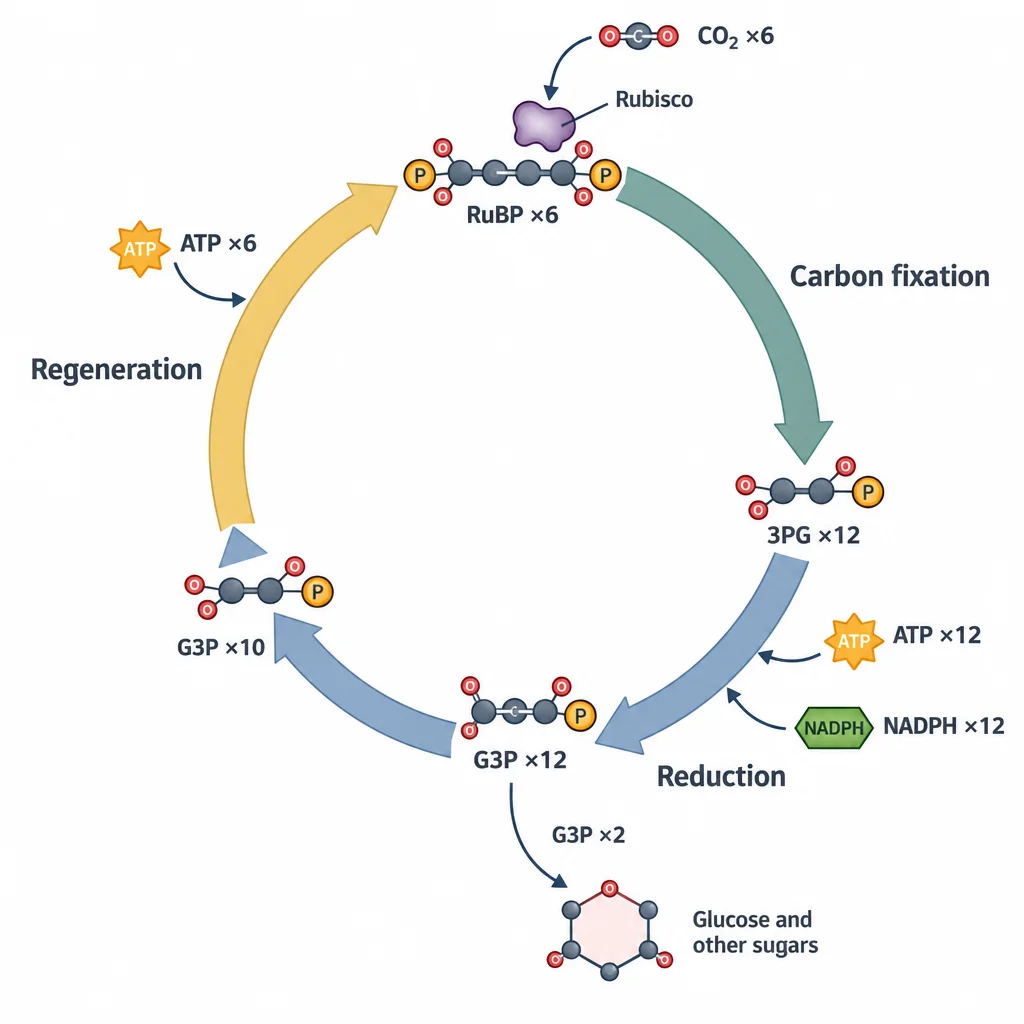
Tracking the carbon atoms through one full set of turns shows why most of the G3P has to stay in the cycle, and where the 18 ATP and 12 NADPH go.
Why the carbon needs electrons
Carbon in CO₂ can’t simply be linked into bigger molecules, because it’s electron-poor. Oxygen is highly electronegative, meaning it pulls shared electrons strongly toward itself. In CO₂, the carbon forms a double bond with each of two oxygen atoms, and the shared electrons sit closer to the oxygens than to the carbon.
In a carbohydrate such as G3P, carbon is electron-rich. It’s bonded to hydrogen and to other carbons, which don’t pull on electrons as hard as oxygen does, so the shared electrons sit closer to the carbon. You can see the change in phase 2: 3PG has a C–O bond at the spot where G3P has a C–H bond, and NADPH’s electrons are what make that switch.
In the Calvin cycle, ATP supplies energy and NADPH supplies high-energy electrons, so the carbon that came from CO₂ ends up reduced. Reduced carbon can form C–C and C–H bonds, which lets the cell build larger molecules such as glucose and amino acids. Those bonds also store a great deal of energy.
How the steps were traced
Calvin and his coworkers worked out the cycle by tracking carbon. They gave green algae CO₂ made with radioactive carbon-14 (¹⁴C), so every molecule built from that CO₂ carried a radioactive tag. After anywhere from a fraction of a second to many minutes, they dropped the cells into alcohol, which stops the enzymes and freezes the cycle in place.
Next they had to find which molecules held the label. They spread the cell contents out by two-dimensional paper chromatography: two different solvents seep through the paper in two directions, carrying each kind of molecule to its own spot. Laying the paper against X-ray film (autoradiography) left a dark mark wherever ¹⁴C was. They identified each spot with chemical tests, for example by checking whether it traveled to the same place as a known molecule.
The timing revealed the order of the steps. After the shortest exposures, only 3PG and 1,3-BPG carried the label, so those molecules form first. After longer exposures, G3P and RuBP were labeled too, because they’re made later in the cycle.
Practice questions
1 of 2
An alga in bright light with plenty of CO₂ is treated with a drug that blocks the regeneration of RuBP. What happens to carbon fixation over the next few minutes?
2 of 2
Calvin’s team fed algae radioactive CO₂ and stopped their reactions after different lengths of time, from fractions of a second to minutes. Why vary the time?