Chloroplasts and the two stages
In plants and algae, photosynthesis takes place inside chloroplasts. To see how the job is divided up, start with a whole leaf and zoom in.
Leaves collect light, water, and CO₂
Every green part of a plant contains chloroplasts and can photosynthesize, but in most plants the leaves do most of it. A leaf is layered like a sandwich. Its top and bottom surfaces are a skin of cells called the epidermis, and the filling is the mesophyll, the leaf’s inner tissue, whose cells are packed with chloroplasts.
Mesophyll cells need three supplies: light, water, and CO₂. Water travels up from the roots and reaches the leaf through its veins. CO₂ enters the leaf, and O₂ leaves it, through tiny pores in the surface called stomata (singular, stoma, from the Greek word for “mouth”). Each stoma is framed by two guard cells.
Inside a chloroplast
A chloroplast is an organelle, a membrane-enclosed compartment with its own job, found in the cells of plants and algae. It’s where photosynthesis happens, and it’s loaded with chlorophyll, the green pigment (light-absorbing molecule) that gives plants their color.
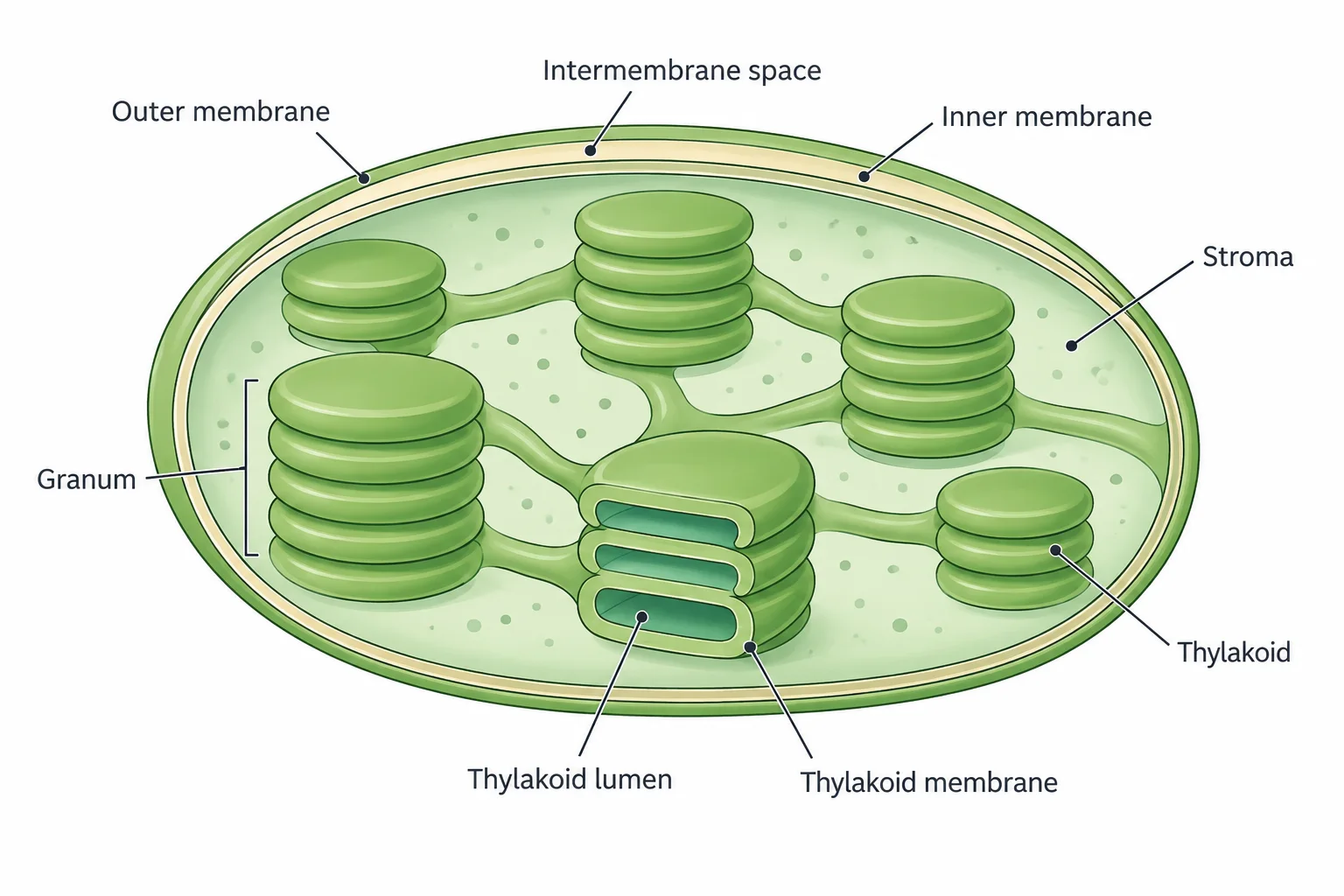
A chloroplast has a double wrapper, just as a mitochondrion (the organelle where most of cellular respiration happens) does: an outer membrane and an inner membrane, with a narrow intermembrane space between them. What sets chloroplasts apart is a third membrane system inside:
- The thylakoid membrane holds the pigments, including chlorophyll. It forms many flattened, fluid-filled sacs called thylakoids.
- The space inside each thylakoid is the thylakoid lumen.
- Thylakoids pile on top of one another like stacks of coins. Each stack is a granum (plural, grana).
- The stroma is the fluid that fills the chloroplast around the thylakoids, between the thylakoid membrane and the inner membrane.
Two stages: the light reactions and the Calvin cycle
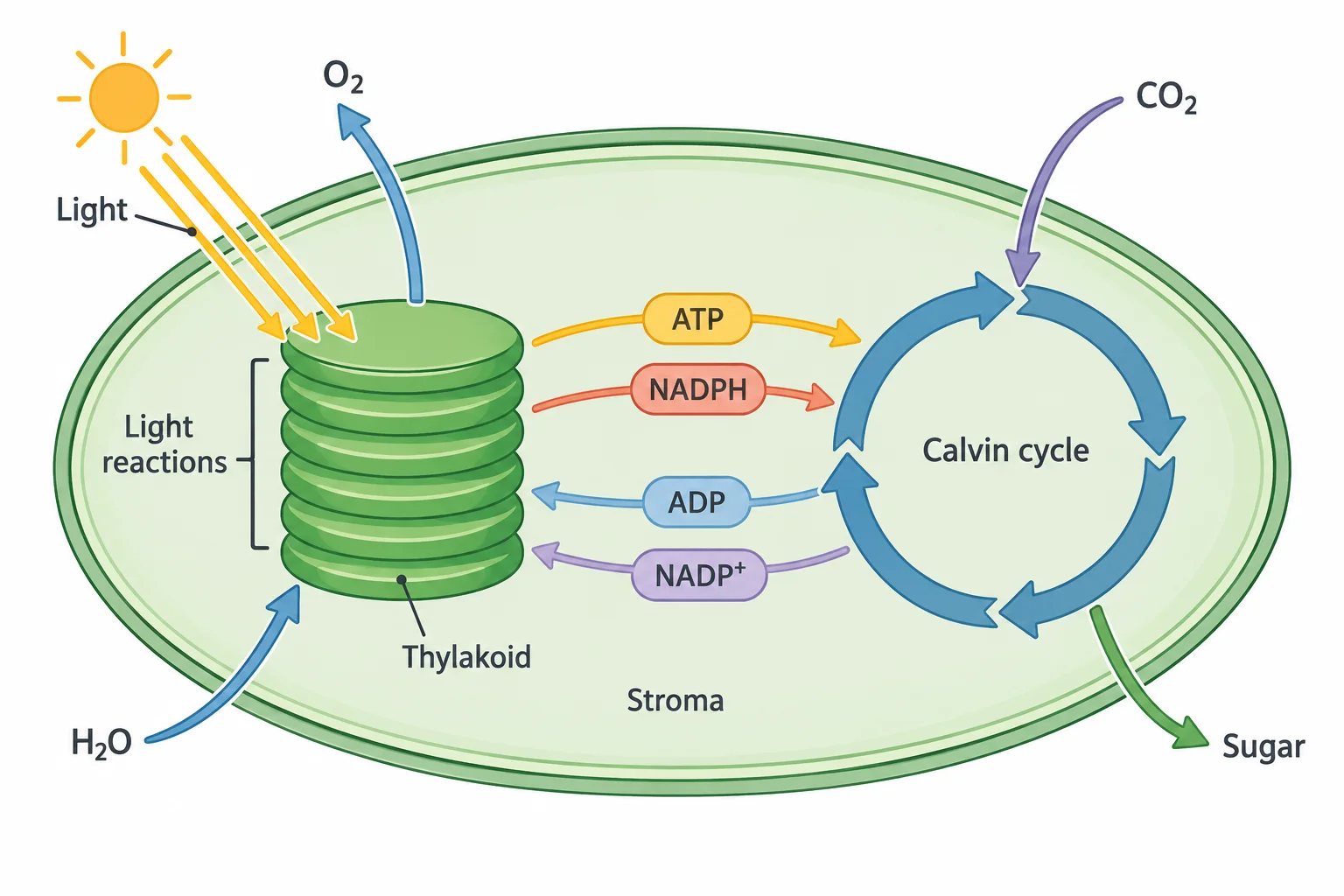
The word photosynthesis names its two stages. “Photo” refers to the light reactions, which capture energy from sunlight. “Synthesis” refers to the Calvin cycle, which uses that energy to build carbohydrate from CO₂.
The light reactions take place in the thylakoid membrane. There, light energy is absorbed, water is split, and three products come out: ATP, NADPH, and O₂. The first two are the energy carriers that link the two stages:
- ATP (adenosine triphosphate) is the cell’s ready-to-spend energy supply. Breaking off one of its three phosphate groups, which leaves ADP, releases energy that drives other reactions.
- NADPH is an electron carrier. It picks up two high-energy electrons (along with an H⁺) and delivers them where they’re needed. It’s nearly identical to NADH, the carrier used in cellular respiration, but has one extra phosphate group. Its empty form is NADP⁺.
The Calvin cycle takes place in the stroma. Its enzymes spend ATP for energy and NADPH for electrons to attach carbon from CO₂ to organic molecules, producing carbohydrate. The spent ADP and NADP⁺ return to the thylakoids to be recharged.
| Light reactions | Calvin cycle | |
|---|---|---|
| Location | Thylakoid membrane | Stroma |
| Takes in | Light, H₂O, ADP, NADP⁺ | CO₂, ATP, NADPH |
| Gives off | O₂, ATP, NADPH | Carbohydrate, ADP, NADP⁺ |
| Job | Convert light energy into chemical energy | Use that chemical energy to build carbohydrate |
Why plants store sugar
ATP and NADPH are short-lived: they break down within seconds to minutes, so a plant can’t stockpile them for the night. Carbohydrates are far more stable. During dark periods, plant cells run on the carbohydrates they built while the light was on.
The Calvin cycle doesn’t use light directly. It can keep running in the dark as long as the stroma still holds enough CO₂, ATP, and NADPH. Because ATP and NADPH don’t last, though, the cycle depends on the light reactions to keep resupplying them.
Check yourselfA plant in bright light is moved into a dark room. Does its Calvin cycle stop the moment the light goes out?
Practice questions
1 of 2
How do water and CO₂ reach the mesophyll cells inside a leaf?
2 of 2
A leaf that has been in bright light is suddenly moved into darkness. What happens to its Calvin cycle?