How C₄ and CAM plants avoid photorespiration
Rubisco, the enzyme that fixes CO₂ in the Calvin cycle, has a weakness: when CO₂ runs low and O₂ builds up, it attaches O₂ more and more often, setting off wasteful photorespiration. Some plants that thrive in heat and drought get around this. They first capture CO₂ with a different enzyme, one that ignores O₂, and then feed that CO₂ to rubisco where or when it can be used efficiently.
C₄ plants make a four-carbon molecule first
In C₄ plants, the first product of carbon fixation isn’t 3PG but a four-carbon molecule, oxaloacetate. Sugarcane, corn, and crabgrass are C₄ plants.
Many C₄ plants have a special leaf layout. An inner layer of the leaf has two kinds of cells that work as a team: mesophyll cells (the chloroplast-filled cells of the leaf’s interior) and bundle-sheath cells, which, as the name suggests, form a sheath around the leaf’s veins.
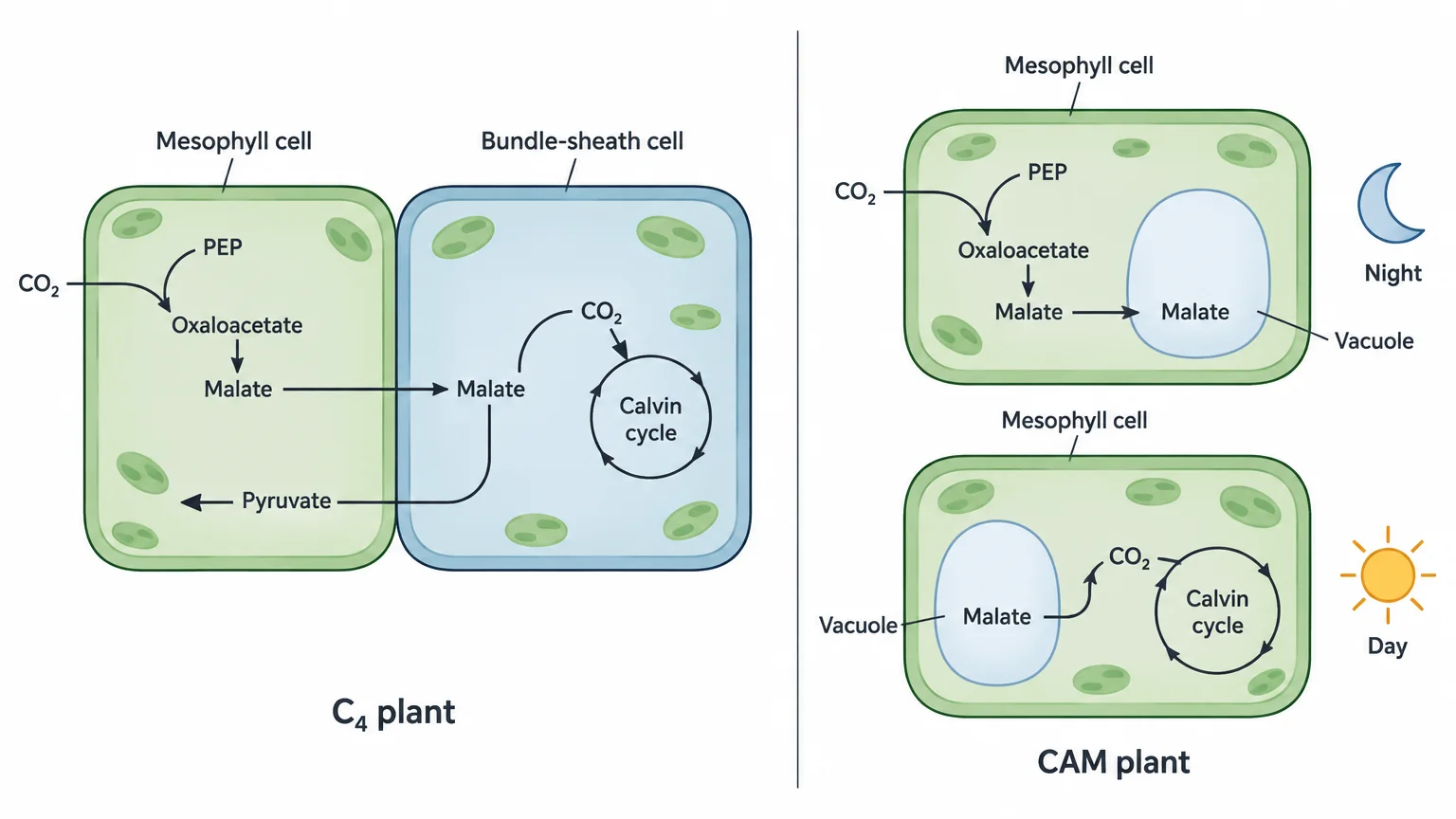
In the mesophyll cells, an enzyme called PEP carboxylase attaches CO₂ to phosphoenolpyruvate (PEP), a three-carbon molecule, producing oxaloacetate. PEP carboxylase ignores O₂, so unlike rubisco, it keeps fixing CO₂ even when CO₂ is scarce and O₂ is plentiful.
- CO₂ enters a mesophyll cell through the stomata, and PEP carboxylase attaches it to PEP, forming oxaloacetate.
- Oxaloacetate is converted to malate, another four-carbon molecule, which moves into a bundle-sheath cell.
- In the bundle-sheath cell, malate is broken down into pyruvate and CO₂.
- The CO₂ enters the Calvin cycle in the bundle-sheath cell’s chloroplasts.
- The pyruvate returns to the mesophyll cell, where ATP is used to convert it back into PEP.
The steady deliveries keep CO₂ concentrated in the bundle-sheath cells, and the mesophyll cells also shield them from high O₂. With plenty of CO₂ and little O₂ around rubisco, photorespiration stays low.
Whether the C₄ route beats the ordinary C₃ route depends on the climate. In warm, dry places, C₄ plants come out ahead: they can keep their stomata partly closed during the day to save water and still keep photorespiration low. In cooler places, the advantage flips to C₃ plants, which fix CO₂ more cheaply because they don’t spend ATP rebuilding PEP.
CAM plants separate the steps in time
The C₄ plants you just met capture CO₂ and run the Calvin cycle in different cells, separating the two steps in space. CAM plants separate the same two steps in time. CAM stands for crassulacean acid metabolism, after the plant family Crassulaceae, in which it was first studied. Most CAM plants are succulents, plants that store water in thick tissues, such as cacti, pineapple and other bromeliads, and sedums.
CAM plants reverse the usual schedule for their stomata. They keep them shut through the heat of the day and open them at night, when the air is cooler and more humid, so less water escapes. Everything happens inside the mesophyll cells:
- At night, CO₂ enters through the open stomata and is attached to PEP, forming oxaloacetate, which is converted to malate. Malate builds up overnight in each cell’s central vacuole, a large storage compartment.
- During the day, the stomata close to conserve water. Malate leaves the vacuole and is broken down, releasing CO₂ that feeds the Calvin cycle.
A C₄ plant is defined as one whose first product of carbon fixation has four carbons. By that definition, CAM plants count as a type of C₄ plant, even though they carry out both steps in the same cells.
Comparing the three strategies
| C₃ plants | C₄ plants | CAM plants | |
|---|---|---|---|
| First product of carbon fixation | 3PG (three carbons) | Oxaloacetate (four carbons) | Oxaloacetate (four carbons) |
| Enzyme that first captures CO₂ | Rubisco | PEP carboxylase | PEP carboxylase |
| How fixation and the Calvin cycle are separated | Not separated | In space: mesophyll and bundle-sheath cells | In time: night and day |
| Stomata | Open by day; close in hot, dry weather | Can stay partly closed by day | Open at night, closed by day |
| Photorespiration in hot, dry weather | High | Minimized | Minimized |
| Best suited to | Cooler, moist conditions | Hot, dry conditions | Hot, dry conditions |
| Examples | Wheat, oak trees | Sugarcane, corn, crabgrass | Cacti, pineapple, sedums |
Check yourselfHow does the arrangement of cells in a C₄ leaf minimize photorespiration?
Mesophyll cells fix CO₂ with PEP carboxylase, which ignores O₂, and pass it as malate to the bundle-sheath cells. There, malate releases CO₂, keeping CO₂ high and O₂ low around rubisco, so rubisco rarely attaches O₂.
Check yourselfUnder what conditions does each kind of plant have the advantage?
When there’s plenty of moisture and it isn’t too hot, C₃ plants photosynthesize more efficiently, because they fix CO₂ with less energy. Under hot, dry conditions, C₄ and CAM plants have the advantage: they lose less water and avoid photorespiration.
Practice questions
1 of 2
Which pair of plants are both C₄ plants?
2 of 2
CAM plants such as cacti open their stomata at night and keep them closed by day. What does this schedule gain them?