Linear electron flow from water to NADPH
The electron that photosystem II captures still has a long way to go. It passes along a chain of carriers to photosystem I, gets a second boost from light, and ends up in NADPH.
Down the electron transport chain
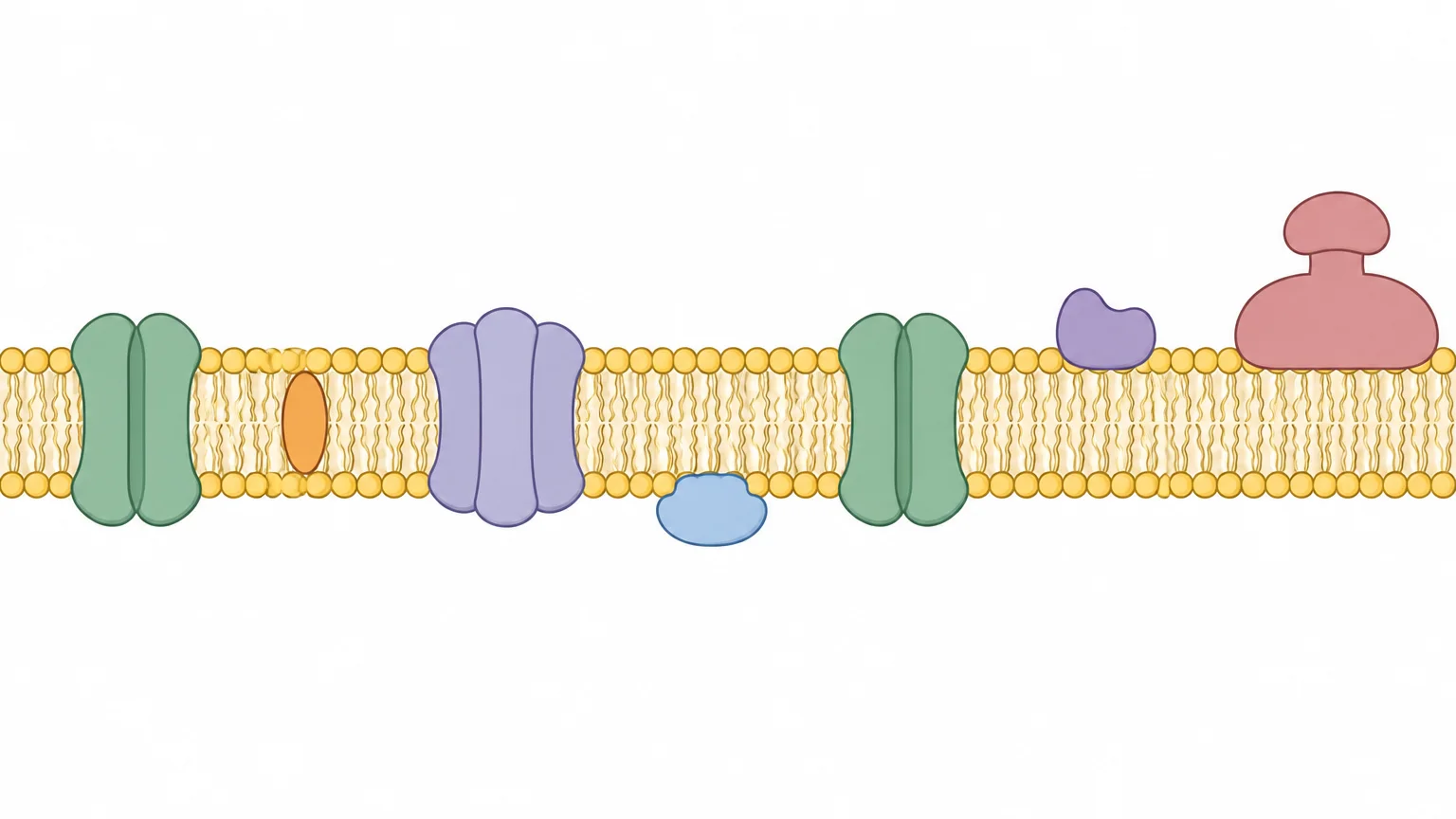
Leaving PSII, the electron is handed along a series of carriers in the thylakoid membrane, each passing it to the next. That series is an electron transport chain (ETC). Each carrier pulls on electrons a little more strongly than the one before it (it’s more electronegative), so the electron moves along on its own and releases some energy at certain steps. The chain works much like the one in mitochondria.
The carriers come in this order. Plastoquinone (Pq) is a small molecule that moves within the membrane. It delivers the electron to the cytochrome complex, a cluster of proteins that uses energy released by the electron to pump H⁺ from the stroma into the thylakoid lumen. Next, plastocyanin (Pc), a small protein, carries the electron to photosystem I.
Photosystem I gives a second boost
Photosystem I has its own light-harvesting complex, which funnels energy to a reaction-center pigment called P700 (it absorbs best at 700 nm). Excited P700 releases a high-energy electron to PSI’s primary electron acceptor.
The two photosystems refill their reaction-center pigments in different ways. P680⁺ in PSII takes electrons from water, but P700⁺ in PSI takes the electron arriving from plastocyanin. Because PSI doesn’t split water, it doesn’t release O₂.
From PSI’s primary electron acceptor, the electron goes to ferredoxin (Fd), a protein that collects two electrons, one at a time. Ferredoxin hands them to the enzyme NADP⁺ reductase, which transfers both electrons, plus an H⁺ taken from the stroma, to NADP⁺. The result is NADPH, made in the stroma. Using up that H⁺ also lowers the stroma’s H⁺ level.
This one-way route, from water through PSII and PSI to NADP⁺, is called linear electron flow.
Comparing the two photosystems
Both photosystems use light to excite an electron, but they differ in where their electrons come from and where they send them.
| Photosystem II | Photosystem I | |
|---|---|---|
| Reaction-center pigment | P680 | P700 |
| Where its replacement electrons come from | Water | Plastocyanin, carrying electrons from PSII |
| Releases O₂? | Yes, by splitting water | No |
| Where its excited electrons go next | The ETC: plastoquinone, cytochrome complex, plastocyanin | Ferredoxin, then NADP⁺ reductase, forming NADPH |
The Z scheme: an electron’s energy rises twice
Follow a single electron’s energy through linear electron flow and plot it, and the line zigzags: up, down, then up again. This pattern is called the Z scheme.
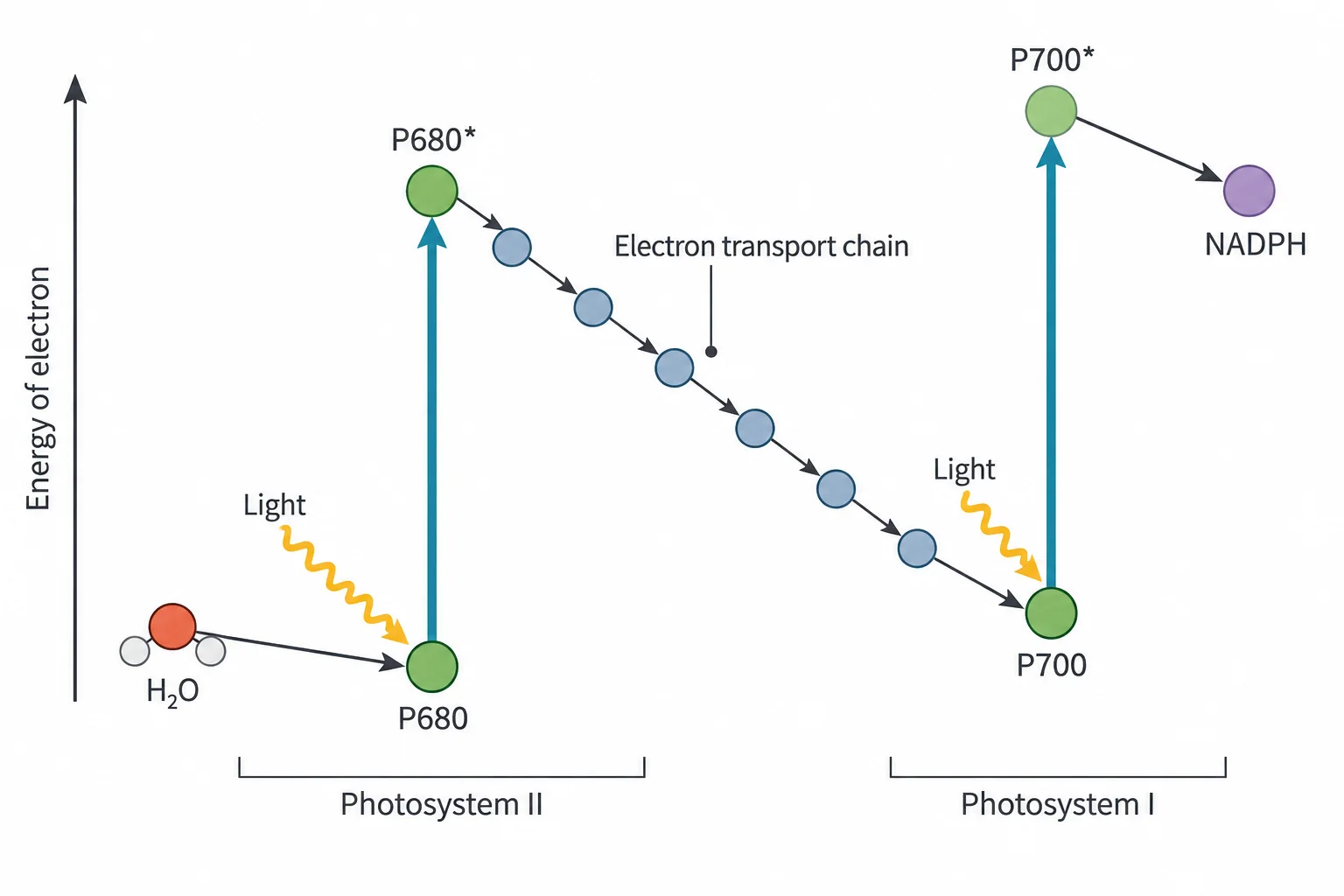
Read from left to right, the diagram shows five changes:
- On P680 in PSII, before light arrives, the electron has its lowest energy.
- Light energy absorbed by PSII boosts the electron to a much higher level.
- Moving along the ETC from PSII to PSI, the electron releases some of that energy, which is used to pump H⁺.
- Light energy absorbed by PSI boosts the electron again, even higher than it rose in PSII. This is its highest energy.
- The electron releases a little energy on its way to NADP⁺.
Splitting one water molecule frees two electrons, which make this trip one at a time. It takes two electrons to make one NADPH, and each of them has been boosted by light twice.
Check yourselfAlong the path from photosystem II to NADP⁺, when does an electron have the most energy?
Right after light boosts it in photosystem I. It gains energy first in PSII, loses some along the electron transport chain, and then gets a second boost in PSI that takes it higher than before. It loses only a little after that, on its way to NADP⁺.
Practice questions
1 of 2
In linear electron flow, which molecule receives the electrons at the very end of the path?
2 of 2
The reaction-center pigment of photosystem I is called P700. What does the 700 refer to?