How photosystem II captures light
The pigments in the thylakoid membrane aren’t scattered at random. Together with proteins, they’re organized into two large complexes that turn absorbed light into energized, moving electrons.
Two photosystems
A photosystem is a complex of proteins and pigment molecules in the thylakoid membrane that captures light energy. Chloroplasts have two kinds, photosystem II (PSII) and photosystem I (PSI). Working together, they make ATP, NADPH, and O₂.
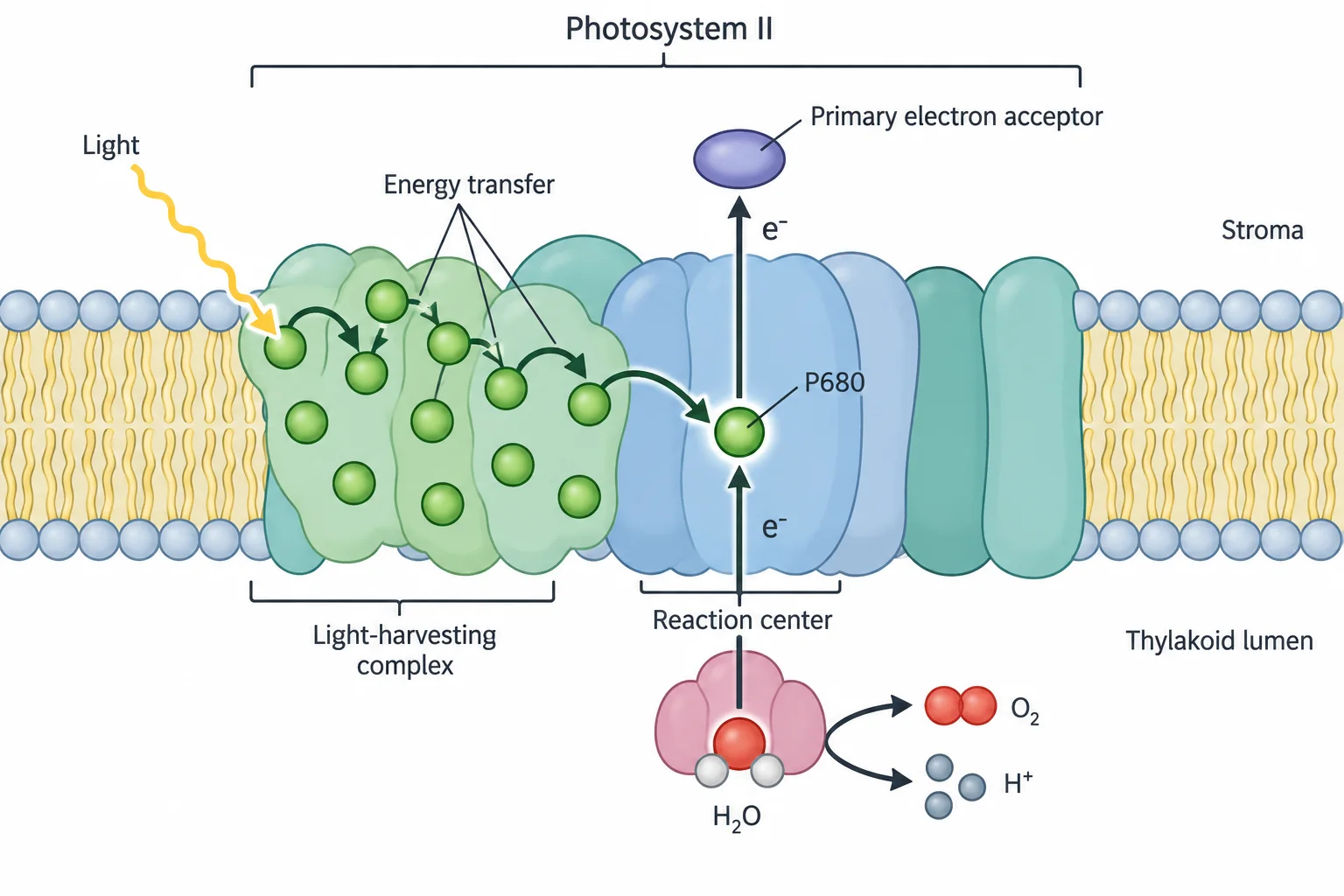
Each photosystem has two main parts. A light-harvesting complex gathers light energy, and a reaction center turns that energy into a moving electron.
The light-harvesting complex gathers energy
The light-harvesting complex is a cluster of several dozen pigment molecules, mostly chlorophylls along with carotenoids, anchored to proteins that span the membrane. Its job is to absorb photons.
When one of these pigments absorbs a photon, one of its electrons jumps to an excited state. That pigment can’t let go of the electron. Instead, it passes the energy, not the electron, to a neighboring pigment by resonance energy transfer. The energy hops from pigment to pigment until it reaches the reaction center.
Because it gathers energy from a wide area and funnels it to one spot, the light-harvesting complex is also called the antenna complex.
P680 hands off an excited electron
At the heart of PSII’s reaction center is a special pigment called P680, named for the wavelength of light it absorbs best, 680 nm. P680 can absorb light directly, but it’s usually energized by resonance energy transfer from the light-harvesting complex. Once excited, it’s written P680*.
What makes P680 special is that it can give away its excited electron, something the antenna pigments can’t do:
Here e⁻ stands for the electron, and the plus sign shows that P680 is now missing one.
The reaction center passes this high-energy electron to the primary electron acceptor, which in PSII is a molecule called pheophytin. The handoff takes less than a few picoseconds (trillionths of a second), so the electron has almost no time to lose its energy as heat or light. Once the electron sits on the primary electron acceptor, where it’s stable, the light energy has been captured. From pheophytin, the electron passes to two more carriers inside PSII, called QA and QB, and then leaves the photosystem.
Water refills P680
P680⁺ is short one electron, and it must get one back before it can work again. It takes a low-energy electron from water. Pulling electrons out of water splits it into H⁺ ions, oxygen, and electrons:
The two electrons are handed to P680⁺ one at a time, and each one restores it to P680. The other products matter too:
- O₂ leaves the chloroplast. It’s the oxygen that organisms use for aerobic respiration.
- H⁺ is released into the thylakoid lumen, adding to a buildup of H⁺ that later drives the making of ATP.
Removing electrons from water is an oxidation. No other known protein complex can oxidize water, which makes photosystem II the source of the O₂ that photosynthesis releases into the air.
| Part | Its role in photosystem II |
|---|---|
| Light-harvesting complex | Absorbs light and passes the energy to P680 by resonance energy transfer |
| P680 | Links the antenna to the acceptor by giving up its excited electron |
| Primary electron acceptor (pheophytin) | Takes the electron and holds it stably, which captures the light energy |
| Water | Supplies replacement electrons to P680⁺; splitting it releases O₂ and H⁺ |
Check yourselfWhat roles do the light-harvesting complex, P680, and the primary electron acceptor play in photosystem II, and at which step is light energy captured?
The light-harvesting complex absorbs light and passes the energy to P680 by resonance energy transfer. Excited P680 gives up a high-energy electron. The primary electron acceptor takes that electron and holds it stably; this transfer is the step that captures the light energy.
Practice questions
1 of 2
After P680 gives away an excited electron, where does it get a replacement?
2 of 2
In photosystem II, which pigment can give away its excited electron rather than only passing energy along?