How cells regulate metabolic pathways
Running a pathway when its product isn’t needed wastes energy and materials. So cells regulate their pathways: catabolic pathways break molecules down only when the cell needs energy or no longer needs those molecules, and anabolic pathways make molecules only when they’re needed.
Three levels of regulation
Cells regulate metabolic pathways at three levels:
| Level | How it works | Example |
|---|---|---|
| Gene regulation | Turns on or off the genes that code for a pathway’s enzymes, so the cell makes more or less of those enzymes | When a sugar is absent, a bacterium turns off the genes for the enzymes that break it down, then turns them back on when the sugar appears |
| Cellular regulation (cell signaling) | A signal from outside the cell sets off a chain of events inside it that changes specific enzymes, often by adding phosphate groups to them | The hormone epinephrine binds muscle cells and triggers the addition of phosphate groups to enzymes of carbohydrate metabolism, which speeds carbohydrate breakdown |
| Biochemical regulation | A molecule binds directly to an enzyme through weak, noncovalent attractions and changes its activity | In feedback inhibition, a high level of ATP binds phosphofructokinase, an enzyme of glycolysis, and slows glucose breakdown |
The three levels overlap. Cell signaling, for example, can also switch genes on or off.
Gene regulation and cell signaling
Enzymes are proteins coded by genes, so a cell can control a pathway by switching those genes on or off. For instance, a bacterium has no use for enzymes that digest a sugar that isn’t around, so it turns off the genes that code for them. When the sugar shows up, it turns those genes back on. (Chapter 14 explains how.)
At the cellular level, cells adjust their metabolism in response to signals from their environment. Many signaling pathways switch on protein kinases, enzymes that attach a phosphate group to specific target proteins.
When a person is frightened, for example, the hormone epinephrine (adrenaline) is released into the blood. It binds to muscle cells and sets off a chain of events inside them that adds phosphate groups to specific enzymes of carbohydrate metabolism. The activated enzymes speed up carbohydrate breakdown, supplying extra energy to fight or flee, which is why epinephrine is called the fight-or-flight hormone. Once the scare is over, epinephrine levels fall, and enzymes called phosphatases remove the phosphate groups, returning carbohydrate breakdown to its usual pace.
Biochemical regulation and feedback inhibition
The third level, and a very common one, acts directly on the enzymes: a molecule binds noncovalently to an enzyme and changes its function on the spot. Competitive inhibitors, which block an enzyme’s active site, and noncompetitive inhibitors, which bind elsewhere on the enzyme, both work this way.
In feedback inhibition, the final product of a pathway inhibits an enzyme that acts early in the pathway. As the product builds up, it shuts down its own production, which keeps too much of it from accumulating. The inhibition is reversible, so it happens only while the product’s concentration is high. When levels fall, the product lets go of the enzyme and the pathway starts up again.
An enzyme controlled this way has two binding sites. Its active site converts substrates to products. A second site outside the active site, the allosteric site, binds the pathway’s product noncovalently, and that binding causes a conformational change (a change in the enzyme’s shape) that inhibits catalysis, for example by altering the structure of the active site. Because the inhibitor binds outside the active site, feedback inhibition is a form of noncompetitive inhibition.
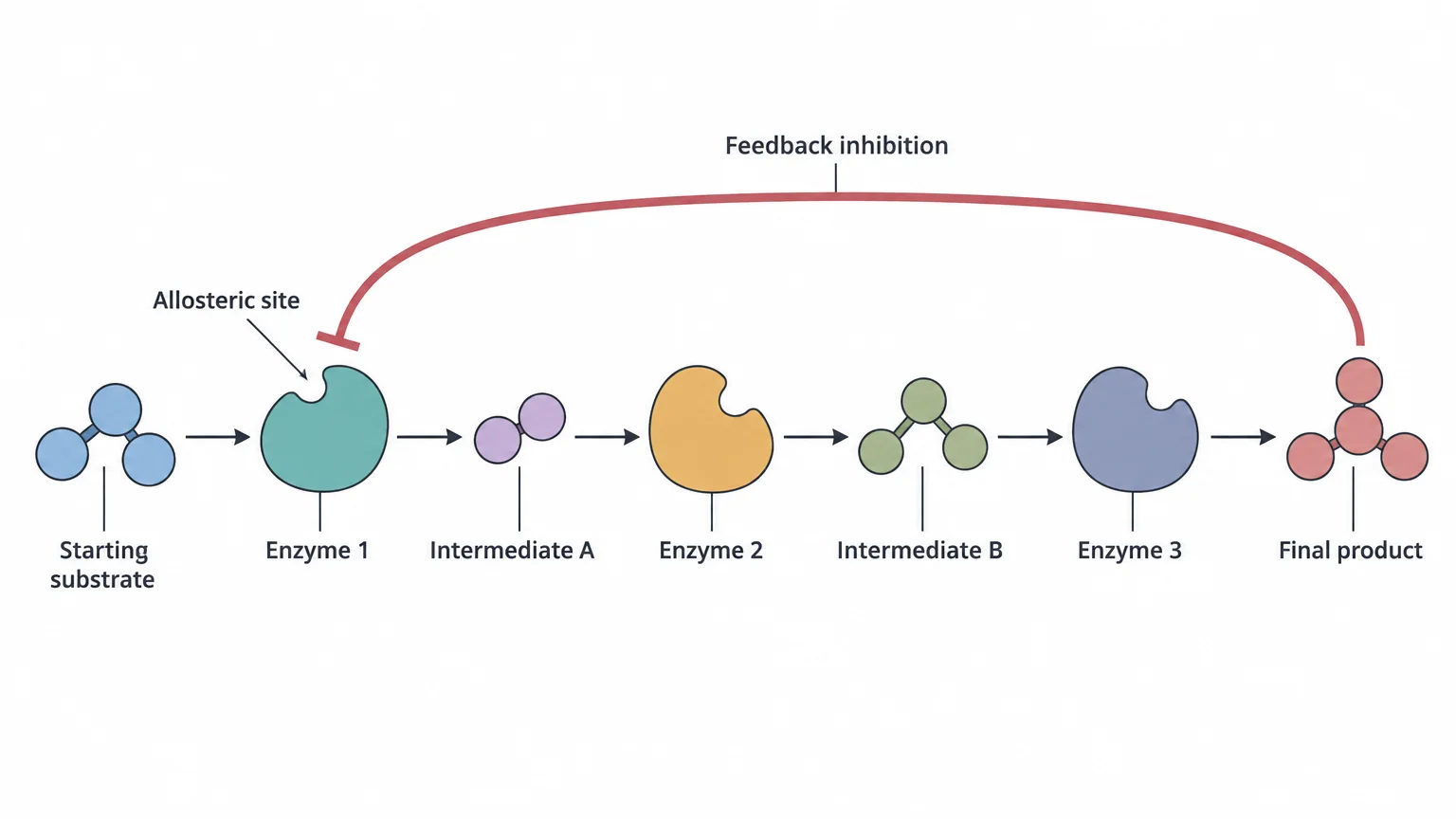
Glycolysis, the pathway that breaks down glucose, offers a real example. High levels of ATP inhibit phosphofructokinase, one of the pathway’s enzymes. A cell that already has plenty of ATP therefore slows its breakdown of carbohydrates instead of wasting fuel on ATP it doesn’t need.
Regulating the slowest step
Cells often aim cell signaling and biochemical regulation at one particular enzyme: the one that catalyzes the rate-limiting step, the slowest step in the pathway. Because that step sets the pace, changing its speed shifts the pathway’s output of final product more than changing any other step would. Controlling one enzyme instead of all of them is a quick, efficient way to adjust how much a pathway makes.
A metabolic pathway works like an assembly line, where each enzyme is a station. The slowest station sets the pace for the whole line; speeding up any other station just piles up parts in front of the slow one.
Check yourselfA four-step pathway’s enzymes have similar Kₘ values. Their Vₘₐₓ values are 90, 30, 400, and 1,100 (all in the same units) for enzymes 1 through 4. Which enzyme is the best target for feedback inhibition?
Enzyme 2. With similar affinities for their substrates, the enzyme with the lowest maximal velocity catalyzes the slowest step, the rate-limiting step. Inhibiting that step has the greatest effect on how much final product the pathway makes.
Check yourselfA mutant enzyme still makes its product normally, but the pathway’s final product no longer inhibits it, so the product piles up. Which part of the enzyme is most likely altered?
The allosteric site. The active site must still work, because the enzyme makes product normally. The final product just can’t bind the allosteric site to switch the enzyme off.
Practice questions
1 of 3
A bacterium growing without the sugar arabinose makes almost none of the enzymes that break arabinose down. Within minutes of arabinose being added, the cell starts producing those enzymes. Which level of regulation does this show?
2 of 3
When a pathway’s end product builds up, it binds an allosteric site on an enzyme early in the pathway and slows production. When the product runs low, it lets go and production resumes. What is this form of regulation called?
3 of 3
In a four-step pathway that makes a vitamin, step 2 is much slower than the other three steps. Which enzyme would the cell’s regulation most likely target to control how much vitamin is made?