How enzymes speed up reactions
A negative ΔG says a reaction can happen, not that it will happen soon. The breakdown of gasoline by oxygen is exergonic, yet gasoline and oxygen can sit together in a container for years with little change. Cells can’t wait that long, so they speed their reactions up.
Catalysts and enzymes
A catalyst is an agent that speeds up a chemical reaction without being used up or permanently changed by it. Because a catalyst comes out of each reaction unchanged, it can be used again and again. The most common catalysts in living cells are proteins called enzymes. (A few RNA molecules act as catalysts too; they appear later in this chapter.)
Enzymes typically make reactions run millions of times faster than they would on their own. The enzyme catalase, which breaks hydrogen peroxide (H₂O₂) into water and oxygen, speeds that reaction up about 10¹⁵-fold: a million billion times.
The activation energy barrier
For two molecules to react, they must collide in the right orientation and with enough energy to change their bonds. As they approach, the electrons in their outer shells repel each other, and their existing bonds must be strained or stretched before they can break. Getting past these obstacles takes an initial input of energy, the activation energy (Eₐ).
With enough activation energy, the reactants reach the transition state, an unstable, in-between arrangement in which their original bonds can break. From the transition state, the reaction proceeds readily to products.
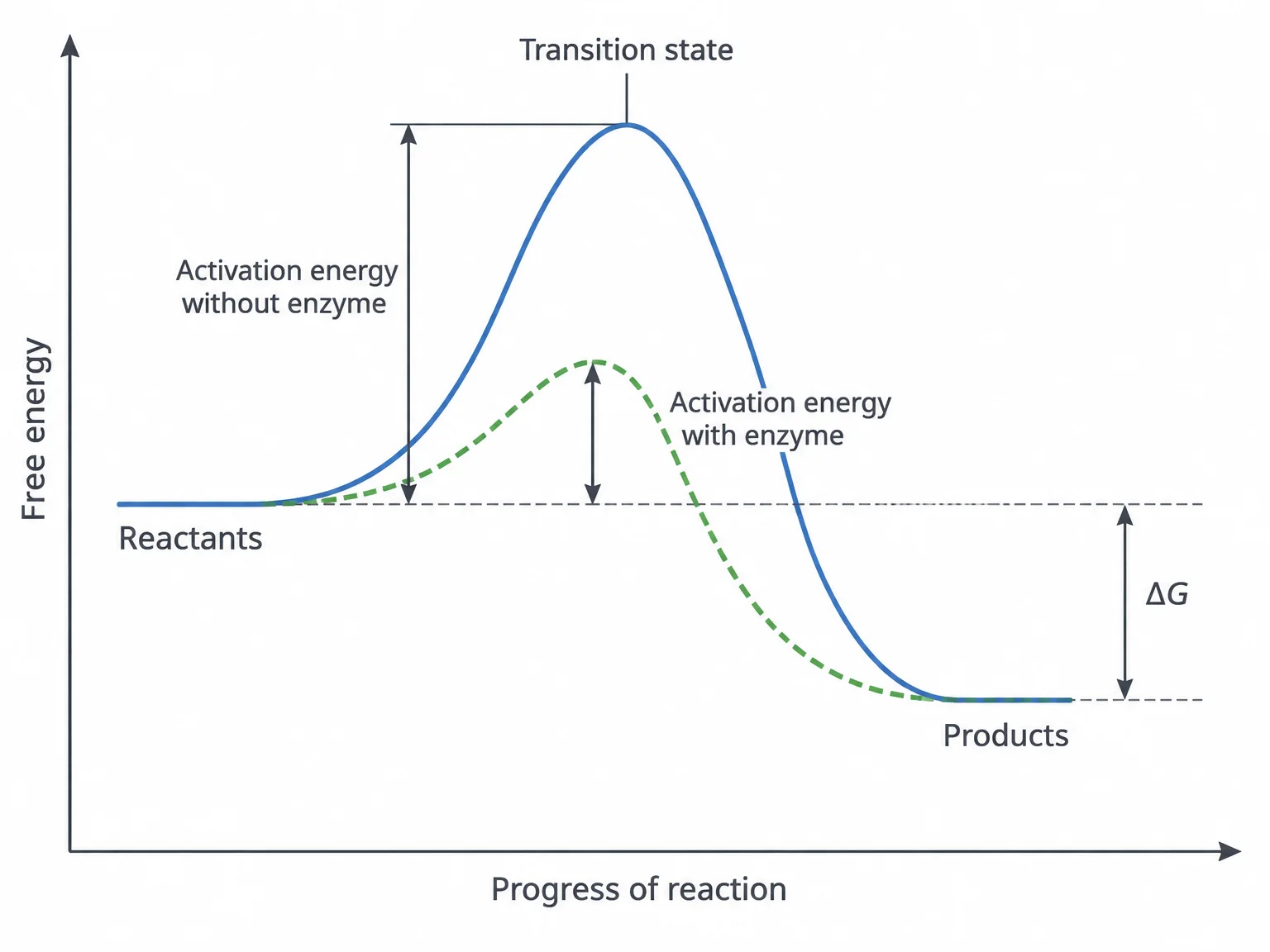
Activation energy is a barrier, and it’s the reason many reactions, including exergonic ones, are slow. With an enzyme, the barrier drops low enough that the ordinary heat energy in a cell can carry reactants to the transition state.
How enzymes lower the barrier
Enzymes lower the activation energy in two main ways:
- Straining reactants: when reactant molecules bind to an enzyme, the enzyme can stretch or bend their bonds, bringing them closer to the transition state.
- Positioning reactants: when a reaction involves two or more reactants, the enzyme holds them very close together, in the orientation that best lets new covalent bonds form.
The active site and specificity
The pocket of an enzyme where the reaction takes place is its active site. The reactant molecules that bind there are the enzyme’s substrates, and an enzyme bound to its substrates forms an enzyme-substrate complex. The enzyme hexokinase, for example, has two substrates, glucose and ATP. It transfers a phosphate from ATP to glucose, releasing glucose-6-phosphate and ADP.
Nearly all enzymes bind their substrates with high specificity, because the shape and chemistry of the active site suit particular molecules. Hexokinase binds glucose readily but binds similar sugars, such as fructose and galactose, poorly. An early model compared this fit to a lock and key: only the right key (the substrate) fits the keyhole (the active site). The comparison captures specificity but misses something: the enzyme itself changes shape.
Induced fit
When substrates bind, the enzyme undergoes a conformational change, a change in its three-dimensional shape, that makes it grip the substrates more tightly. This is induced fit. Catalysis starts only once this shape change has happened, and the tighter grip is one of the ways the enzyme lowers the activation energy. If the lock-and-key model pictures a rigid fit, induced fit is more like a hand closing around a ball: the grip tightens once the ball is in the palm.
Put together, one round of catalysis by hexokinase runs like this:
- The substrates, glucose and ATP, bind to the active site, forming an enzyme-substrate complex.
- The enzyme changes shape and grips the substrates more tightly (induced fit).
- The substrates are converted into products, glucose-6-phosphate and ADP.
- The products are released, and the unchanged enzyme is ready to bind new substrates.
Check yourselfAn enzyme speeds up a reaction whose ΔG is −3 kcal/mol. What is ΔG with the enzyme present, and what did the enzyme change?
ΔG is still −3 kcal/mol. The enzyme lowered the activation energy, so reactants reach the transition state more easily and the reaction runs faster, but the free energies of the reactants and products stay the same.
Practice questions
1 of 2
An enzyme that breaks down lactose, the sugar in milk, barely acts on sucrose (table sugar), even though the two sugars are similar in size. What best explains this?
2 of 2
After catalase breaks down a molecule of hydrogen peroxide, what becomes of the catalase?