How ATP powers endergonic reactions
Building proteins, pumping ions, and contracting muscles are all endergonic, so none would happen on its own. Cells drive them by pairing each with a reaction that releases plenty of free energy, most often the breakdown of ATP.
Splitting ATP
Adenosine triphosphate (ATP) has three parts: adenine (a ring-shaped molecule containing nitrogen), ribose (a five-carbon sugar), and a tail of three phosphate groups, which are negatively charged clusters of phosphorus and oxygen atoms.
In the hydrolysis of ATP, water is used to split off the last phosphate (hydrolysis means “splitting with water”). The bond between the second and third phosphate groups breaks, a water molecule splits too, and the water’s OH joins the freed phosphate. The products are ADP (adenosine diphosphate, which has two phosphates) and a loose phosphate. A free phosphate like this, attached to no carbon-containing molecule, is called inorganic phosphate, written Pᵢ.
ATP + H₂O → ADP + Pᵢ (ΔG = −7.3 kcal/mol)
That large negative ΔG means the reaction is strongly exergonic: forming ADP and Pᵢ is highly favored.
Where the energy comes from
Breaking a covalent bond (a bond in which atoms share electrons) always takes energy; forming bonds is what releases it. So the energy doesn’t come from the broken bond itself. It comes from the products: ADP and Pᵢ have stronger covalent bonds overall than ATP and water did, and they interact with the surrounding water differently. They end up with less free energy than the reactants had, and the difference is released.
Water isn’t the only possible partner: inside cells, ATP’s last phosphate often goes to a hydroxyl (OH) group on a small organic molecule or a protein instead. Removing it is exergonic either way.
Coupling reactions
A cell can’t make an endergonic reaction exergonic, but it can pair it with a reaction that is. When two reactions are coupled, meaning they happen together as one combined process, their ΔG values add up. If the total is negative, the coupled reaction is exergonic and proceeds on its own, carrying the endergonic step along with it.
In the coupled reaction, no water is used: the phosphate moves directly from ATP to an OH group on glucose. Attaching a phosphate group to a molecule is called phosphorylation.
Coupling works like two buckets hung on a rope over a pulley. A heavy bucket dropping on one side (ATP hydrolysis) can lift a lighter bucket on the other side (the endergonic reaction), but only if the dropping bucket is the heavier of the two.
The ATP cycle
Cells don’t stockpile ATP; they rebuild it constantly. Energy released by breaking down food molecules is used to attach a phosphate to ADP, making ATP (an endergonic reaction). The ATP is then broken down to drive the cell’s endergonic reactions and processes, and the leftover ADP and Pᵢ are rebuilt into ATP. ATP works like a rechargeable battery: food recharges it, and cell processes drain it.
The recycling is fast. A typical human cell uses millions of ATP molecules every second. An average person breaks down about 100 pounds of ATP a day yet never holds anywhere near that much at one time, because each ATP molecule is broken down and rebuilt about 10,000 times a day.
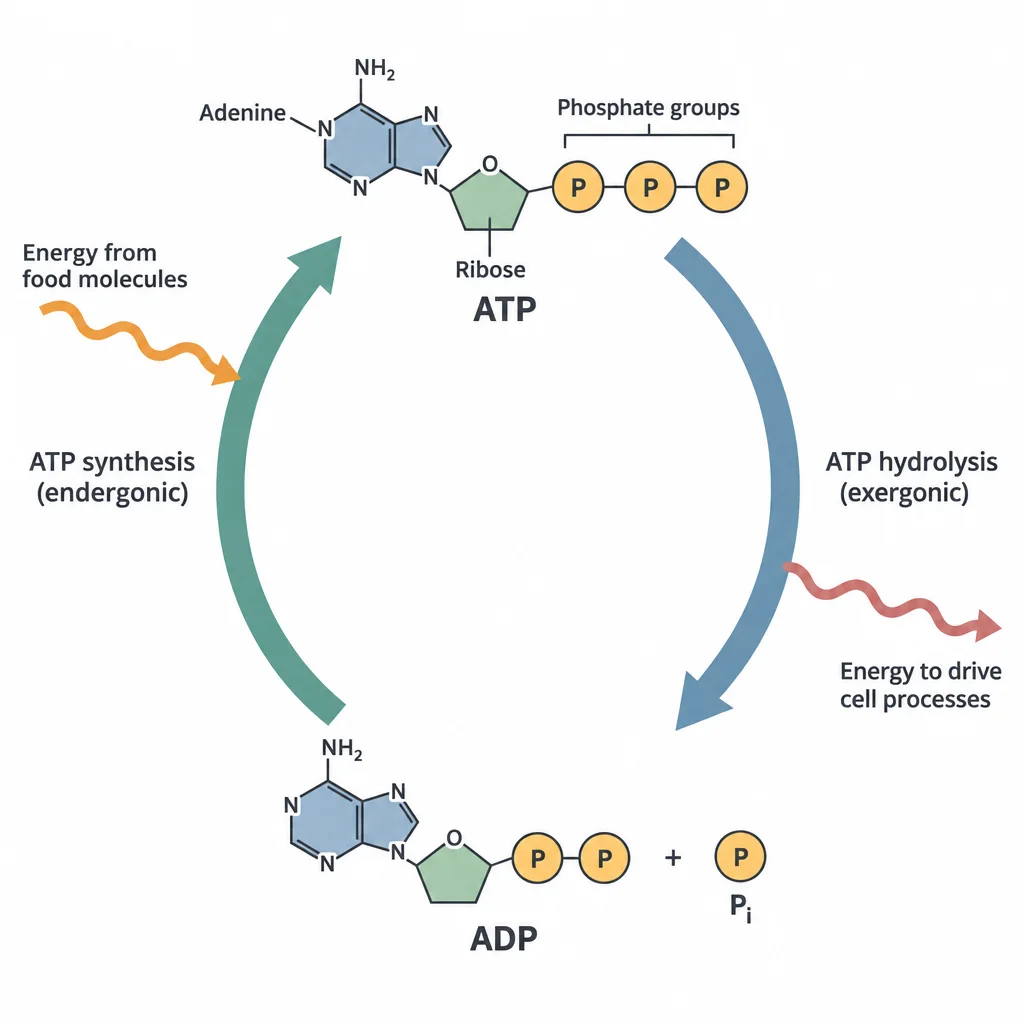
Since new ATP is built from ADP, a cell that lost much of its ADP couldn’t make enough ATP, and the cycle would slow.
Proteins that run on ATP
Many kinds of proteins bind ATP and use its energy:
- metabolic enzymes, such as hexokinase, which uses ATP to attach phosphate to glucose
- transporters, such as the Na⁺/K⁺-ATPase pump, which moves ions against their gradients (Chapter 5)
- motor proteins, such as myosin, which powers muscle contraction and other movement
- chaperones, which help other proteins fold and unfold
- DNA-modifying enzymes, such as helicases and topoisomerases, which change DNA’s shape
- aminoacyl-tRNA synthetases, which attach amino acids to tRNAs, the carriers that bring amino acids to protein synthesis
- protein kinases, which attach phosphates to other proteins to change how they work
ATP-binding sites in proteins have recognizable amino acid sequences. Once a species’ genome (its complete set of DNA) is sequenced, researchers can scan its genes for those sequences and predict which proteins bind ATP. Surveys of the proteome, all the proteins a cell or organism makes, find that on average over 20% of proteins in bacteria, archaea, and eukaryotes bind ATP, and the true share is probably higher.
Check yourselfA reaction a cell needs has a ΔG of +9.0 kcal/mol. Would coupling it to the hydrolysis of one ATP make it spontaneous?
No. The combined ΔG would be +9.0 + (−7.3) = +1.7 kcal/mol, which is still positive, so the coupled reaction would still be endergonic. Coupling works only when the exergonic reaction releases more free energy than the endergonic one requires.
Practice questions
1 of 2
An average person breaks down roughly 100 pounds of ATP a day but has only a small fraction of that amount in the body at any moment. How is this possible?
2 of 2
A reaction has a ΔG of +9.0 kcal/mol. If a cell couples it to the hydrolysis of one ATP (ΔG = −7.3 kcal/mol), will the coupled reaction proceed on its own?