Energy and the laws of thermodynamics
Every living cell carries out thousands of chemical reactions, processes that change one set of substances into others by joining molecules, splitting them, rearranging their atoms, or passing electrons between them. All the chemical reactions in an organism, taken together, make up its metabolism. The fate of each reaction depends on its direction (forward or backward), which energy largely decides, and its rate (how fast it goes), which enzymes largely set.
What energy is
Swinging a bat, warming your body, and building a new molecule all make something change. What makes change possible is energy, defined as the ability to cause change or do work. It comes in two general forms:
- Kinetic energy is the energy of motion, like a baseball bat in mid-swing.
- Potential energy is stored energy that an object or substance has because of its structure or location, like a drawn bow just before the arrow is released.
Even electrons have potential energy. They sit around an atom’s nucleus in layers called shells, or energy levels, and the farther out an electron’s shell, the more potential energy the electron has. When an electron drops to a shell closer to the nucleus, part of that potential energy becomes kinetic energy.
Forms of energy in living things
The potential energy stored in atoms and in the bonds between them is chemical potential energy, usually just called chemical energy. Organic molecules (the carbon-based molecules that living things are built from), such as glucose, hold a great deal of it. When cells break these molecules down, part of the released energy is captured to make ATP, the small molecule that directly powers most cell activities.
Chemical energy is one of several forms that matter in biology:
| Form | What it is | Example in living things |
|---|---|---|
| Light | Electromagnetic radiation (energy that travels as waves) that our eyes can see, carried in packets called photons | Pigments in chloroplasts absorb light during photosynthesis, and that energy is eventually used to make organic molecules |
| Heat | Kinetic energy that flows from a warmer object or place to a cooler one | Heat released by chemical reactions helps keep the human body at a constant temperature |
| Mechanical | Energy an object has because of its motion or its position relative to other objects | Contracting muscles move your legs when you walk |
| Chemical | Potential energy stored in atoms and chemical bonds | Glucose and ATP store large amounts; breaking large molecules into smaller ones releases energy for cell processes |
| Electrical and ion gradients | Energy from moving or separated charges, including a difference in ion concentration across a membrane | A gradient of H⁺ ions across a membrane powers ATP production during cellular respiration (Chapter 7) |
The two laws of thermodynamics
Energy is constantly converted from one form to another, and the study of these conversions is thermodynamics. Two of its laws set the rules that every organism lives by.
The first law of thermodynamics, also called the law of conservation of energy, says that energy cannot be created or destroyed. It can move from place to place and change from one form into another, but the total stays the same. Your body doesn’t make energy out of nothing: it converts the chemical energy in food into motion, heat, and new chemical bonds.
The second law of thermodynamics says that every energy transfer or transformation increases the disorder of a system. That disorder is entropy, a measure of how random, or spread out, the molecules in a system are.
A salt crystal is a tidy, repeating grid of sodium ions (Na⁺) and chloride ions (Cl⁻), so its entropy is low. Drop it in water and the ions scatter in every direction, so the entropy rises.
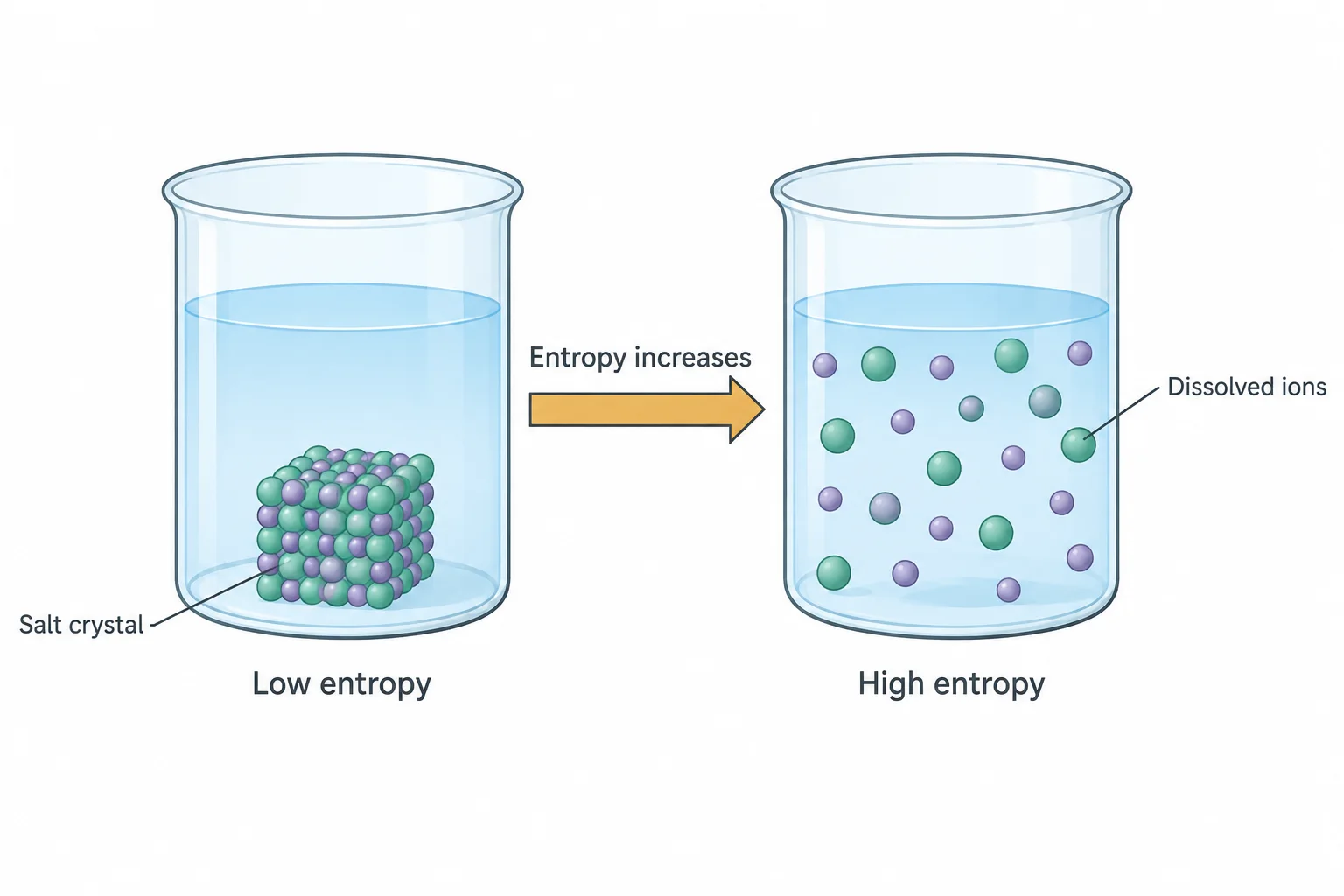
Entropy matters because energy that has spread out is less able to cause change. Each time energy changes form, some of it ends up in a form living things can’t use, often as heat given off by a chemical reaction.
How living things stay organized
Cells are highly ordered. They build complex molecules and keep their parts carefully arranged, which might seem to defy the second law. It doesn’t, because the law applies to a whole system: the organism plus its surroundings.
Organisms take in energy from their environment, as food or (for plants) as sunlight, and use it to build order inside themselves. In the process they give off heat, which increases the disorder of their surroundings. The organism becomes more organized, but the total entropy of the organism and its surroundings still goes up.
Check yourselfA tree builds large, orderly molecules, such as the cellulose in its wood, from carbon dioxide and water. Does this break the second law of thermodynamics?
Practice questions
1 of 4
What do biologists call the ability to cause change or do work?
2 of 4
When a cell breaks down glucose, only part of the energy released is captured in ATP. What happens to the rest of that energy?
3 of 4
A drop of food coloring is placed in a glass of still water and slowly spreads until the water is evenly tinted. What happens to entropy as the dye spreads?
4 of 4
A chick embryo inside an egg turns the nutrients in the yolk into highly organized tissues. How is this consistent with the second law of thermodynamics?