Enzyme speed, affinity, and inhibitors
Lowering the activation energy explains why enzymes speed reactions up. How fast a particular enzyme-catalyzed reaction actually runs depends on how much substrate is around, how tightly the enzyme binds it, and whether another molecule is getting in the way.
Speeding up, then leveling off
To measure how fast an enzyme works, biochemists mix the same amount of enzyme with different amounts of substrate and measure how much product forms per second. That rate is the reaction’s velocity.
At low substrate concentrations, adding substrate raises the velocity, because more active sites are occupied at any given moment. Eventually the velocity levels off. By then nearly every active site is filled, so the enzyme is saturated with substrate, and adding more barely helps. The velocity at this plateau is the reaction’s maximal velocity, Vₘₐₓ.
Checkout lanes in a store behave the same way, with active sites as the lanes and substrate molecules as the shoppers. When only a few shoppers are in line, more shoppers means more sales per minute. Once every lane is busy, extra shoppers just wait, and sales per minute hit a ceiling. That ceiling is Vₘₐₓ.
Kₘ and affinity
How strongly an enzyme and its substrate attract each other is the enzyme’s affinity for that substrate. A high-affinity enzyme binds its substrate even when only a little is around. A low-affinity enzyme forms enzyme-substrate complexes readily only when the substrate is more concentrated.
Kₘ, also called the Michaelis constant, is the substrate concentration at which a reaction runs at half its maximal velocity. It measures how much substrate an enzyme needs: an enzyme with a high Kₘ needs a higher substrate concentration to reach a given velocity than an enzyme with a low Kₘ.
An enzyme-catalyzed reaction happens in two steps. The enzyme (E) binds the substrate (S), a step that can reverse when the substrate falls off; then the enzyme-substrate complex (ES) forms the product (P):
E + S ⇌ ES → E + P
When forming the product is much slower than the substrate falling off, Kₘ is inversely related to affinity. A low Kₘ means high affinity: the enzyme binds its substrate tightly and reaches half speed at a low concentration, like enzyme X. A high Kₘ means low affinity: the enzyme binds weakly and needs more substrate, like enzyme Y.
Inhibitors
Molecules that slow or stop an enzyme are inhibitors, and many drugs work this way. Aspirin and ibuprofen, for instance, inhibit cyclooxygenase, an enzyme needed to make prostaglandins, signaling molecules involved in inflammation, pain, and fever. Inhibitors fall into two broad groups:
- Reversible inhibitors bind to an enzyme noncovalently (through weak attractions, not shared electrons) and can let go again.
- Irreversible inhibitors usually bind covalently and permanently inactivate the enzyme. The nerve gas DIFP is one: it bonds covalently to acetylcholinesterase, an enzyme that nerve cells need to work properly.
Cells seldom regulate their own enzymes with irreversible inhibitors. A reversibly inhibited enzyme can go back to work once the inhibitor’s concentration drops, and reusing an enzyme saves the energy of making a new one.
Competitive and noncompetitive inhibitors
Reversible inhibitors come in two types:
- A competitive inhibitor binds to the active site itself, keeping the substrate out. It usually resembles the substrate, at least in part. Because the two compete for the same spot, a high enough substrate concentration can outcompete the inhibitor. As a result, Kₘ rises (more substrate is needed to reach half speed), but Vₘₐₓ doesn’t change.
- A noncompetitive inhibitor binds somewhere else, at an allosteric site, a binding site outside the active site. Its binding changes the enzyme’s shape and reduces its ability to catalyze the reaction. It lowers Vₘₐₓ without changing Kₘ, and adding more substrate doesn’t overcome it.
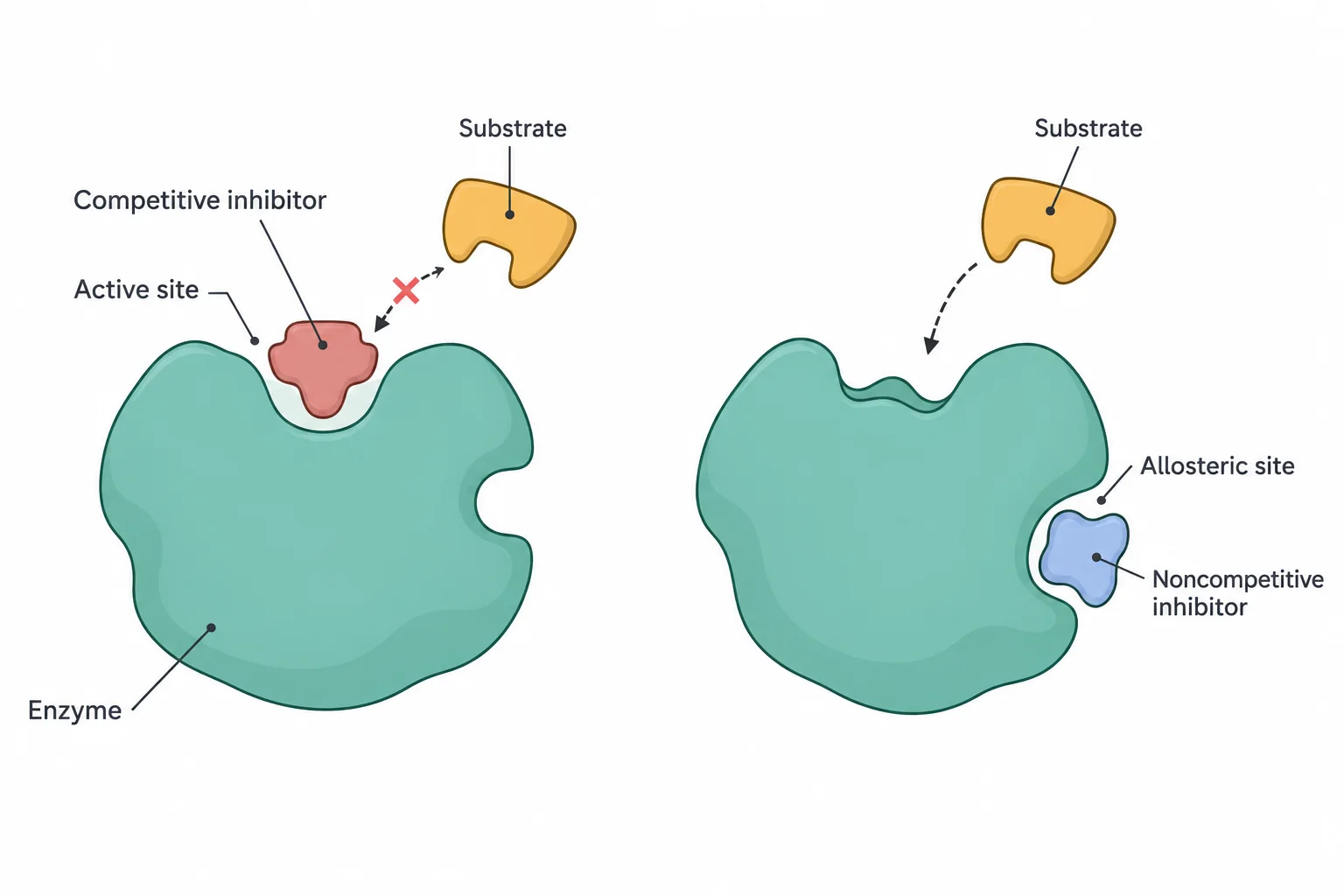
| Competitive inhibitor | Noncompetitive inhibitor | |
|---|---|---|
| Where it binds | Active site | Allosteric site |
| Effect on Kₘ | Raises it | No change |
| Effect on Vₘₐₓ | No change | Lowers it |
| Overcome by more substrate? | Yes | No |
Check yourselfA drug raises an enzyme’s Kₘ but leaves its Vₘₐₓ unchanged. What kind of inhibitor is it, and where does it bind?
It’s a competitive inhibitor, so it binds the active site. It competes with the substrate, so more substrate is needed to reach half speed (a higher Kₘ). With enough substrate, though, the substrate still wins, so the maximal velocity is unchanged.
Practice questions
1 of 2
In an experiment, adding more substrate to a fixed amount of enzyme speeds up the reaction at first, but eventually the velocity stops rising. Why does it level off?
2 of 2
Why do cells regulate their own enzymes mostly with reversible inhibitors rather than irreversible ones?