The nucleus, the genome, and the proteome
In chemistry, a nucleus is the dense center of an atom. In cell biology, the nucleus is something else entirely: the organelle of a eukaryotic cell that holds most of its genetic material. (Mitochondria and chloroplasts hold a little DNA of their own.)
The nuclear envelope
The nucleus is wrapped in the nuclear envelope, which is made of two membranes, an inner one and an outer one. At many points the two membranes meet and form openings called nuclear pores. These pores are the nucleus’s doors: molecules and large molecules such as proteins and RNA pass in and out through them.
The nuclear envelope belongs to the endomembrane system, the cell’s network of connected internal membranes (next segment). The contents of the nucleus do not.
Chromosomes and the nuclear matrix
A chromosome is one very long DNA molecule plus the proteins that pack it tightly enough to fit inside the nucleus. The DNA–protein material that chromosomes are made of is called chromatin.
The chromosomes aren’t tangled randomly. A framework of protein fibers, the nuclear matrix, keeps them organized. It has two parts:
- the nuclear lamina, a mesh of intermediate filaments (made of lamin proteins) lining the inner membrane, which also anchors the nuclear pores
- the internal nuclear matrix, which connects to the lamina and fills the interior
Thanks to this framework, each chromosome occupies its own region of the nucleus, called a chromosome territory, without overlapping its neighbors. When a cell divides, the nuclear envelope breaks apart, the chromosomes condense, and the territories disappear.
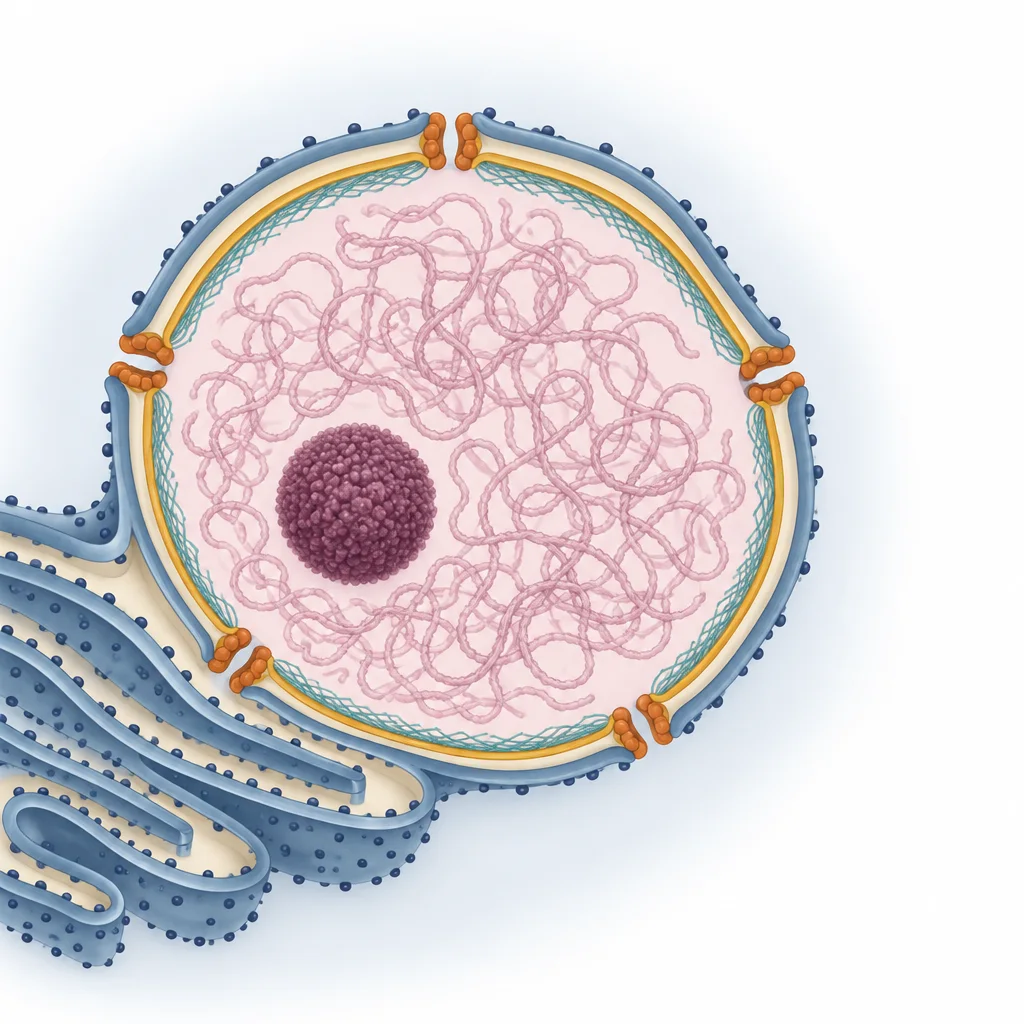
The nucleus’s main jobs are to protect, organize, copy, and use (express) the genetic material. It has one more job: assembling the subunits of ribosomes.
The nucleolus: an organelle without a membrane
Most organelles are wrapped in one or two membranes, but cells have another way to make a compartment. In liquid-liquid phase separation, certain proteins and RNA molecules cluster together and separate from the surrounding fluid into a droplet. The droplet is round, has surface tension (like a drop of water) and viscosity (resistance to flowing), and holds together even though molecules can move around inside it and occasionally escape. Compartments formed this way are called droplet organelles.
Droplets help cells in two ways. They bring molecules close together so they can assemble into complexes, and they create a chemical environment different from the rest of the cell, which can affect events such as how RNA folds.
The main example of a droplet organelle is the nucleolus (plural, nucleoli), a dense region inside the nucleus of nondividing cells. It’s where the cell assembles ribosomal subunits.
A ribosome has two parts, a small subunit and a large subunit, each made of RNA plus several proteins. Parts are made in two different places and brought together in the nucleolus:
- Most of the ribosomal RNA is made near the nucleolus.
- Ribosomal proteins are made in the cytosol and imported through the nuclear pores.
- The RNA and proteins come together in the nucleolus and are assembled into small and large subunits.
- The finished subunits leave through the nuclear pores and work in the cytosol, building polypeptides.
Same genome, different proteome
The genome is stored in the nucleus, and nearly every cell in your body carries the same one. Yet a skin cell and a neuron look and act nothing alike. The difference lies in the proteins.
The proteome is the complete set of proteins that a cell is making at a given time, or that an organism can make. A cell’s proteome largely determines its structure and function. Think of the genome as a cookbook every cell shares, and the proteome as the menu each cell actually cooks from it. Two cells with identical genes can have very different proteomes for four reasons:
- Different proteins. Some genes are switched on in one cell type and off in another.
- Different amounts. Both cells may make a protein, but at different levels, depending on how fast it’s made and broken down.
- Different versions. Through alternative splicing, the RNA copied from a single gene can be cut and joined in different ways, producing two or more polypeptides with different amino acid sequences. The versions often do similar jobs, each tuned to its cell type.
- Different finishing touches. After a protein is made, a cell may attach groups such as phosphates or carbohydrates, or cut the protein to a smaller size.
Proteomes also largely produce an organism’s traits, such as eye color, and proteome changes are linked to disease. Lung cancer cells, for example, have different proteomes from healthy lung cells, and the proteome keeps shifting as the cancer progresses. In cancer, mutations (changes in the DNA) alter which genes are used, so a change in the genome leads to a change in the proteome.
Check yourselfYour skin cells and neurons have the same genes. Why do they look and work so differently?
Practice questions
1 of 3
Liver cells and muscle cells in one person arose from the same fertilized egg, yet they look and work very differently. What mainly explains the difference?
2 of 3
Ribosomal proteins are made in the cytosol. If a drug blocked all traffic through the nuclear pores, what would happen to the production of new ribosomes?
3 of 3
Lung cancer cells from a patient make several proteins that the patient’s healthy lung cells do not make. What most likely explains this?