Mitochondria, chloroplasts, and endosymbiosis
Two organelles handle the cell’s energy. Chloroplasts capture light energy and use it to build organic molecules; mitochondria break organic molecules down and store the released energy in ATP. Both are semiautonomous organelles: they grow and divide on their own, but they import most of their proteins and many other parts from the rest of the cell.
Mitochondria
A mitochondrion (plural, mitochondria) is about the size of a bacterium. A typical cell has hundreds to thousands of them, and cells with high energy demands, such as muscle cells, have more. Regular exercise even increases the number and size of mitochondria in your muscles.
Each mitochondrion has two membranes. The space between them is the intermembrane space. The inner membrane is deeply folded into cristae, and the fluid it encloses is the mitochondrial matrix. ATP is made at the inner membrane, so the folds matter: they pack far more membrane, and therefore more ATP-making machinery, into the same small space.
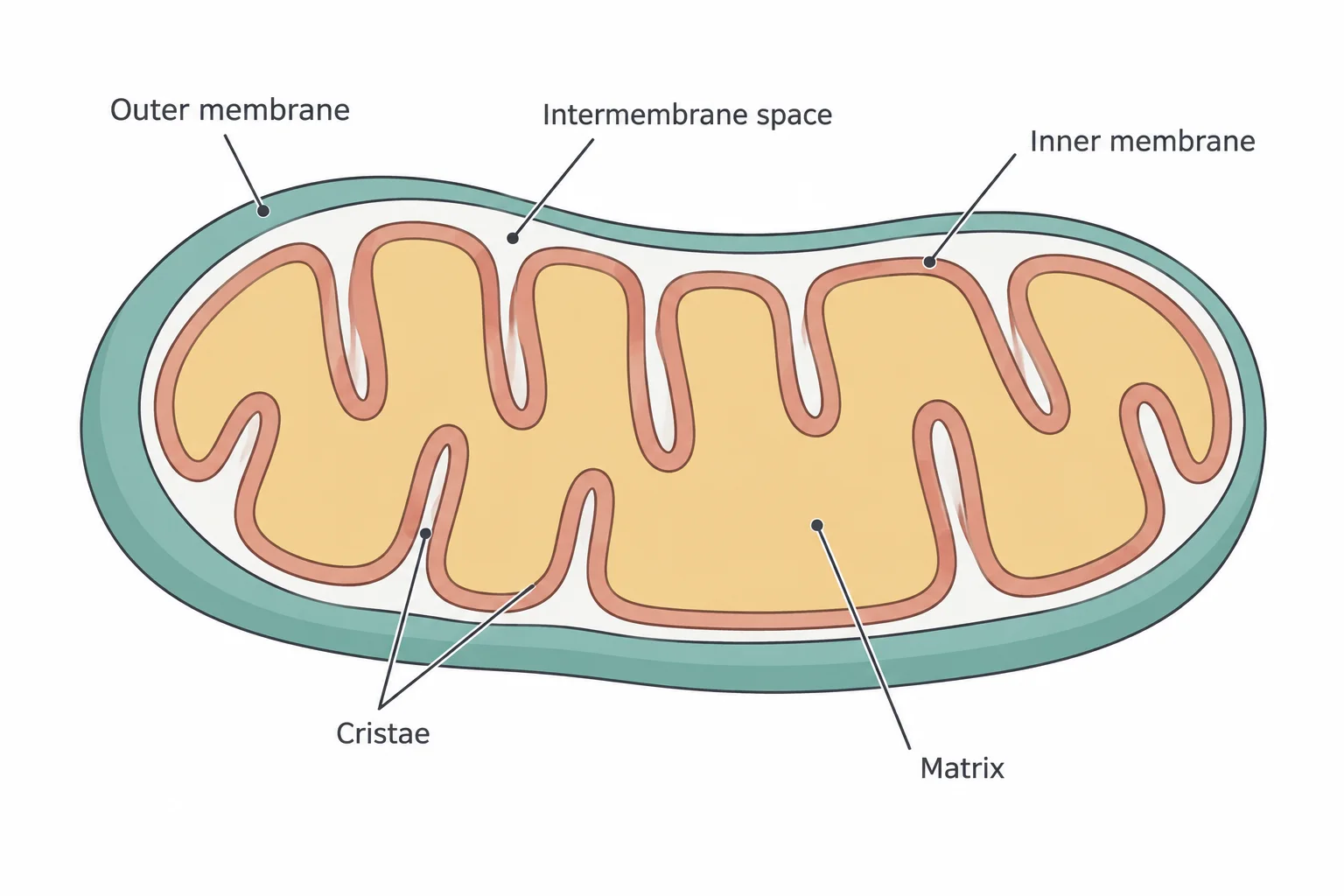
ATP (adenosine triphosphate) is the energy currency that many proteins spend to do their jobs, from muscle contraction to cell division. Mitochondria make most of a cell’s ATP, but they don’t make energy from nothing. They move energy already stored in sugars, fats, and amino acids into ATP, a form the cell can spend right away: more a currency exchange than a mint.
Mitochondria also help make, modify, and break down molecules (some hormones require mitochondrial enzymes). In brown fat cells they release energy as heat, helping hibernating animals warm up and keeping young animals warm. Mutations that weaken ATP production harm high-demand cells such as neurons and muscle cells most.
Chloroplasts
Chloroplasts carry out photosynthesis: they capture light energy and use it to make organic molecules such as glucose. They’re found in nearly all plants and algae.
Like a mitochondrion, a chloroplast has an outer membrane, an inner membrane, and an intermembrane space. Inside is a third membrane, the thylakoid membrane, which forms flattened, fluid-filled sacs enclosing the thylakoid lumen. The sacs are stacked like coins; each stack is a granum (plural, grana). The fluid surrounding the thylakoids, inside the inner membrane, is the stroma.
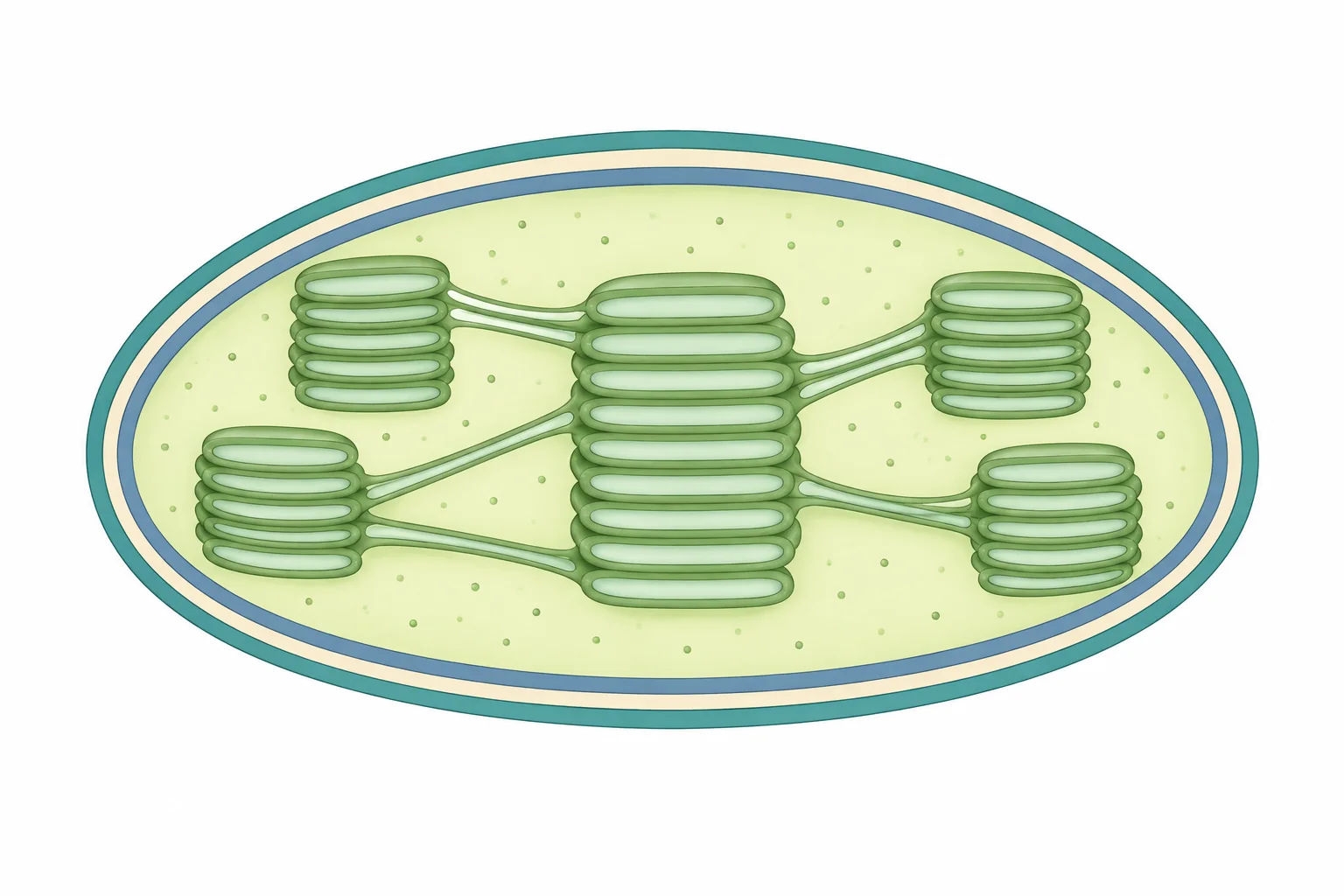
| Mitochondrion | Chloroplast | |
|---|---|---|
| Internal membranes | Cristae: folds of the inner membrane | Thylakoids: a third membrane, stacked into grana |
| Fluid inside the inner membrane | Matrix | Stroma (around the thylakoids) |
Chloroplasts are one kind of plastid, a family of plant organelles that all develop from unspecialized proplastids. Plastids differ in their pigments and in what they make:
| Plastid | Pigment | What it does |
|---|---|---|
| Chloroplast (chloro, green) | Green chlorophyll | Photosynthesis |
| Chromoplast (chromo, color) | Yellow, orange, and red carotenoids | Makes and stores pigments that color fruits, flowers, and autumn leaves |
| Leucoplast (leuco, white) | Usually none | Varies; one type, the amyloplast (amylo, starch), makes and stores starch, especially in roots and tubers |
Their own DNA, their own division
Mitochondria and chloroplasts have their own genetic material: the mitochondrial genome and chloroplast genome, separate from the nuclear genome. Like a bacterial genome, each is usually a single circular chromosome, though an organelle may hold several copies.
These genomes are tiny. The human nuclear genome holds about 200,000 times as much DNA as the human mitochondrial genome, and about 20,000 protein-coding genes compared with about a dozen. Chloroplast genomes are bigger, roughly 10 times the size of the human mitochondrial genome.
Mitochondria and chloroplasts multiply by binary fission: the organelle copies its chromosome, then splits in two, much as a bacterium does (though a dividing bacterium must also build a new cell wall between the two cells). Cells adjust the numbers to their needs; leaf cells in brighter sunlight, for instance, make more chloroplasts.
Endosymbiosis: bacteria that moved in
Endosymbiosis is a relationship in which a smaller species (the symbiont) lives inside a larger one (the host). The endosymbiosis theory states that mitochondria and chloroplasts descend from bacteria that took up residence inside early eukaryotic cells. Mitochondria came from a group called proteobacteria, and chloroplasts from cyanobacteria, bacteria that carry out photosynthesis. An early eukaryote probably engulfed these bacteria, and over roughly 2 billion years they changed into organelles.
The evidence:
- Their genomes look like small bacterial chromosomes.
- Their genes, such as those for ribosomal RNA, closely match bacterial genes.
- They’re similar in size and shape to certain bacteria.
- They divide by binary fission, as bacteria do.
- Endosymbiosis happens today: reef-building corals host algae, and bacteria living inside cells supply nutrients to about 10–15% of insect species.
The partnership paid off. The host gained photosynthesis (from cyanobacteria) or much greater ATP production (from proteobacteria), and the bacteria may have gained a stable, nutrient-rich home. DNA comparisons suggest eukaryotes first arose within the domain Archaea, and gaining mitochondria then helped them grow larger, divide faster, and spread into many environments.
Over time, many of the bacteria’s genes moved to the nucleus. Hundreds of the proteins in these organelles are now coded by nuclear genes, made in the cytosol, and imported.
Check yourselfWhich observation would NOT support the endosymbiosis theory: organelle genomes that resemble bacterial chromosomes, division by binary fission, or the presence of ribosomes?
Practice questions
1 of 2
Why do muscle cells contain more mitochondria than most other cells?
2 of 2
A potato tuber is packed with starch. Which kind of plastid makes and stores that starch?