How natural selection changes populations
Darwin and Wallace summed up their theory as “descent with modification through variation and natural selection.” Each part of that phrase names something biologists can observe and test.
Descent with modification
Every species alive today descends from species that lived before it, and it changed along the way. That’s descent with modification: existing species arise from pre-existing ones as their traits are modified over many generations.
The idea explains two patterns at once. Related species resemble each other because they inherited features from a shared ancestor. They differ because, after they split, their populations changed in different directions.
The two ingredients of natural selection
Natural selection, which you met in Chapter 1, is a key process behind those modifications. Darwin and Wallace saw that it depends on two conditions:
- Heritable variation. Individuals in a population differ in their traits, and some of those differences pass from parents to offspring. Finches vary in beak size, and big-beaked parents tend to have big-beaked chicks. We now know this variation traces back to random mutations in genes.
- More offspring than can survive. Most populations produce far more young than the available food, space, and other resources can support. Individuals whose inherited traits suit the environment better tend to survive and reproduce more. Others leave fewer offspring, or none.
Put the two together and the outcome follows. Traits that improve reproductive success are passed on more often, so they become more common in each generation. Over time, the population accumulates adaptations, the inherited traits that suit it to its environment.
Check yourselfSuppose finches differed in beak size only because of what they ate as chicks, not because of their genes. Could natural selection change the population’s average beak size?
No. Natural selection works only on heritable variation. If beak size isn’t passed from parents to offspring, the survivors’ chicks won’t have larger beaks on average, so the next generation looks the same as the last.
Selection in action: finches on an island
Picture a flock of finches carried from the mainland to a distant island. Their beaks vary in size, and the variation is heritable. The island’s plants happen to produce larger, harder seeds than the plants back on the mainland.
- Birds with larger beaks crack the big seeds more easily, so they get more food.
- Better-fed birds are more likely to survive and raise chicks, and those chicks inherit large beaks.
- Small-beaked birds struggle to eat enough and leave fewer offspring.
- With each generation, a larger share of the population has large beaks.
- After many generations, enough traits may have changed that the island population becomes a new species.
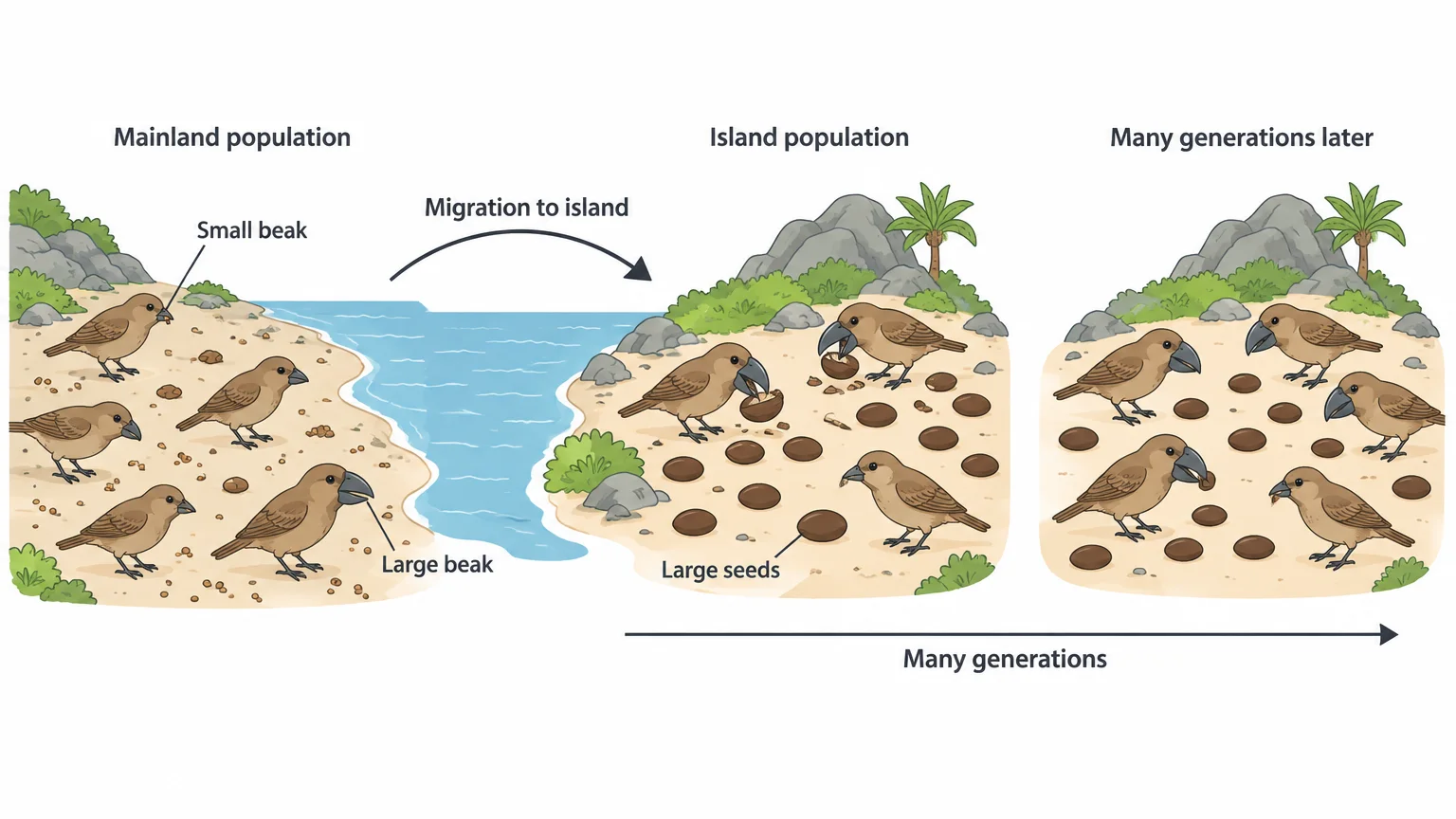
Selection removes traits as well as spreading them. A trait that lowers survival or reproduction, such as a small beak on this island, tends to disappear because its carriers leave fewer offspring. Field studies of wild finches have measured exactly this kind of shift: after a drought left mostly large, tough seeds, the next generation’s average beak size was larger.
Check yourselfAfter a year of weight training, a friend says, “I’ve evolved bigger arms.” Why isn’t that evolution in the biological sense?
Evolution is a heritable change in a population across generations, not a change in one individual’s body. The bigger muscles aren’t inherited, and no individual evolves: natural selection is the process, and evolution is its outcome in the population.
Selection you can watch: antibiotic resistance
Bacteria reproduce so quickly that natural selection shows up within a few years. An antibiotic kills bacteria or stops their growth by blocking something they need, such as building a cell wall or making proteins. A strain that the drug no longer stops is called antibiotic resistant.
Resistance arises in two ways. A new mutation can change the drug’s target protein so the antibiotic can’t bind to it. Or a bacterium can pick up a resistance gene from another bacterium by horizontal gene transfer, for instance a gene for an enzyme that breaks the drug down.
Check yourselfA farmer sprays the same insecticide on a field every year, and it kills fewer insects each year. Explain what is happening.
Natural selection. A few insects were already resistant by chance. The spray kills the others, so the resistant survivors leave most of the next generation, and resistance becomes more common every year. The spray selected the resistance; it didn’t cause it.
Practice questions
1 of 2
Natural selection acts on individuals, but which of these actually evolves?
2 of 2
Over many generations, natural selection leaves a population with inherited traits that help it survive and reproduce where it lives. What are these traits called?