Evolution in genes and chromosomes
Comparing bodies, living and fossil, reveals evolution from the outside. Reading DNA sequences shows the changes in the genetic material itself. Evolution at the level of genes, proteins, and chromosomes is molecular evolution.
Homologous genes: orthologs and paralogs
Two or more genes descended from the same ancestral gene are homologous genes. They come in two kinds, depending on whether they sit in different species or in the same one.
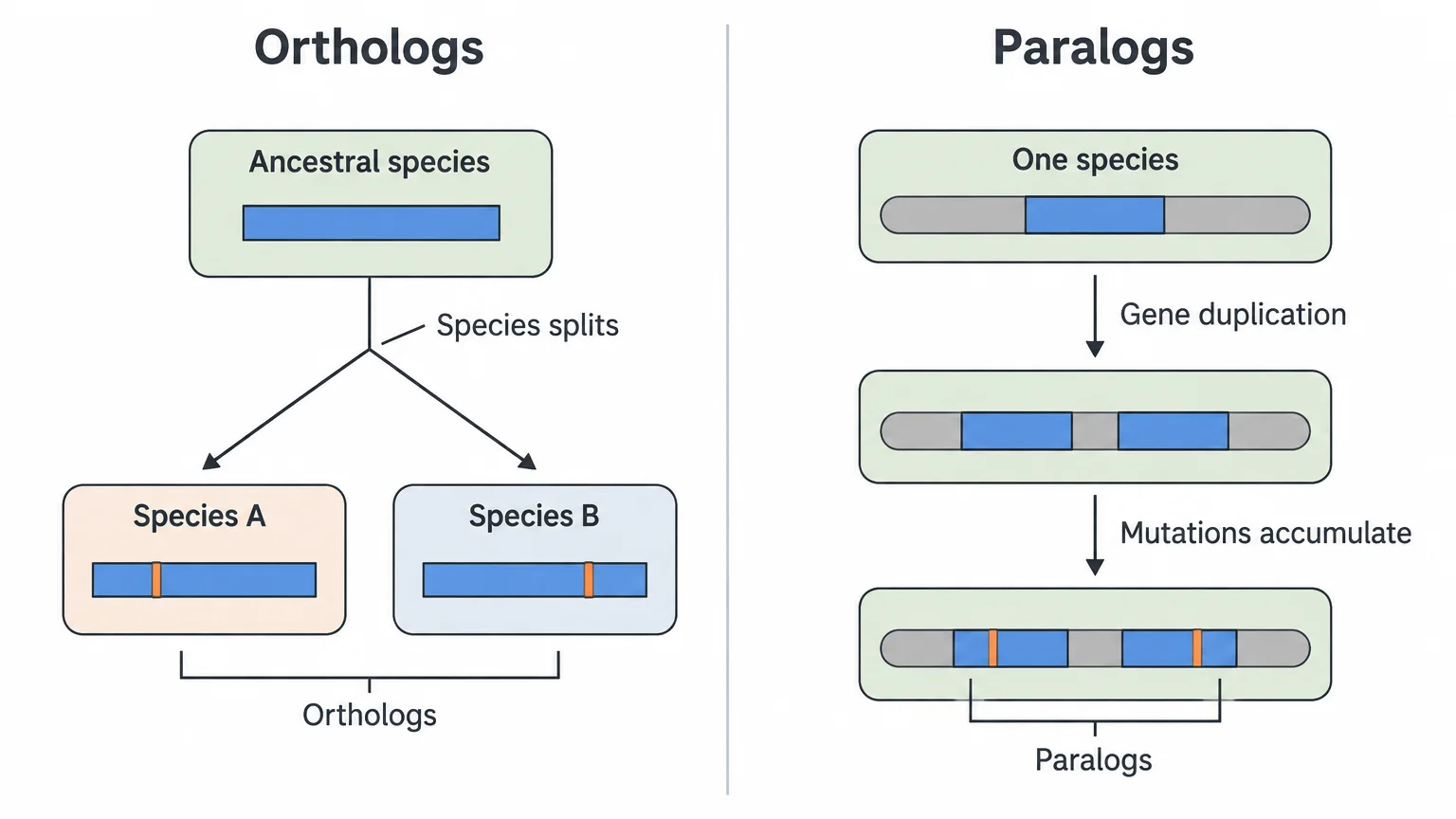
When one species splits into two, each new species inherits a copy of every gene. From then on, the copies change independently, each picking up its own random mutations. Homologous genes found in different species are orthologs. They’re similar because they came from the same ancestral gene, and they’re not identical because each lineage accumulated different mutations. For example, many bacterial species carry a gene for a protein that brings metal ions into the cell, and the versions in two distantly related species are still strikingly alike.
Within a single species, a gene is occasionally copied by mistake, so the genome ends up holding two copies. This rare event is gene duplication. Each copy can then change on its own. Homologous genes within one species are paralogs. Repeated duplications can build a gene family, a set of paralogs in the genome of a single species.
The globin gene family
Globins are the protein chains that make up hemoglobin, which carries oxygen in the blood. Humans have 14 globin genes, spread over three chromosomes, all thought to descend from a single ancestral globin gene through repeated duplications.
A gene family gives a species spare copies to work with. One copy keeps doing the original job while others accumulate changes and take on new roles. The human globin genes now differ in when they’re switched on and how their proteins behave. Some are used in the embryo, some in the fetus, and others after birth, matching the body’s oxygen needs at each stage.
That specialization supports internal gestation, the development of young inside the mother’s body. On land, eggs and small embryos easily dry out; birds and reptiles protect them with a shell, while most mammals keep them inside the body. Embryonic and fetal hemoglobins make that possible by pulling oxygen from the mother’s blood.
Check yourselfHumans and mice both have a β-globin gene. Humans also have an α-globin gene that arose from the same ancestral gene. Which pair is orthologs, and which is paralogs?
The human and mouse β-globin genes are orthologs, because they’re homologous genes in different species. The human α-globin and β-globin genes are paralogs, because they’re homologous genes in the same species, produced by gene duplication.
Vertical evolution and horizontal gene transfer
Orthologs and paralogs both arise through vertical evolution, which Chapter 1 introduced: genetic changes such as mutations and gene duplications build up in a lineage and pass from ancestors to descendants. Horizontal gene transfer adds genes from outside the lineage.
Gene sequence comparisons show that horizontal gene transfer is common and runs in every direction: among bacteria and archaea, from them to eukaryotes and back, and between eukaryotes. For example, a single-celled eukaryote that engulfs a bacterium to digest it can end up with one of the bacterium’s genes inserted into its own chromosome.
Bacteria and archaea share genes through three natural routes: conjugation (direct transfer between two cells in contact), transformation (taking up DNA from the surroundings), and transduction (a virus carrying DNA from one cell to another). Genome studies suggest that a large share of the genetic differences among bacterial species comes from horizontal gene transfer. The genes gained this way often help their new owners survive, such as genes for antibiotic resistance, for breaking down toxic compounds, or for causing disease.
Changes in chromosome structure and number
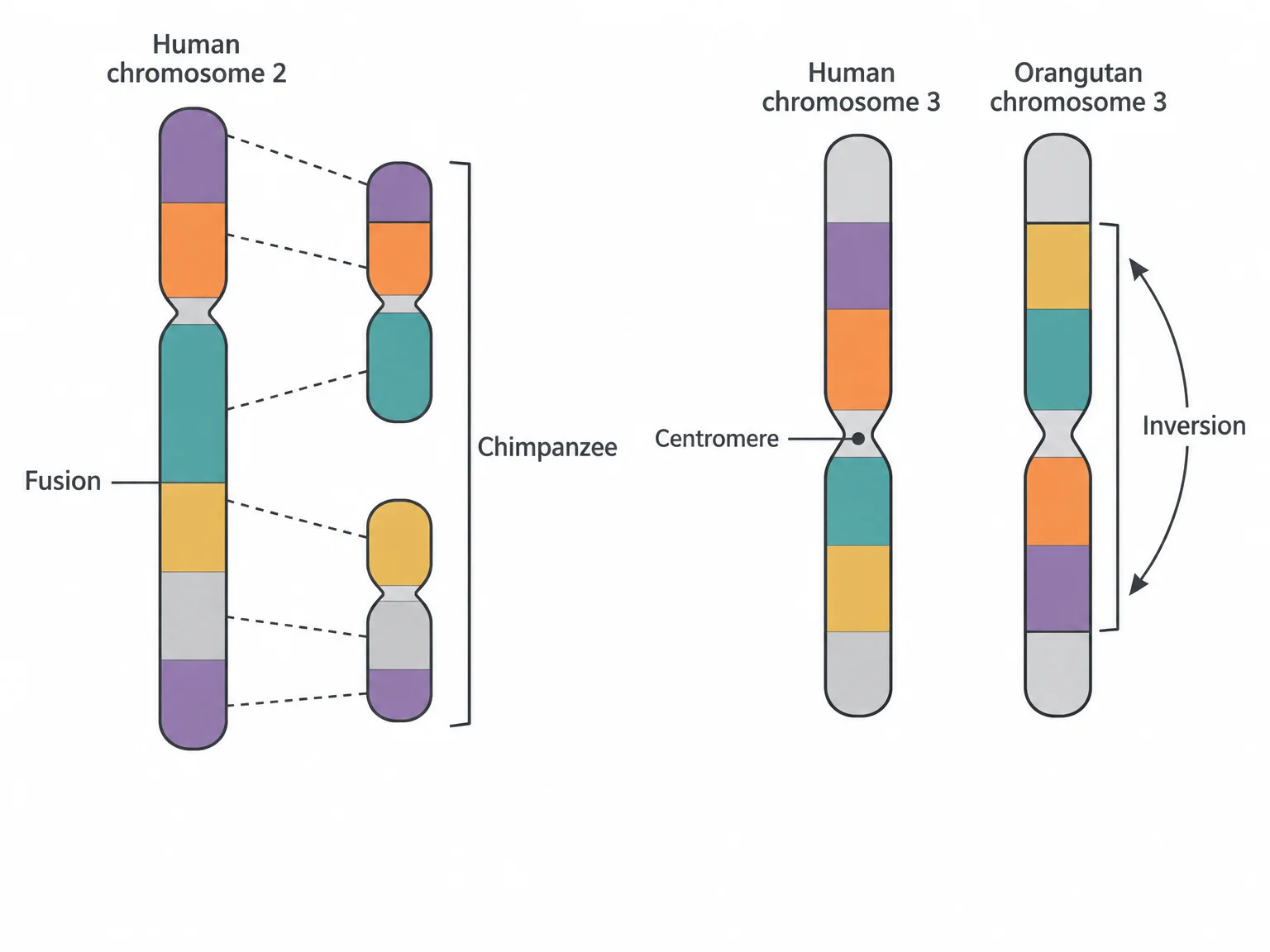
Evolution also rearranges whole chromosomes. Stained chromosomes show light and dark bands, and matching band patterns mark matching stretches of DNA. Comparing human chromosomes with those of chimpanzees, gorillas, and orangutans, our closest relatives, reveals both kinds of change:
- Number: humans have one large chromosome 2, but the other three species have two smaller chromosomes in its place. Two ancestral chromosomes likely fused in the human lineage. That’s why human cells have 23 pairs of chromosomes and the other three species have 24.
- Structure: chromosome 3 looks nearly the same in humans, chimpanzees, and gorillas, but in orangutans a large segment near the centromere is flipped end to end, an inversion like those in Chapter 16.
Changes like these can make it harder for two populations to interbreed, so they have played a part in forming new species. Together, the chapter’s molecular processes give four sources of genetic change:
| Change | What happens | Example |
|---|---|---|
| Gene mutation | A gene’s DNA sequence changes | Orthologs drifting apart in two species |
| Gene duplication | A gene is copied within a genome | The human globin gene family |
| Horizontal gene transfer | An organism gains genes from one that isn’t its parent | A bacterium gaining antibiotic resistance |
| Chromosome change | Chromosomes fuse, split, or have segments flipped | Human chromosome 2 |
Check yourselfA primate species has one fewer pair of chromosomes than its closest relative, yet the two species’ band patterns match almost completely. What change best explains this?
A chromosome fusion. Two chromosomes in the ancestor joined into one in this species’ lineage, as happened with human chromosome 2, so the same DNA is packaged into one fewer pair.
Practice questions
1 of 3
Comparing the DNA and protein sequences of many species to trace how their genes changed over time is a study of
2 of 3
Which route of gene transfer among bacteria involves taking up loose DNA from the surroundings?
3 of 3
Compared with its close relatives, one primate species has a chromosome segment whose bands run in reverse order. What kind of change is this?