Evidence from breeding and geography
A scientific theory earns its standing by explaining many independent observations. Evolution draws support from six main kinds of evidence, and exam questions often describe one of them and ask you to name it.
Six lines of evidence
| Evidence | What it shows |
|---|---|
| Studies of natural selection | Populations followed over time change as their environment changes |
| Selective breeding | People choosing which individuals breed can reshape a species’ traits |
| Biogeography | Species in isolated places evolved there from ancestors that arrived earlier |
| Convergent evolution | Unrelated species in similar environments evolve similar traits |
| Fossil record | Fossils ordered from oldest to youngest show change step by step |
| Homologies | Features inherited from a common ancestor reveal how species are related |
Studies of natural selection, like the finch and bacteria examples, show evolution as it happens. The other five come from comparing living things with each other and with the past.
Selective breeding
Chapter 1 introduced artificial selection, also called selective breeding: people choose which plants or animals become parents, based on traits they want. The only real difference from natural selection is who does the choosing. In natural selection, the environment determines which individuals reproduce most. In artificial selection, the breeder decides.
Selective breeding works only when a trait varies for genetic reasons. Usually the individuals carry different alleles of the genes behind the trait. A breeder who keeps choosing parents with a desirable allele makes that allele more common in each generation.
Dogs show how far this can go. A greyhound, a dachshund, and a bulldog hardly look like the same kind of animal, yet all dogs belong to one species and can interbreed. They carry the same genes; they differ in which alleles of those genes they carry. Body size, for example, depends heavily on which allele of a growth hormone gene a dog has.
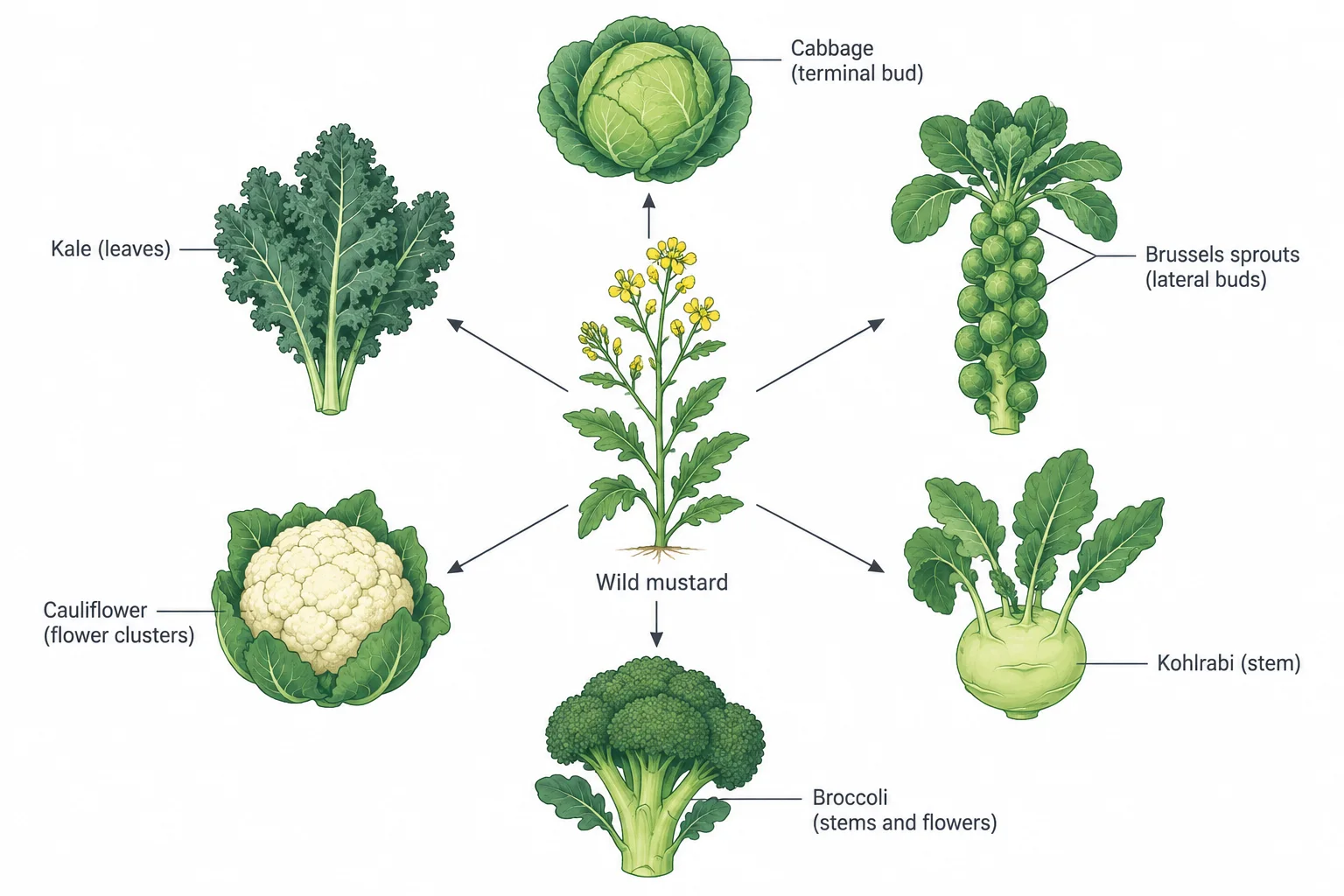
Crops tell the same story. Broccoli, Brussels sprouts, cabbage, cauliflower, kale, and kohlrabi are all one species, bred over thousands of years from wild mustard. They can still interbreed: broccoflower is a cross between broccoli and cauliflower.
Check yourselfA gardener saves seeds only from her sweetest tomatoes each year, and after a decade her tomatoes are much sweeter. Which kind of evidence for evolution does this resemble, and what made it possible?
Selective breeding. It worked because sweetness varied among the plants for genetic reasons, so choosing the sweetest plants as parents made the alleles for sweetness more common.
Biogeography
The study of where living and extinct species are found on Earth is biogeography. Its main lesson is that isolated islands and continents have evolved their own distinct communities of plants and animals.
Islands are full of endemic species, ones found naturally in only one place. An endemic island species usually has close relatives on nearby islands or the nearest mainland, because its ancestors came from there and then evolved in isolation.
For example, near the end of the last Ice Age, gray foxes could reach a group of islands off the California coast. When the ice melted and sea levels rose, the island population was cut off. Over about 16,000 years, natural selection on the islands turned it into a separate species of fox, much smaller than its mainland relative and found nowhere else.
Large animals stranded on islands often shrink this way, a pattern called island dwarfing. Smaller bodies likely win out where food and other resources are limited.
Isolated continents
The same pattern holds for whole continents. Australia separated from the other continents early in the history of mammals. Placental mammals, the group whose young develop inside the mother through a long pregnancy and are born well developed, arose afterward somewhere else. The ocean kept most land-dwelling placental mammals from ever reaching Australia, so none of the larger ones are native there.
Instead, Australia has more than 100 species of marsupials, such as kangaroos and koalas. Marsupial young are born very immature and finish developing in a pouch on the mother’s belly. Most of these species live nowhere else, because they evolved in isolation from the rest of the world for millions of years.
Check yourselfWhy does Australia have many native marsupials but no large native land-dwelling placental mammals?
Australia was cut off by ocean before placental mammals arose elsewhere, so they couldn’t migrate there. The marsupials already in Australia evolved in isolation into many species found nowhere else.
Practice questions
1 of 2
Why does Australia have no large native land-dwelling placental mammals?
2 of 2
Large animals stranded on islands often become much smaller over many generations. What most likely drives this?