Convergent evolution and the fossil record
Two more lines of evidence come from comparing body forms: across unrelated species alive today, and across fossils of different ages.
Unrelated species, similar solutions
A hummingbird and a hummingbird moth both hover beside flowers on rapidly beating wings, sipping nectar through a long, thin tube: the bird’s beak and the moth’s mouthpart, its proboscis. Yet one is a vertebrate and the other an insect. They aren’t close relatives. Each evolved these features on its own because both make a living the same way.
When species from different lineages independently evolve similar characteristics because they occupy similar environments, that’s convergent evolution. The similar features it produces are called convergent traits, or analogous structures.
Convergence happens at the molecular level too. Some fishes in icy Arctic and Antarctic seas make antifreeze proteins that stop ice crystals from forming in their body fluids. Different fish species make these proteins from entirely different genes, and the proteins differ in their amino acids and shape: one is built mostly of β pleated sheet, another mostly of α helices. The same problem was solved more than once.
Check yourselfSharks are fish and dolphins are mammals, yet both have streamlined bodies and fins. Does this similarity show they are close relatives?
No. Sharks and dolphins come from different lineages and evolved their body shapes independently because both swim fast in open water. This is convergent evolution, and the shapes are analogous structures.
Fossils show change in sequence
The fossil record is far from complete, but it holds the remains of countless past organisms. Arrange fossils of related organisms from oldest to youngest, and you can follow change happening one step at a time.
The most telling fossils are transitional forms: organisms intermediate between an ancestral form and its descendants, with a mix of old and new features.
One transitional form links fishes to tetrapods, the four-limbed vertebrates. This fossil, nicknamed the fishapod, had fins like a fish. But it also had a broad skull with eyes on top like a crocodile’s, a flexible neck, ribs suggesting simple lungs, and fin bones containing the beginnings of a wrist and five finger-like bones. It could likely prop itself up in shallow water and lift its head above the surface, and perhaps leave the water for short periods. Early tetrapods later gave rise to amphibians, to birds and reptiles, and to mammals.
From land mammals to whales
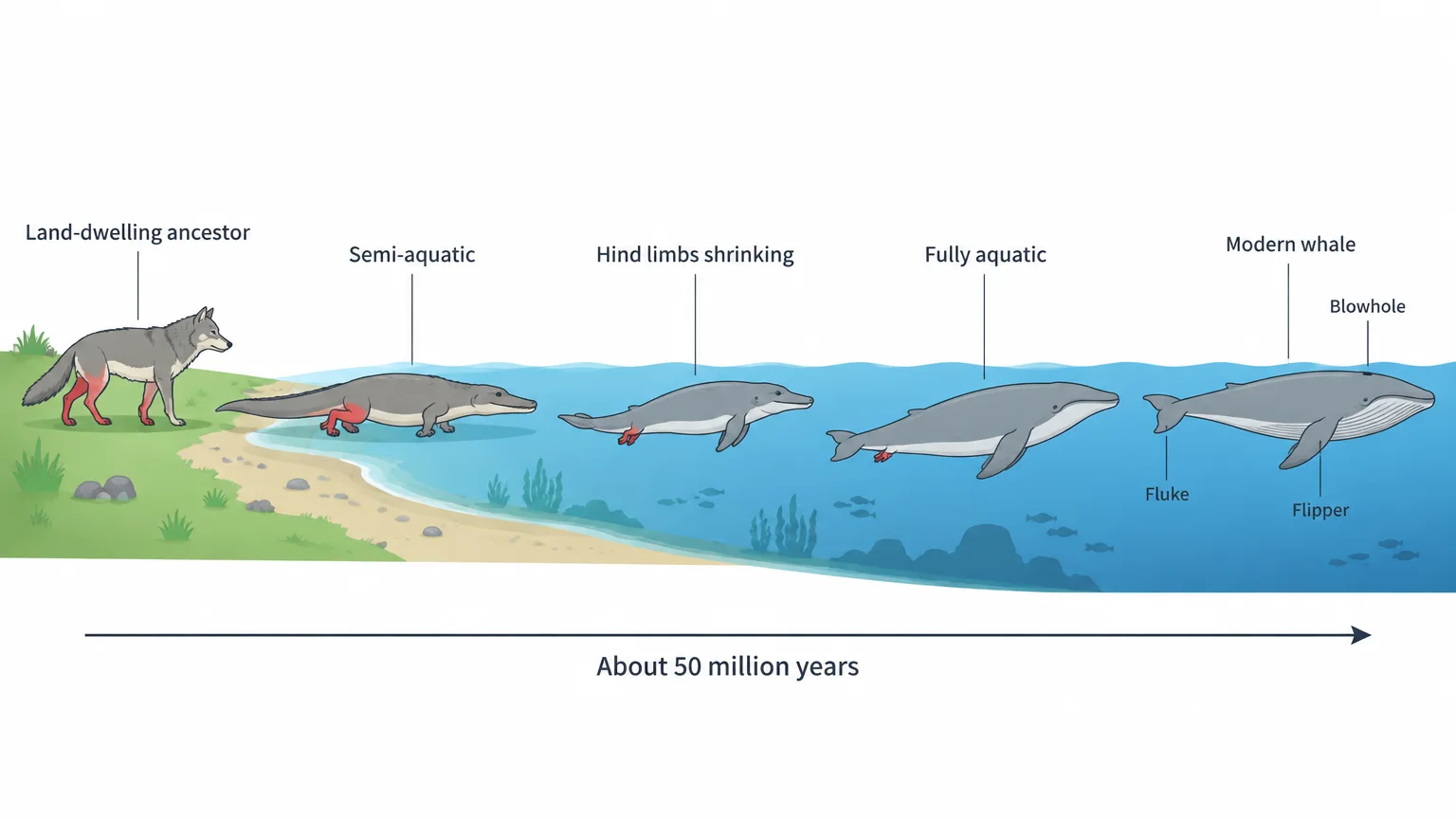
Whales, dolphins, and porpoises descend from four-legged land mammals, and their closest living relatives are hippos. Fossils spanning about 50 million years record the change from land to sea:
- The earliest known whales were wolflike meat-eaters that spent some time in fresh water. They already had a thick, bony wall around the middle ear, a feature found only in whales.
- Later species were semi-aquatic, with short, powerful legs and a large, muscular tail probably used for swimming.
- In still later species, the eyes sat on the sides of the head, the nostrils had begun moving back from the tip of the snout, and the hind limbs were shrinking.
- Fully aquatic whales followed, with flippers for forelimbs, tiny hind limbs, a tail fluke, and nostrils moved back to form a blowhole.
- Modern whales, dolphins, and porpoises have no hind limbs at all as adults.
Check yourselfA fossil animal has fins but also a neck and wrist-like bones in its front fins. What kind of fossil is this, and what does it suggest?
It’s a transitional form. Its mix of fish and four-limbed features suggests that land-dwelling tetrapods evolved from fishes in a series of steps.
Practice questions
1 of 2
Two unrelated fishes in icy seas each make an antifreeze protein, but from entirely different genes. This is an example of
2 of 2
What do fossils of related organisms reveal when they are arranged from oldest to youngest?