Homologies and vestigial structures
Convergent traits look alike because unrelated species solved the same problem. The opposite case is just as revealing: features that may look different on the surface but share a deeper plan, because they were inherited from a common ancestor.
Three kinds of homology
A similarity that exists because two species descend from a common ancestor is a homology. Biologists find homologies at three levels:
| Homology | What’s shared | Example |
|---|---|---|
| Anatomical | Body structures built on the same plan | The same forelimb bones in humans, bats, and whales |
| Developmental | Features of early embryos, often lost later | Gill ridges and a tail in human embryos |
| Molecular | Genes and protein sequences | The same glycolysis gene in bacteria, plants, and animals |
Homologous structures
Compare the forelimbs of a human, a turtle, a bat, and a whale. The arm grasps, the turtle’s limb walks and swims, the wing flies, and the flipper steers through water. Yet each is built from the same set of bones: one upper arm bone, two forearm bones, a group of wrist bones, and the bones of the hand and fingers. Only their sizes and shapes differ.
Structures that are similar because they derive from a structure in a common ancestor are homologous structures. Natural selection modified the ancestor’s limb bones in different ways in each lineage, suiting them to different functions.
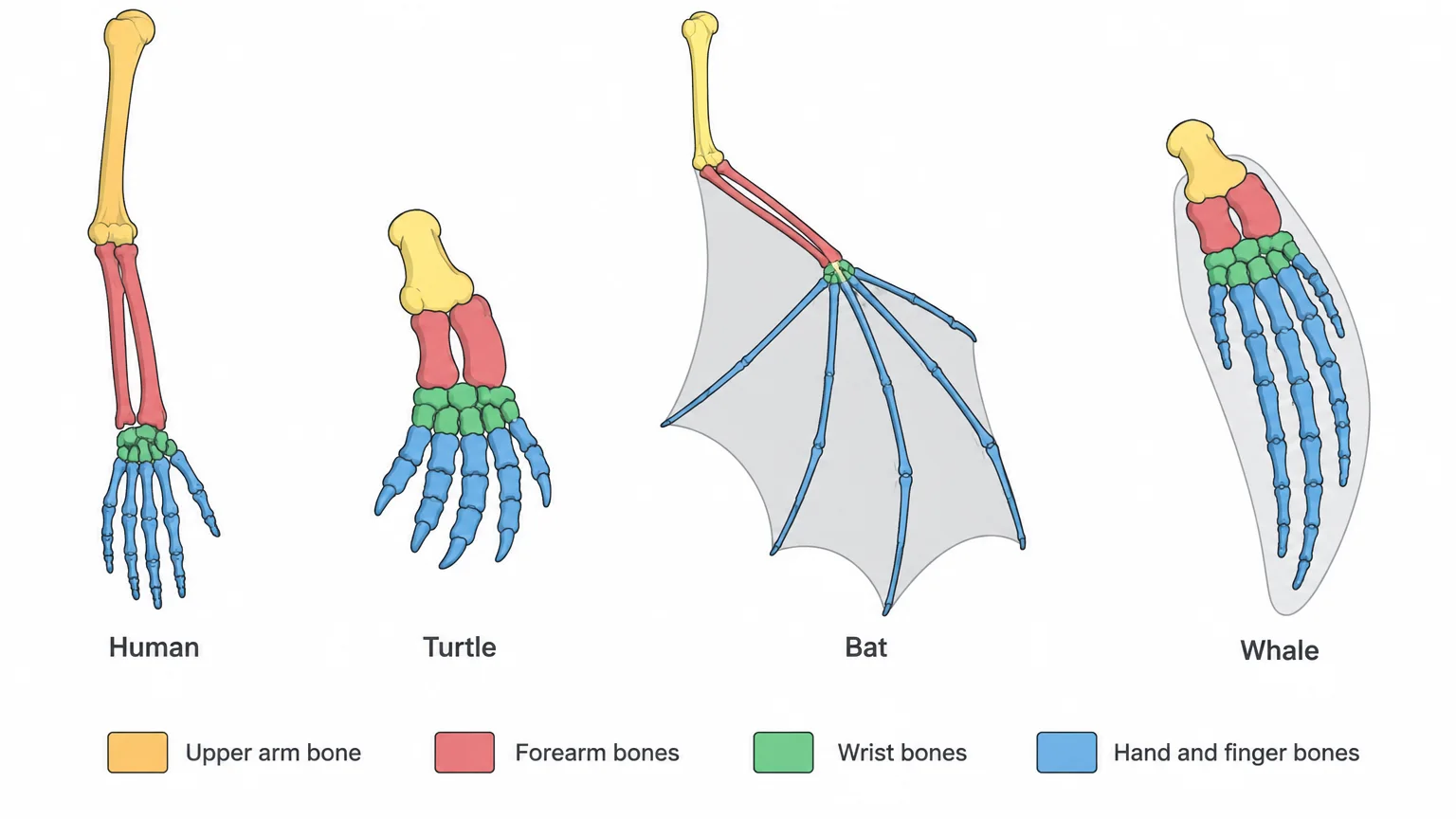
A single structure can be both, depending on what you compare. Bird wings and bat wings are homologous as forelimbs, since both groups inherited forelimbs from a shared four-limbed ancestor. As wings, though, they’re analogous, because flight evolved separately in birds and in bats.
Check yourselfWhich pair is homologous and which is analogous: (a) a cat’s front leg and a seal’s flipper; (b) a butterfly’s wing and a sparrow’s wing?
(a) is homologous: both are mammal forelimbs built from the same bones inherited from a common ancestor. (b) is analogous: insect and bird wings evolved independently, with no shared ancestral wing, because both animals fly.
Vestigial structures
Some features linger after they’ve stopped being useful. Vestigial structures are anatomical features whose function is reduced or absent but that resemble functional structures in the species’ ancestors. Examples include:
- Humans: a full set of muscles for moving the ears, which most people can’t use, and a bony tail in the embryo
- Snakes such as boa constrictors: remnants of hip and hind leg bones
- Whales: remnants of a pelvis
- Manatees: fingernails on their flippers
Why would a species keep a useless part? Natural selection normally keeps a structure in working order, because individuals with a poorly built version fare worse.
When a change in lifestyle makes the structure useless, that pressure disappears. Mutations that shrink or distort it are no longer weeded out, so the structure dwindles over many generations. Selection may even favor losing it, since building an unused part wastes energy.
Check yourselfFish that live in totally dark caves often have small, nonfunctional eyes, though their relatives in sunlit streams see well. Explain this using natural selection.
In darkness, eyes no longer help the fish survive, so selection stops keeping them functional. Mutations that shrink the eyes accumulate, and saving the energy of building eyes may even be favored. The leftover eyes are vestigial structures.
Developmental homologies
Species that look very different as adults often look alike as early embryos. These shared embryonic features are developmental homologies.
Human embryos briefly have gill ridges like a fish embryo’s, even though they get oxygen through the umbilical cord. They also have a bony tail. Both make sense if humans descend from aquatic ancestors with gill slits, and from ancestors with tails. Similarly, some snakes grow hind limb buds as early embryos and lose them before hatching, a sign that snakes evolved from ancestors with legs.
Molecular homologies
Similarities in genes and proteins that come from common ancestry are molecular homologies. They show two patterns:
- The same gene turns up in very different organisms. For example, the gene for the enzyme that runs the first step of glycolysis is found in bacteria, archaea, fungi, protists, plants, and animals. All of them inherited it from a very ancient common ancestor.
- The more closely related two species are, the more similar their versions of a gene are. That glycolysis gene is more alike in two plant species than in a plant and an animal.
The p53 protein, which helps prevent cancer, shows the second pattern clearly. Compared with the human version, the p53 of monkeys is the most similar, followed by that of other mammals such as rabbits and dogs. The fish versions are the least similar to ours, but they closely resemble each other.
Check yourselfThe same ribosome protein gene is sequenced in a house cat, a lion, a frog, a trout, and a mushroom. Which species’ gene should match the house cat’s most closely, and why?
The lion’s. Both are cats, so they share the most recent common ancestor, and their genes have had the least time to accumulate different mutations.
Practice questions
1 of 2
A stretch of one protein is compared with a fox’s version. Species W differs at 2 amino acids, species X at 8, species Y at 17, and species Z at 30. Which species is most closely related to the fox?
2 of 2
Which pair of structures is homologous?