Strands and the double helix
Nucleotides on their own carry no message. Information appears when they are linked into a chain, and the chain pairs with a partner to form DNA’s famous twisted ladder.
Linking nucleotides into a strand
A strand is a chain of nucleotides joined one after another by covalent bonds. The link runs through the phosphate: each phosphate is bonded to the sugar of one nucleotide and to the sugar of the next.
A bond between a phosphate and another molecule, such as a sugar, is a phosphoester bond. Each phosphate in a strand forms two of them, one to each neighboring sugar, so the connection is called a phosphodiester linkage (di- means two).
The alternating sugars and phosphates form the strand’s backbone, also called the sugar-phosphate backbone. The bases stick out to the side of the backbone. Because every phosphate carries a negative charge, the whole backbone is negatively charged.
Every strand has a direction
Each phosphate links the 5′ carbon of one sugar to the 3′ carbon of the next. As a result, every sugar in a strand faces the same way, and the strand has a front and a back. This property is its directionality.
The two ends are chemically different:
- The 5′ end has a free phosphate group.
- The 3′ end has a free hydroxyl group (–OH) on the 3′ carbon.
A sequence is written with its direction shown, such as 5′–GATC–3′. Read it as “the strand runs from its 5′ end to its 3′ end.”
The sequence is the message
What makes one strand different from another is the order of its bases, its sequence. Because the nucleotides are held together by stable covalent bonds, the sequence stays the same over time, except in the rare event of a mutation (a change in the sequence). This stable, specific sequence is what lets DNA store information, much as the order of letters on this page stores meaning.
Two strands make a double helix
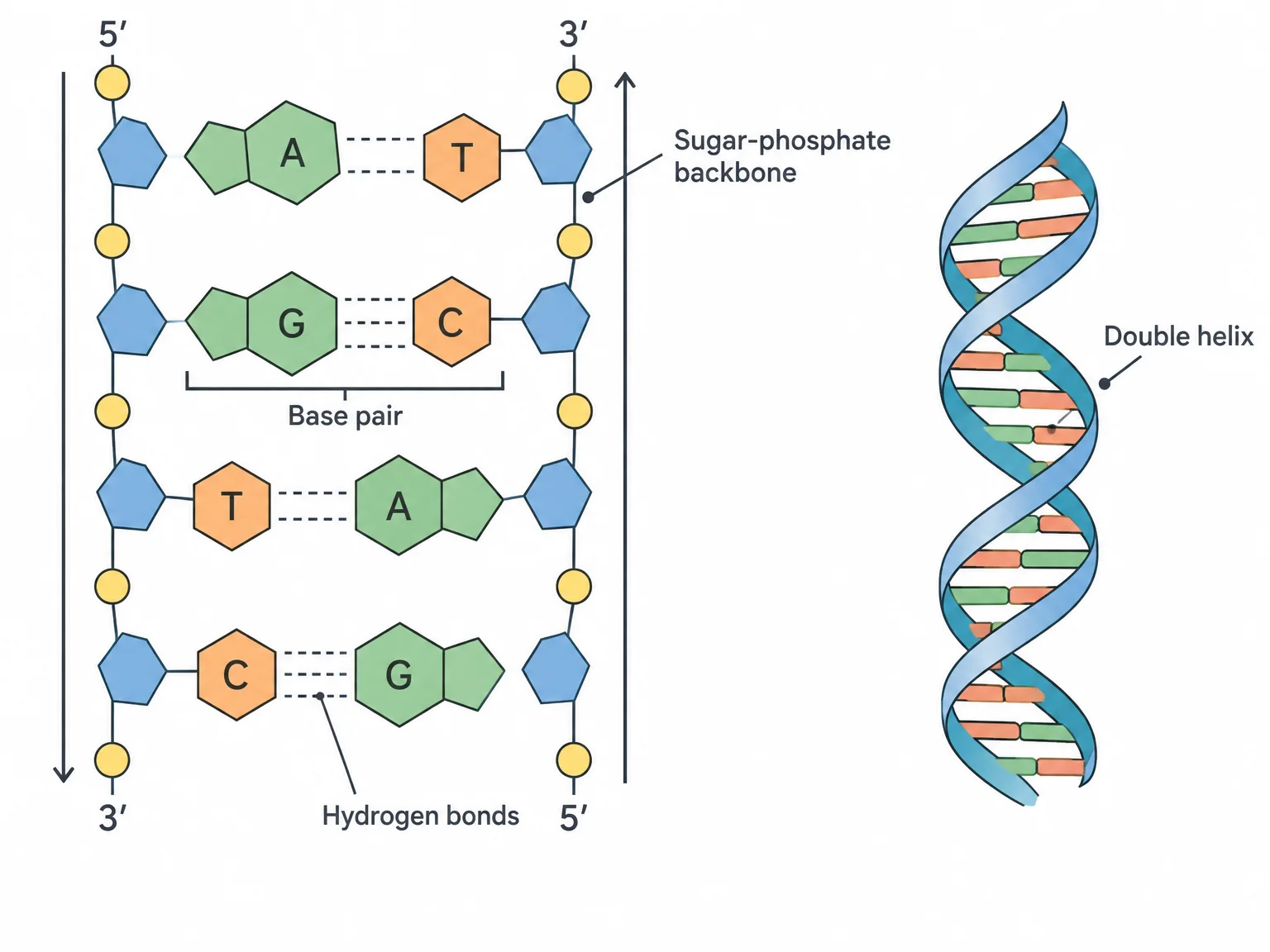
DNA has two strands wound around each other in a double helix. The sugar-phosphate backbones run along the outside, and the bases point inward, where each pairs with a base on the opposite strand. These base pairs are held together by hydrogen bonds, weak attractions that are easy to break one at a time but strong in large numbers.
Pairing is strict:
- A pairs with T, joined by two hydrogen bonds.
- G pairs with C, joined by three hydrogen bonds.
This is the AT/GC rule. Every pair joins a two-ring purine (A or G) to a one-ring pyrimidine (T or C), so every rung of the ladder has the same width. That keeps the helix a uniform thickness. One complete turn is 3.4 nm long and contains about 10 base pairs.
Complementary and antiparallel
Because of the AT/GC rule, the two strands are complementary: knowing the sequence of one tells you the sequence of the other.
The strands also run in opposite directions. Where one strand runs 5′ to 3′ from top to bottom, its partner runs 3′ to 5′ from top to bottom. Strands arranged this way are antiparallel, like the two lanes of a two-way street.
Grooves on the surface
Different models of DNA highlight different features. A ribbon model shows the parts clearly. A space-filling model, which draws every atom as a ball, shows the molecule’s surface.
In a space-filling model, the backbone forms the outer surface and has the most contact with surrounding water. The bases lie deeper inside. Where the edges of the bases are exposed to water, the surface dips into spiral channels called grooves. There are two: a wide major groove and a narrow minor groove.
Check yourselfOne DNA strand reads 5′–GATTACA–3′. What is the sequence of the complementary strand, with its ends labeled?
3′–CTAATGT–5′. Each A pairs with T and each G with C, and because the strands are antiparallel, the partner’s 3′ end lines up with the first strand’s 5′ end. Written 5′ to 3′, it is 5′–TGTAATC–3′.
Practice questions
1 of 2
What makes up the backbone of a single DNA strand?
2 of 2
Which base pair is held together by three hydrogen bonds?