Opening the fork and building DNA
The AT/GC rule explains what gets built during replication. Inside a real cell, a team of proteins does the building: some open the helix, some hold it open, and one adds the nucleotides.
Replication starts at origins
Replication doesn’t begin just anywhere. It starts at specific sites on a chromosome called origins of replication. There, the two strands come apart and form an opening called a replication bubble.
Each bubble has a replication fork at both ends, and the two forks move away from each other, copying DNA as they go. Copying in both directions from one origin is bidirectional replication.
How many origins a chromosome has depends on the organism:
| Bacteria | Eukaryotes | |
|---|---|---|
| Chromosome shape | Small and circular | Large and linear |
| Origins per chromosome | One | Many |
| How replication ends | The two forks meet on the opposite side of the circle | Forks from neighboring origins meet each other |
Eukaryotic chromosomes are so long that copying from a single origin would take far too long. Many origins working at once let the whole chromosome finish in a reasonable time.
Opening and holding the fork
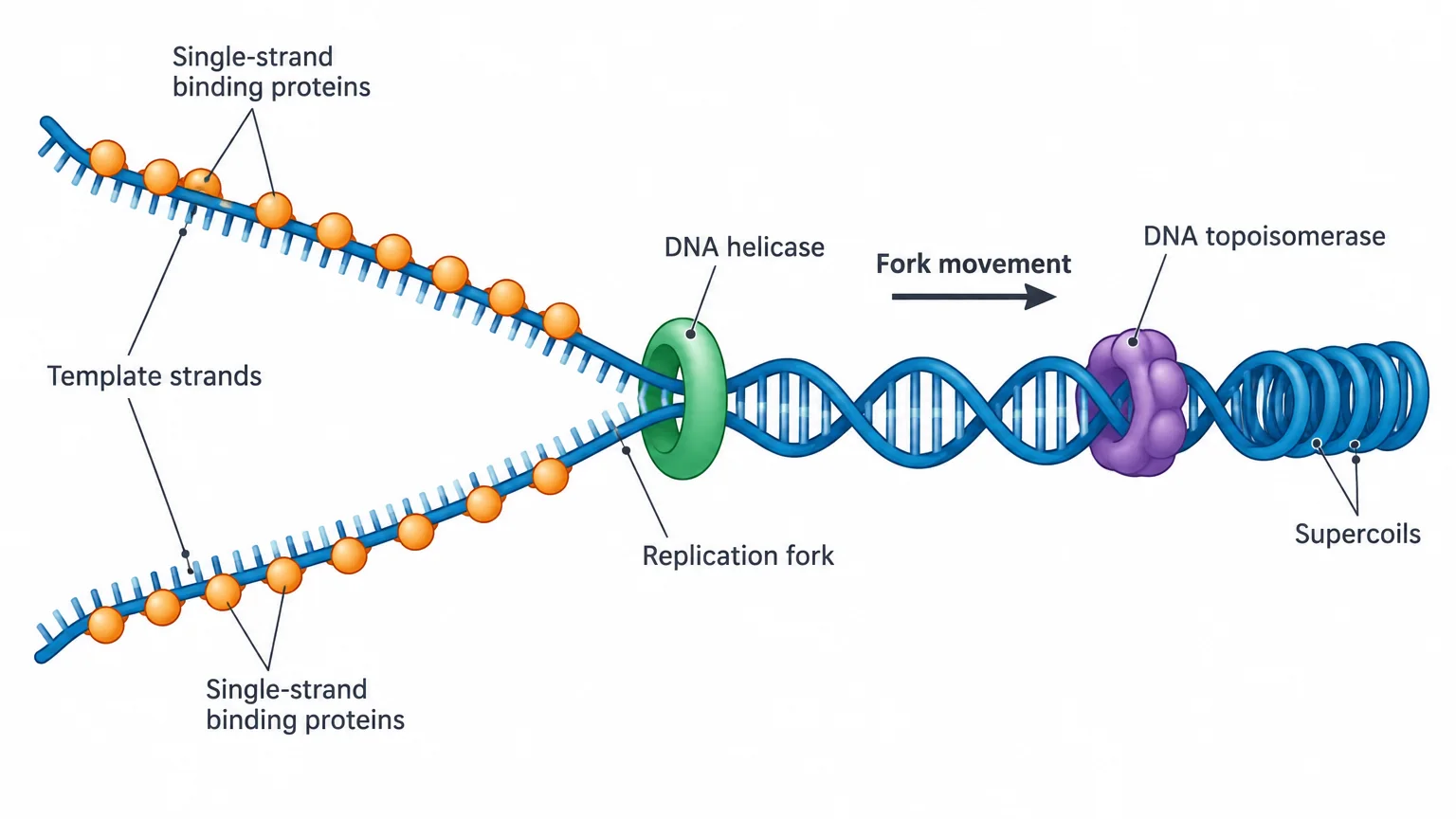
To be copied, the strands must be pulled apart, kept apart, and untangled. Three proteins handle this:
- DNA helicase separates the strands. It travels along one strand in the 5′ to 3′ direction, toward the fork, and uses energy from ATP to break the hydrogen bonds between base pairs, pushing the fork forward.
- DNA topoisomerase relieves twisting. Unwinding the helix makes the DNA just ahead of the fork wind tighter, forming knots called supercoils. Topoisomerase removes them. (In bacteria it’s also called DNA gyrase.)
- Single-strand binding proteins coat the separated strands so they can’t snap back together, leaving their bases exposed to serve as templates.
DNA polymerase builds the new strand
The enzyme that links nucleotides into a new DNA strand is DNA polymerase. It slides along the template strand like a hand gripping a rope.
The raw materials arrive as deoxynucleoside triphosphates (dNTPs): DNA nucleotides carrying three phosphate groups instead of one. Each dNTP pairs with the template by the AT/GC rule. DNA polymerase then snaps off two of its phosphates, released together as pyrophosphate, and bonds the remaining nucleotide to the 3′ end of the growing strand. The new bond forms between the incoming phosphate and the oxygen of the –OH group on the previous sugar’s 3′ carbon.
Breaking off the pyrophosphate releases energy, and that energy pays for the new bond. The pyrophosphate is then split into two separate phosphates.
DNA polymerase is fast: about 500 nucleotides per second in bacteria and about 50 per second in eukaryotes.
Two limits of DNA polymerase
DNA polymerase has two quirks that shape everything about how replication works.
It can’t start a strand from scratch. It can only add nucleotides to a strand that is already paired with the template. Something else must lay down a starter. That job belongs to DNA primase, which makes a short RNA strand, typically 10 to 12 nucleotides long, called a primer. DNA polymerase then extends the primer with DNA.
It builds in only one direction. DNA polymerase can add nucleotides only to the 3′ end of a strand, so a new strand always grows in the 5′ to 3′ direction. Because the template is antiparallel to the new strand, the polymerase reads the template in the 3′ to 5′ direction.
Check yourselfWhy does a human chromosome need many origins of replication when a bacterial chromosome needs only one?
Eukaryotic chromosomes are linear and far larger than the small circular chromosome of a bacterium, and eukaryotic DNA polymerase is also slower. Starting replication at many origins at once lets the whole chromosome be copied in a reasonable amount of time.
Practice questions
1 of 3
Replication starts at specific sites on a chromosome where the two strands first come apart and form a bubble. What are these sites called?
2 of 3
Why does a eukaryotic chromosome have many origins of replication, while a bacterial chromosome has just one?
3 of 3
Once the two template strands are separated, what keeps them from pairing back up into a double helix?