Semiconservative replication
As soon as Watson and Crick saw that the two strands of DNA are complementary, they saw how DNA could be copied: pull the strands apart and use each one as a pattern for building a new partner. Testing that idea took one of biology’s most elegant experiments.
Three ways DNA might be copied
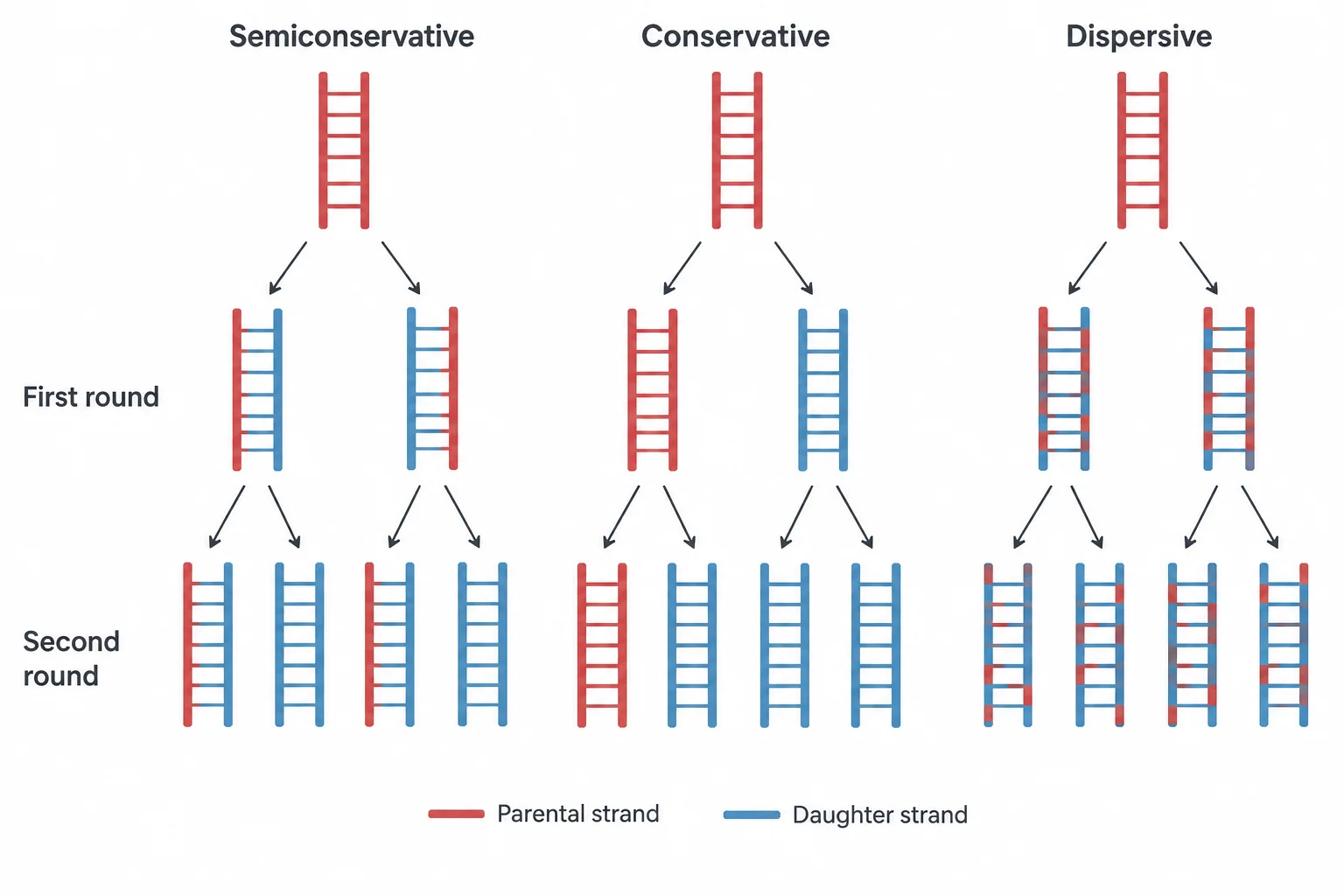
When a double helix is copied, the original strands are the parental strands and the newly made ones are the daughter strands. In the late 1950s, three models were on the table for how they end up arranged:
| Model | After one round of copying |
|---|---|
| Semiconservative | Each new double helix has one parental strand and one daughter strand |
| Conservative | One double helix has both parental strands; the other has two new daughter strands |
| Dispersive | Every strand is a patchwork of old and new segments |
Watson and Crick’s proposal was the semiconservative one: half of each original molecule is kept (“conserved”) in each copy.
The Meselson–Stahl experiment
In 1958, Matthew Meselson and Franklin Stahl found a way to tell old DNA from new DNA by weight. Nitrogen, an element in every DNA base, comes in two isotopes (forms of an element that differ in mass): common, light ¹⁴N and rare, heavy ¹⁵N. DNA built with ¹⁵N is slightly denser than DNA built with ¹⁴N.
- Grow the bacterium E. coli for many generations on food containing only ¹⁵N, so all of its DNA is heavy.
- Move the bacteria to food containing only ¹⁴N. Any strand made from now on is light, while the original strands stay heavy.
- Collect samples after one round of cell division (one round of DNA replication), after two rounds, and so on.
- Spin each DNA sample at high speed in a tube of cesium chloride, a salt that forms a density gradient (denser toward the bottom). Each DNA molecule settles where its density matches the salt’s.
- Locate the DNA bands with UV light. Heavy DNA settles low, light DNA settles high, and half-heavy DNA (one heavy strand, one light) settles in the middle.
Reading the results
| Model | Predicted after 1 round | Predicted after 2 rounds |
|---|---|---|
| Semiconservative | One half-heavy band | Half-heavy band + light band |
| Conservative | Heavy band + light band | Heavy band + light band |
| Dispersive | One half-heavy band | One band, ¼ heavy |
| Observed | One half-heavy band | Half-heavy band + light band |
After one round, all the DNA was half-heavy. That ruled out the conservative model, which predicts a fully heavy band. After two rounds, there were two bands, half-heavy and light. That ruled out the dispersive model, which predicts a single band. Only the semiconservative model matched both results.
Copying by the AT/GC rule
Replication relies on complementary pairing. The two parental strands separate, and each serves as a template strand, a pattern for building a new daughter strand. The spot where the helix is opening up is the replication fork.
At the fork, free nucleotides line up along each template strand by the AT/GC rule: A across from T, G across from C. Then a covalent bond joins the phosphate of each new nucleotide to the sugar of the previous one, extending the daughter strand.
The result is two double helices with exactly the same base sequence as the original. That is how DNA preserves its information through each copy. Notice the core idea of structure and function at work: being double-stranded and following the AT/GC rule is precisely what makes accurate copying possible.
Check yourselfIn the Meselson–Stahl experiment, what would you expect after three rounds of replication in ¹⁴N?
Practice questions
1 of 2
Why does each new double helix produced by replication have the same base sequence as the original?
2 of 2
According to the semiconservative model, what does each new double helix contain after one round of replication?