Nucleotides: the building blocks
Once DNA was known to be the genetic material, the next question was how its structure lets it store information and get copied. In biology, structure explains function, so the answer starts with the small parts DNA is made of.
DNA and RNA are nucleic acids
DNA (deoxyribonucleic acid) and its close relative RNA (ribonucleic acid) are both nucleic acids: long chains, or polymers, built from repeating units called nucleotides. Nucleic acids store, use, and pass on genetic information.
The name comes from two facts. DNA was first found in cell nuclei, and these molecules are acids: in water they release hydrogen ions (H⁺) and carry a negative charge.
Five levels of DNA structure
DNA is easiest to understand if you build it up in layers, each made from the one before.
| Level | What it is |
|---|---|
| 1. Nucleotide | A single building block |
| 2. Strand | A chain of nucleotides joined by covalent bonds (strong bonds in which atoms share electrons) |
| 3. Double helix | Two strands held together by hydrogen bonds and twisted around each other like a spiral staircase |
| 4. Chromosome | A double helix packed together with many proteins into a compact structure |
| 5. Genome | All of an organism’s genetic material |
Most bacteria have a genome made of one circular chromosome. A eukaryotic cell (a cell with a nucleus, like yours) has DNA in its nucleus, and also in its mitochondria and, in plants, its chloroplasts. Levels 1 to 3 come first; chromosomes appear at the end of the chapter.
The three parts of a nucleotide
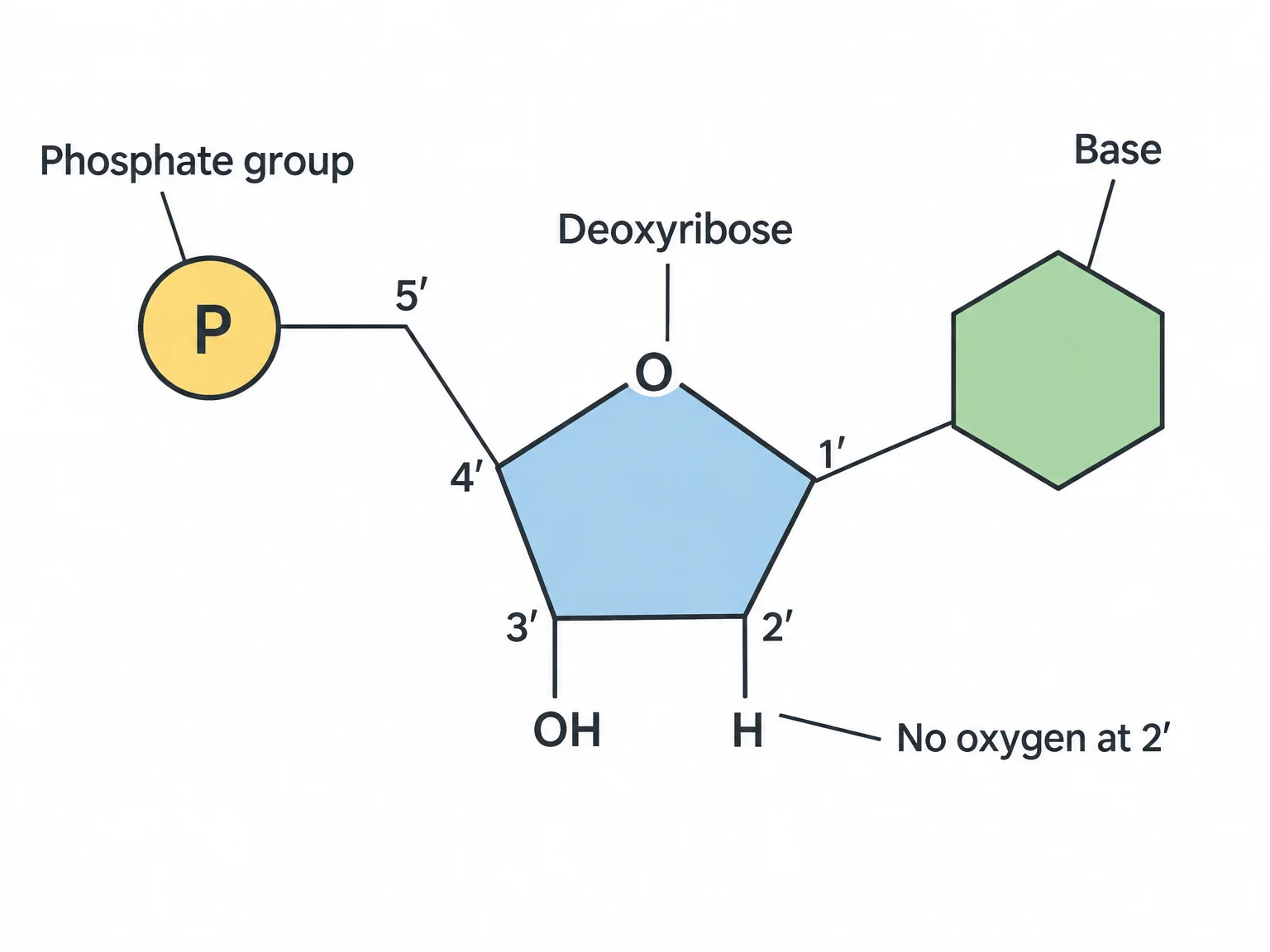
Every nucleotide has the same three parts:
- A phosphate group, a phosphorus atom surrounded by oxygen atoms.
- A pentose, a sugar with five carbon atoms.
- A nitrogen-containing base, a ring-shaped molecule made of carbon and nitrogen atoms.
Purines and pyrimidines
Five different bases occur in nucleotides, though each nucleotide carries only one. They fall into two groups by shape. Purines are bigger, with two fused rings. Pyrimidines are smaller, with a single ring.
| Base | Letter | Group | Rings | Found in |
|---|---|---|---|---|
| Adenine | A | Purine | Double | DNA and RNA |
| Guanine | G | Purine | Double | DNA and RNA |
| Cytosine | C | Pyrimidine | Single | DNA and RNA |
| Thymine | T | Pyrimidine | Single | DNA only |
| Uracil | U | Pyrimidine | Single | RNA only |
So DNA uses A, G, C, and T, while RNA uses A, G, C, and U. Thymine and uracil are the swap. Since three bases are shared, the one part that always differs between a DNA nucleotide and an RNA nucleotide is the sugar.
Numbering the atoms
To describe how nucleotides connect, biologists number the atoms in each nucleotide. The carbons in the sugar get a prime mark (′) so they can’t be confused with atoms in the base, which are numbered without one.
The sugar carbons are 1′ (“one prime”) through 5′. Counting starts at the carbon just to the right of the oxygen atom in the sugar’s ring and goes clockwise. The 5′ carbon sticks out of the ring. Two attachment points are worth memorizing:
- The base attaches to the 1′ carbon.
- The phosphate group attaches to the 5′ carbon.
The 3′ carbon matters too, because that is where the next nucleotide will connect. Its role comes up in the next segment.
What “deoxy” means
Ribose and deoxyribose differ by a single oxygen atom. Ribose has a hydroxyl group (–OH) on its 2′ carbon. Deoxyribose has only a hydrogen there. The prefix deoxy- means “without oxygen,” so deoxyribose is simply ribose missing the oxygen at 2′.
Practice questions
1 of 2
Which list orders the levels of DNA structure from smallest to largest?
2 of 2
Which base is found in RNA nucleotides but never in DNA?