What evolution is
All living things share a common set of features, yet they differ enormously in form and way of life. Evolution explains both facts, and underneath it is a story of changes in inherited instructions.
A change in a population over generations
The inherited traits of a population shift over time, with some becoming more common and others rarer. A heritable change in a population of organisms from one generation to the next is biological evolution, or simply evolution. Heritable means the change can be passed from parents to offspring.
Notice that evolution describes populations, not individuals. A single animal doesn’t evolve during its lifetime; what changes is the makeup of the population across generations.
Life on Earth began as simple cells about 3.5 to 4 billion years ago. Every species alive today descends from populations that came before it, so all modern life is connected by a shared evolutionary history.
Unity and diversity
Evolution accounts for two big patterns in the living world:
- Unity: all modern species descend from related ancestors, so they share many features inherited from those ancestors.
- Diversity: Earth’s environments range from tropical rain forests and salty oceans to hot deserts and cold mountaintops. Populations have evolved in ways that help them thrive in their own environments, so species have become very different from one another.
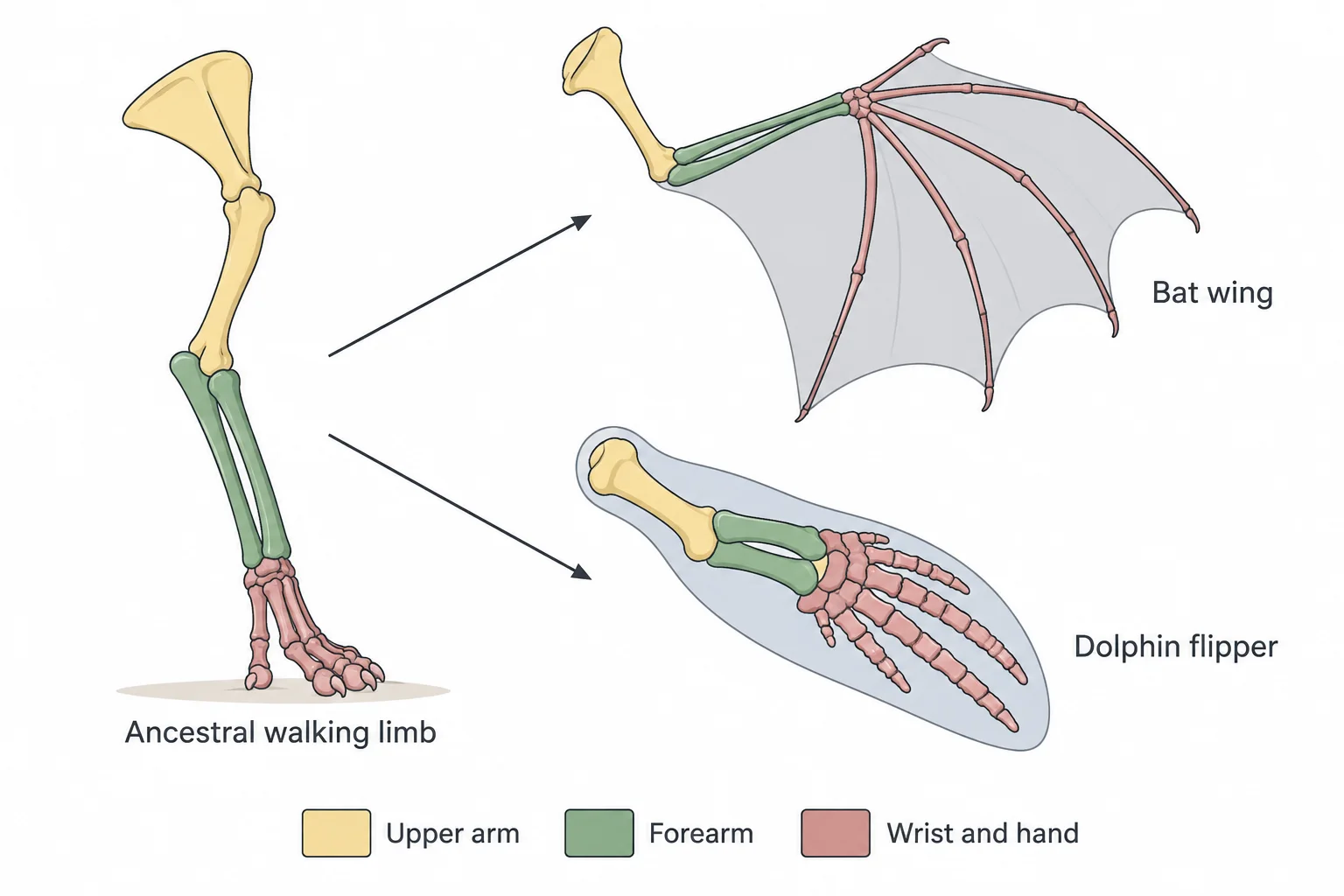
Evolution usually works by modifying structures that already exist rather than building new ones from scratch. Over long periods, a structure that served one function can be reshaped to serve another.
The front limbs of bats and dolphins show how this produces unity and diversity at the same time. A bat’s wing is built for flying and a dolphin’s flipper for swimming, yet fossils show that both are modified versions of a front limb that an ancestor used for walking. The shared set of bones reflects their common ancestry, and the different shapes reflect their different ways of life.
Evolution runs on DNA
At the molecular level, evolution is change in the genetic material. That material is DNA (deoxyribonucleic acid), a long molecule that stores the instructions for building and running an organism. Parents pass copies of their DNA to their offspring, which is why DNA is heritable.
DNA is divided into genes, stretches of DNA that each help determine an organism’s characteristics, or traits. Most genes act through a short chain of events:
- The gene’s DNA is copied into a related molecule called messenger RNA (mRNA).
- The cell reads the mRNA and follows its instructions to build a polypeptide, a chain of building blocks called amino acids linked in a specific order.
- One or more polypeptides make up a protein. Proteins do most of the work in cells, so their structures and functions play a key role in determining traits.
Once in a while, the DNA itself changes. A mutation is a heritable change in the genetic material, one that can be passed from cell to cell or from parent to offspring. By altering a gene, a mutation can change the protein made from it and, through that protein, the traits of any offspring that inherit it.
When it comes to survival, a mutation may be beneficial, harmful, or neutral. These changes in DNA are the raw material that evolution works with.
Check yourselfWhy do biologists say that populations evolve but individuals don’t?
Evolution is a heritable change in a population from one generation to the next, so it can only be seen across generations. An individual lives for just one generation; what changes over time is how common different inherited traits are in the population.
Check yourselfA bat’s wing and a dolphin’s flipper do very different jobs. What does their shared origin show about how evolution works?
Practice questions
1 of 2
Which of these is an example of biological evolution?
2 of 2
A bat’s wing and a dolphin’s flipper are built from the same groups of bones, yet one is used for flying and the other for swimming. How does evolution explain both the similarity and the difference?