Levels of biological organization
Biology is the study of life, and its discoveries often turn out to be practical. A chemical in the venom of a Brazilian viper, for example, became the basis for drugs now widely used to treat high blood pressure.
Every living thing, from a bacterium to a blue whale, is an organism. Each organism keeps its insides organized and separate from its surroundings. To make sense of something so complex, biologists describe life as a series of levels, from the tiniest parts up to the whole planet.
Levels inside an organism
Each level is built from units of the level below it, like rungs on a ladder. The first seven rungs take you from atoms to one complete living thing.
- Everything, living or not, is built from tiny particles. The smallest piece of an element (a pure substance such as carbon or oxygen) that still behaves chemically like that element is an atom.
- Atoms link together, or bond, to form molecules. Some molecules are enormous chains made of many smaller molecules joined together; these are macromolecules. Carbohydrates such as starch, proteins, and nucleic acids (DNA and RNA) are important macromolecules in living things.
- The simplest unit that is actually alive is the cell: a collection of molecules and macromolecules wrapped in a membrane, a thin boundary that separates the cell from its surroundings. An organism made of just one cell is unicellular. Plants, animals, and other organisms made of many cells are multicellular.
- In a multicellular organism, many cells of the same type group together to form a tissue, such as muscle tissue.
- Two or more types of tissue that work together to carry out a particular function form an organ. The heart, for example, contains muscle tissue, nervous tissue, and connective tissue.
- Organs usually work as part of a larger team of interacting organs, called an organ system. In birds and mammals, the heart belongs to the circulatory system, which moves blood around the body.
- All of these systems working together make one complete individual: the organism.
Organisms that share a distinctive form and set of traits in nature, and that are close genetic relatives, belong to the same species.
Not every organism uses all seven levels. Many microorganisms (living things too small to see without a microscope) are unicellular, so they have no tissues or organs at all.
Levels beyond one organism
Above the organism, the levels describe groups of organisms and the places where they live.
- Organisms of the same species living in the same area make up a population, such as a herd of bison on a prairie.
- Populations of different species living in the same area form a community. Which species a community contains depends on the environment and on how the species interact with each other.
- A community together with its physical environment (the soil, water, air, and sunlight that its members interact with) is an ecosystem.
- Every place on Earth where life exists, including the air, bodies of water, the land, and the soil, makes up the biosphere.
Notice where the physical environment enters the picture. Populations and communities include only living organisms; the ecosystem is the first level that adds the nonliving surroundings.
The whole ladder
Seen all at once, the levels form a staircase from a single atom to the entire planet.
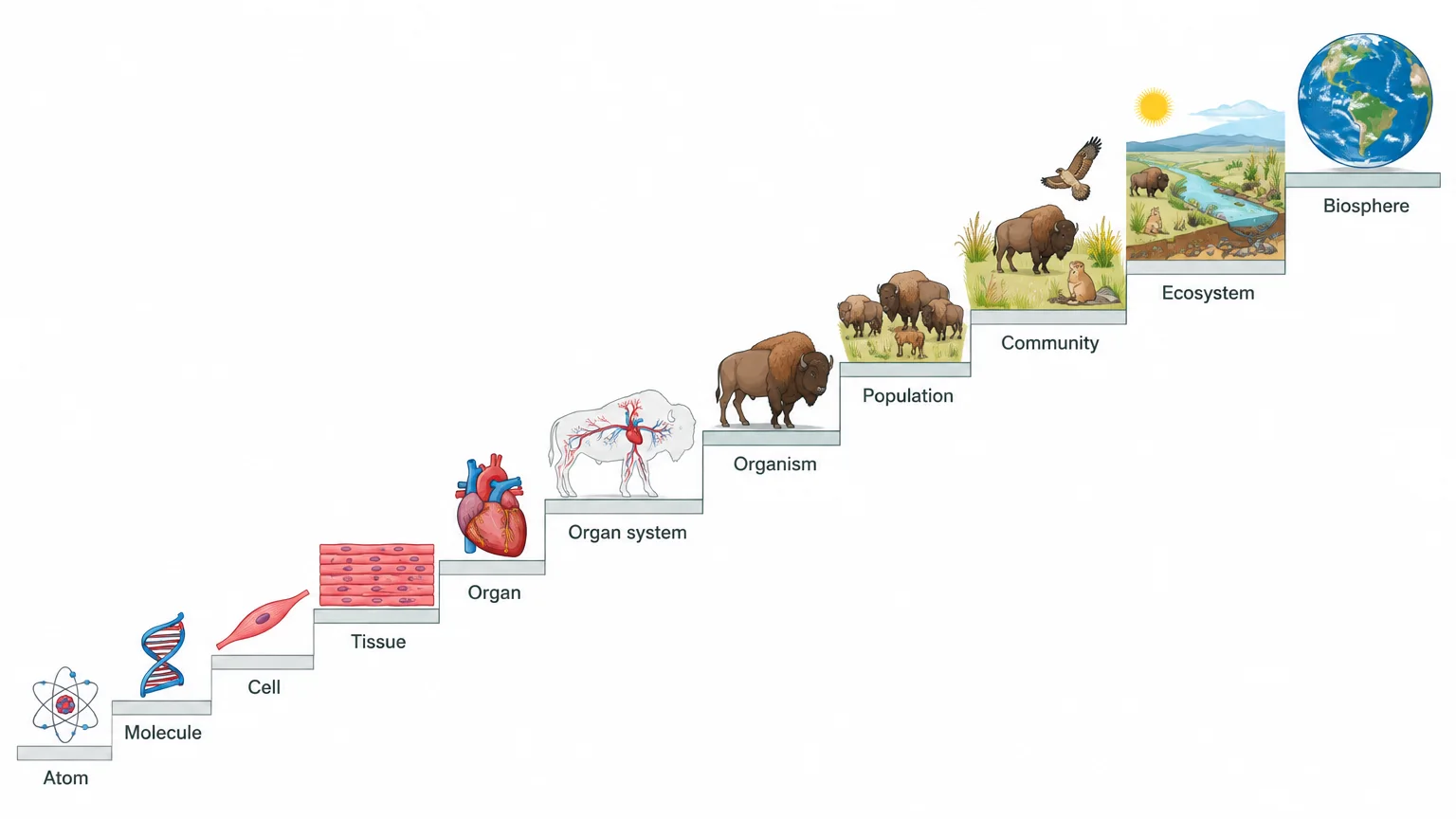
The order matters, and the middle is easy to scramble. This sentence keeps all eleven levels in sequence:
Once you know the order, you can rank any example by asking what it’s made of. A protein is a macromolecule, one step above the atoms it’s built from. A heart muscle cell is a cell, a patch of heart muscle is a tissue, and the whole heart is an organ. A school of dolphins sits at the population level, one step above a single dolphin.
Check yourselfWhy don’t biologists describe a single bacterium at the tissue or organ level?
Check yourselfA researcher studies how the frogs, fish, insects, and algae in a pond affect one another. Which level is she studying, and what would she add to study the next level up?
The community level, because she is studying several interacting species. To study the pond as an ecosystem, she would also include its nonliving environment, such as the water, its temperature, and the sunlight reaching it.
Practice questions
1 of 3
Which list orders levels of biological organization from smallest to largest?
2 of 3
The stomach is made of muscle tissue, nervous tissue, and a lining tissue that releases digestive juices, all working together to digest food. At which level of organization is the stomach?
3 of 3
Which list orders these from least to most complex: a nerve cell, the brain, the nervous system, a flock of geese, and a pond with its organisms, water, and sunlight?