Discovery-based science and hypothesis testing
Real research rarely runs in a straight line. Scientists ask questions, make observations, refine their questions, and try experiments that may fail and need a new approach. Curiosity drives the process, and researchers use two general approaches, often side by side.
Two ways to do research
Sometimes researchers collect and analyze data without starting from any particular hypothesis. This is discovery-based science, or simply discovery science.
Researchers have, for example, identified many previously unknown genes in the human genome (the complete set of human genetic material) without knowing what those genes do. The goal is to gather clues that may eventually suggest a hypothesis. Discovery-based science can also lead to practical applications, and it often leads to hypothesis testing.
The second approach starts with a hypothesis and tests it. This process is the scientific method, also called hypothesis testing, and it can be described in five steps:
- Make observations about a natural phenomenon.
- Propose a hypothesis to explain the observations. A useful hypothesis is testable because it makes specific predictions.
- Run experiments to see whether the predictions are correct.
- Analyze the data from the experiments.
- Conclude that the hypothesis is consistent with the data, or reject it.
A controlled experiment
Return to the hypothesis that maple trees drop their leaves because the days get shorter in autumn. It predicts that trees given gradually shorter days will drop their leaves. To test that prediction, researchers could grow young maple trees in two greenhouses, keeping the temperature, water, and nutrients the same in both.
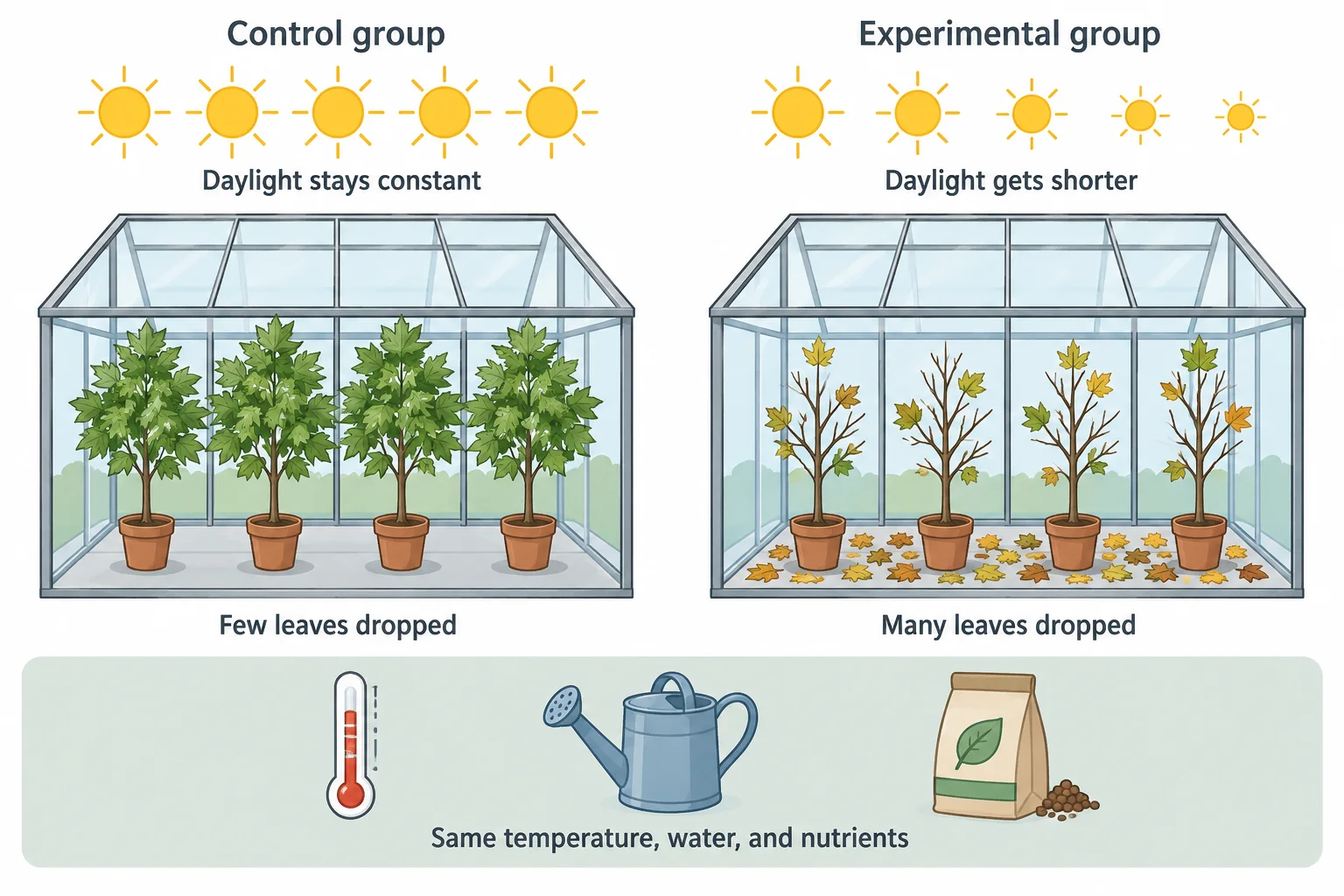
One greenhouse gets the same amount of light every day; its trees are the control group, the baseline that doesn’t receive the change being tested. The other gets gradually shorter days, mimicking autumn; its trees are the experimental group. After a set period, the researchers count how many leaves each group has dropped.
Biology is a quantitative science, so researchers analyze their data with statistics. The question is whether the difference between the control and experimental groups is bigger than random chance would produce. A difference that is unlikely to have occurred by chance is statistically significant.
- If the difference is not significant, the hypothesis is rejected.
- If it is significant, as when the shorter-day trees drop far more leaves, the hypothesis is consistent with the data. It still isn’t proven.
A valid experiment must also be repeatable: running it again should give similar results.
Both approaches at work: cystic fibrosis
Cystic fibrosis (CF) is an inherited disease in which thick, sticky mucus clogs the lungs and other organs, leading to life-threatening lung infections. People with CF inherit two faulty copies of a gene called CFTR, one from each parent. Research on the disease used both approaches:
- Discovery-based science: researchers located the CFTR gene without any hypothesis about what it does.
- The gene closely resembled genes already known to code for transport proteins, which move substances across cell membranes. People with CF were also known to have an abnormal salt balance across their cell membranes. Together, these clues led to a hypothesis: the normal CFTR gene codes for a protein that carries chloride ions (Cl⁻, the electrically charged form of chlorine found in table salt) across the membrane.
- Hypothesis testing: cells from people with CF turned out to be defective in chloride transport, and adding a normal CFTR gene to those cells in the lab corrected the defect.
The conclusion: a mutation in CFTR produces a faulty chloride transport protein. Chloride can’t move out of the cells normally, so the salt balance across the membrane shifts, less water ends up outside the cells, and the mucus there turns thick and sticky.
Science is a social process
Biologists rarely work alone. Labs often collaborate, and researchers present new results at scientific meetings, where colleagues question and debate them. Before a paper appears in a scientific journal, it usually goes through peer review: experts in the same field read it and judge its quality. The journal then accepts it, rejects it, or sends it back to the authors with suggested revisions or additional experiments.
Check yourselfWhy does a hypothesis-testing experiment need a control group?
The control group shows what happens when the factor being tested is left unchanged. Comparing it with the experimental group reveals whether that single factor, rather than something else, causes the outcome.
Check yourselfIn the cystic fibrosis research, which part was discovery-based science and which was hypothesis testing?
Finding the CFTR gene without a hypothesis about its function was discovery-based science. Proposing that it codes for a chloride transport protein, then testing chloride transport in CF cells with and without a normal gene, was hypothesis testing.
Practice questions
1 of 3
Which sequence lists the five steps of the scientific method in order?
2 of 3
To test whether a fertilizer makes tomato plants grow taller, a student grows 20 plants with the fertilizer and 20 without it, keeping light, water, and soil the same for all of them. What role do the plants without fertilizer play?
3 of 3
A lab reports that a new fertilizer doubles bean yields, but three other labs following the same procedure see no effect. Which hallmark of valid experiments does the original result fail to show?