Vertical descent and horizontal gene transfer
Mutations change the DNA of individuals, but reshaping a whole species takes more: the changes have to spread through a population over many generations. Biologists describe two main ways the genetic material of a species changes over time.
Vertical descent with mutation
Genes usually travel straight down the generations. A cell that divides passes copies of its genes to its daughter cells, the new cells it splits into, and parents pass genes to their offspring through sperm and eggs, the reproductive cells called gametes.
A series of related species, each descended from an earlier one, is a lineage. Evolution within a lineage is vertical evolution: new species arise from existing ones as mutations accumulate over many generations. Biologists call this mechanism vertical descent with mutation.
The horse lineage is a well-studied example. The earliest horses were about the size of dogs and had small teeth. Over millions of years, as mutations accumulated, their descendants changed: modern horses often weigh more than half a ton and have large back teeth (molars) with complex ridges.
Natural selection spreads helpful changes
A mutation tends to spread through a population when it changes a trait in a way that helps its carriers survive and reproduce. Those individuals leave more offspring on average, so the mutation tends to become more common from one generation to the next. This process is natural selection: individuals with greater reproductive success pass more of their characteristics to future generations.
Natural selection explains the changes in horses. As much of North America changed from dense forest to grassland, larger horses were better at escaping predators and traveling long distances for food. Bigger, ridged teeth suited a shift from tender leaves to tough grasses.
Selection isn’t the only thing going on. Populations also accumulate neutral changes, which neither help nor harm, and occasionally even harmful ones.
Horizontal gene transfer
Genes don’t always pass from parent to offspring. The transfer of genetic material from one organism to another organism that is not its offspring is horizontal gene transfer. It can even happen between different species.
Antibiotic resistance in bacteria is a familiar example. A gene that lets one bacterial species survive an antibiotic can be transferred to a different bacterial species, which then becomes resistant too. Genes gained this way are subject to natural selection like any others, so they can spread through the species that receives them.
Horizontal gene transfer has been an important source of evolutionary change, especially among bacteria. It was also a major part of the early history of life, a few billion years ago, when it helped give rise to all of today’s species.
From a tree of life to a web of life
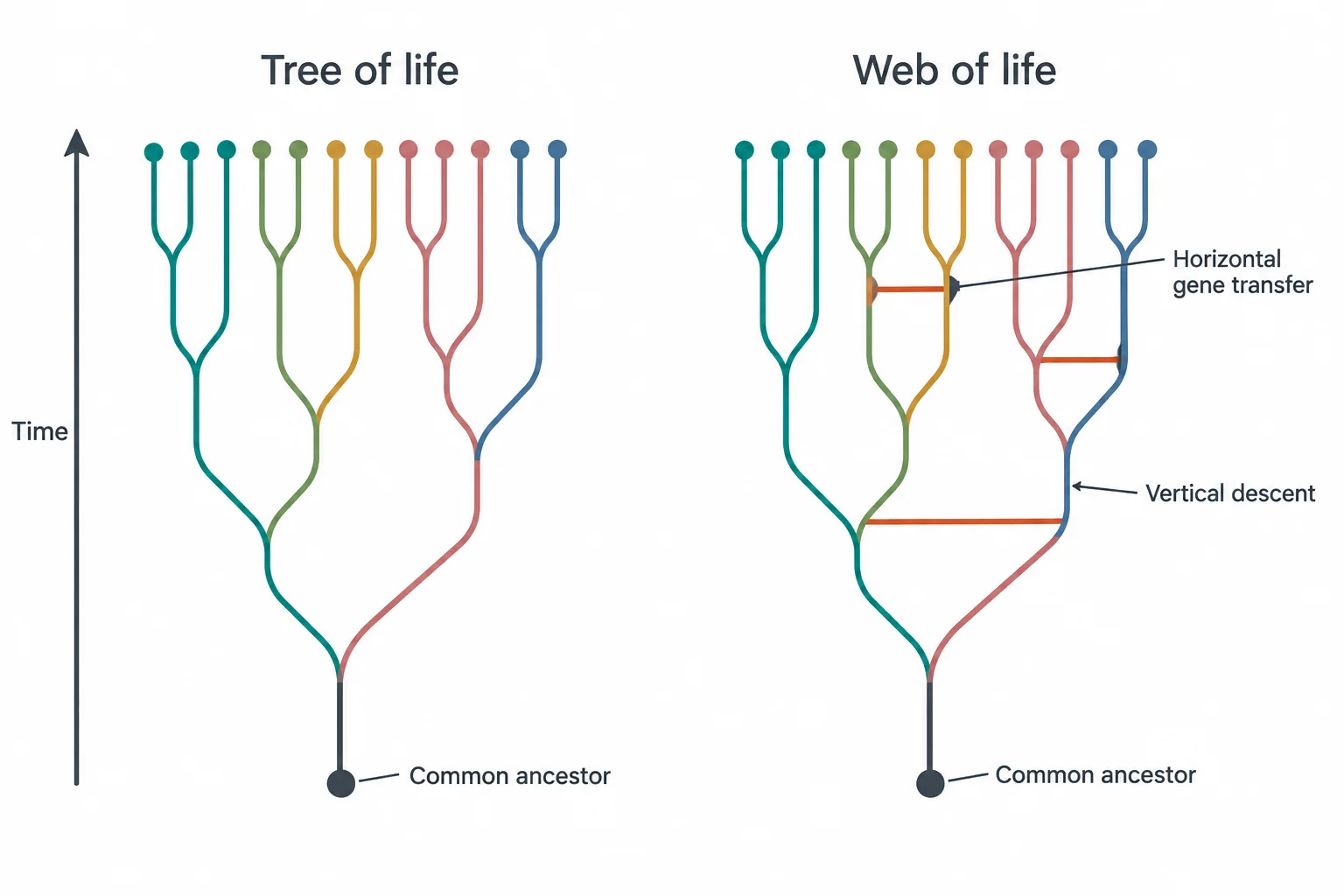
For decades, biologists pictured evolution as a tree of life: one common ancestor at the base, with branches that only split as new species descend from old ones. That picture shows vertical descent alone.
Now that horizontal gene transfer is known to be so important, biologists describe a web of life instead. It keeps the branching lines of vertical descent and adds horizontal lines wherever genes moved between branches.
The names come from how these diagrams are drawn. Time runs up the vertical axis, so descent from ancestor to offspring appears as upright branches. A gene transfer between species living at the same time appears as a horizontal line.
Check yourselfA gene for antibiotic resistance passes from a bacterium to its two daughter cells when it divides. Is this horizontal gene transfer?
Check yourselfTwo bacterial species infect the same patient, and only one of them can survive a certain antibiotic. A few days later, both can. What is the most likely explanation?
Practice questions
1 of 4
A gene in a plant cell changes, and when the cell divides, both new cells carry the changed version of the gene. What is this kind of change called?
2 of 4
Over millions of years, the horse lineage changed from dog-sized, leaf-eating forest animals into large grazers with big, ridged molars. Which explanation fits this example of vertical descent with mutation?
3 of 4
Why do many biologists now picture the history of life as a web rather than a tree?
4 of 4
In a web-of-life diagram, time runs up the vertical axis. What does a horizontal line joining two branches represent?