Genomes, proteomes, and artificial selection
Nobody can travel back 4 billion years to watch evolution happen. Instead, biologists read its record in fossils and in the genetic material of the species alive today.
The genome
The complete genetic material of an organism or species is its genome. A typical bacterial genome contains a few thousand genes, while plant and animal genomes can contain tens of thousands.
A genome does three jobs:
- It stores information in a stable form: the blueprint for the organism’s traits.
- It provides continuity from generation to generation, because it is copied and passed on.
- It acts as an instrument of evolutionary change. Mutations alter it, and horizontal gene transfer can add new genes to it. As these changes accumulate over generations, species change and new species arise.
Reading and analyzing the DNA sequences of whole genomes (the exact order of the chemical “letters” that spell out their genes) is genomics. Comparing genomes shows how traits evolved. A frog, a giraffe, and a petunia all carry genes for breaking down sugars, for instance, but only the petunia has genes for photosynthesis, the process of using light energy to make sugars.
The proteome
The main job of most genes is to code for polypeptides, the chains that make up proteins. All of the proteins that a cell or organism makes form its proteome, and the genome carries the information for making it.
Proteins do most of a cell’s work and form many of its structures, so they largely determine how cells and organisms are built and how they function. Some form the cytoskeleton, a framework of protein fibers inside the cell, and others help organize the cell. Many work as enzymes, which speed up chemical reactions, or as transport proteins, which move substances into and out of cells. Others carry signals between cells or work outside the cell.
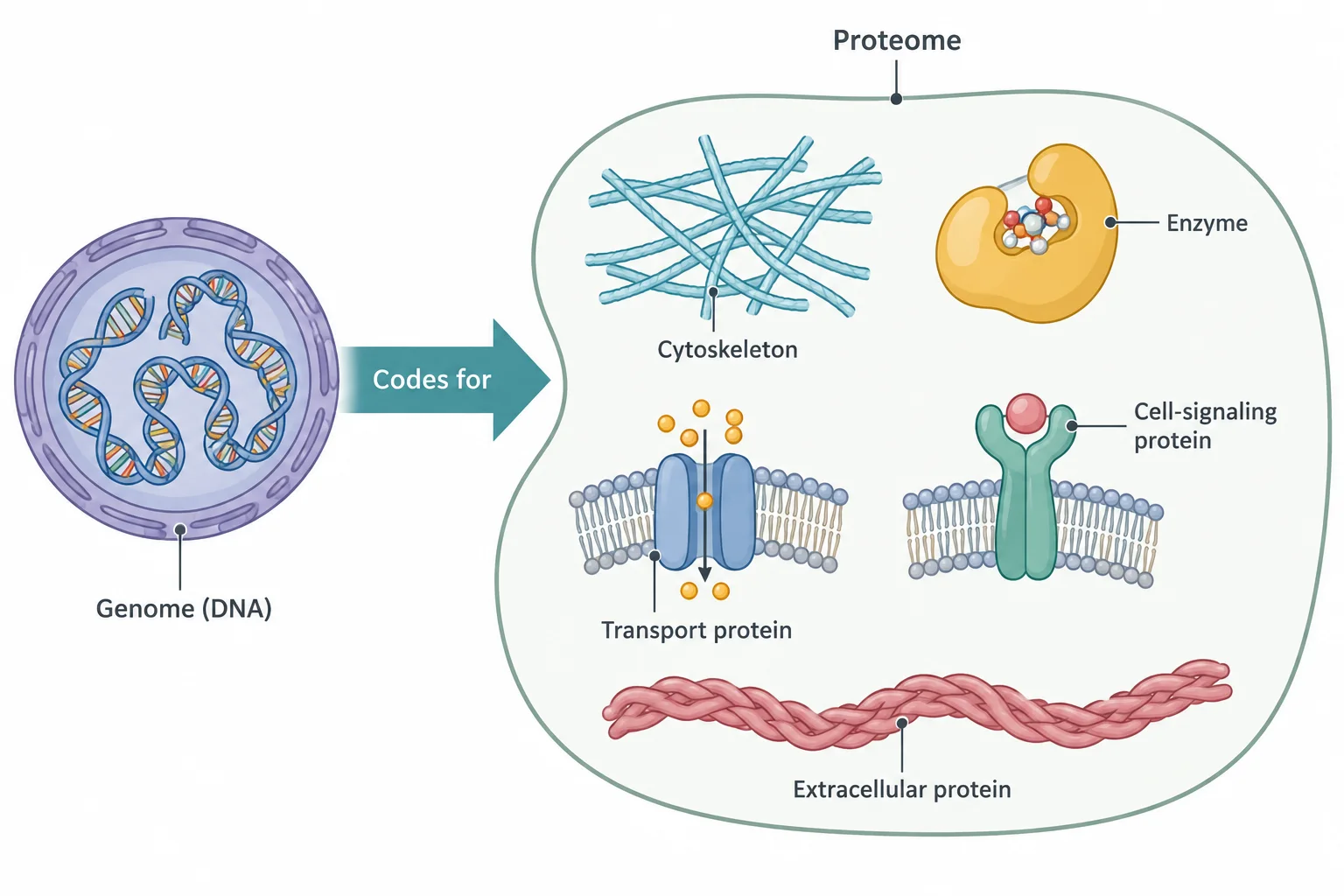
That division of labor is why biologists call the genome the storage unit of life and the proteome largely its functional unit.
The set of techniques for analyzing a species’ proteome, and for comparing the proteomes of different species, is proteomics. It links the levels of biology, from protein molecules to the traits of cells and organisms and, ultimately, to how well populations survive in their environments.
Artificial selection
People have been reshaping populations for thousands of years. When breeders of domesticated plants or animals decide which individuals get to reproduce, picking the ones with the traits they want, the population’s traits shift over the generations. This practice is artificial selection.
Artificial and natural selection both change a population from one generation to the next. The difference is who does the choosing. In natural selection, the environment favors whatever traits help individuals leave more offspring. In artificial selection, people favor the traits they find desirable.
A long-term experiment with red foxes shows how far it can go. Researchers started with captive foxes from fur farms and, generation after generation, bred the ones that were friendliest toward people. After about 40 years, 70–80% of the foxes were eager for human contact, wagging their tails and whining for attention much like pet dogs.
The foxes were never trained. The original population already carried inherited variation that affected behavior: some of it promoted aggression, and some promoted tameness. Selective breeding made the tameness-promoting variation more common and the aggression-promoting variation rarer. When researchers later compared the genomes of tame foxes, aggressive foxes, and an unselected group, they found many regions of DNA that differed, including regions with genes known to affect tameness in dogs.
Check yourselfA mutation changes one gene. Using the terms genome and proteome, explain how this could change a trait.
Check yourselfWhy is the foxes’ tameness an example of evolution rather than learning?
The foxes were never trained. Their tameness came from inherited variation that selective breeding made more common over generations, so it was a heritable change in the population.
Practice questions
1 of 4
Which statement correctly describes how a cell’s genome and proteome are related?
2 of 4
A mutation changes a gene that codes for one of a plant’s enzymes. Which sequence shows how this could change one of the plant’s traits?
3 of 4
For many generations, farmers have replanted seeds only from the corn plants with the largest ears. Which process is changing the traits of their corn population?
4 of 4
After about 40 years of breeding captive foxes for friendliness toward people, most foxes in the population wagged their tails and sought out human contact. What explains this change?