Pumps and active transport
Channels and many transporters let solutes flow downhill, from higher to lower concentration. Moving a solute uphill takes energy, and cells supply that energy in two ways.
Primary active transport
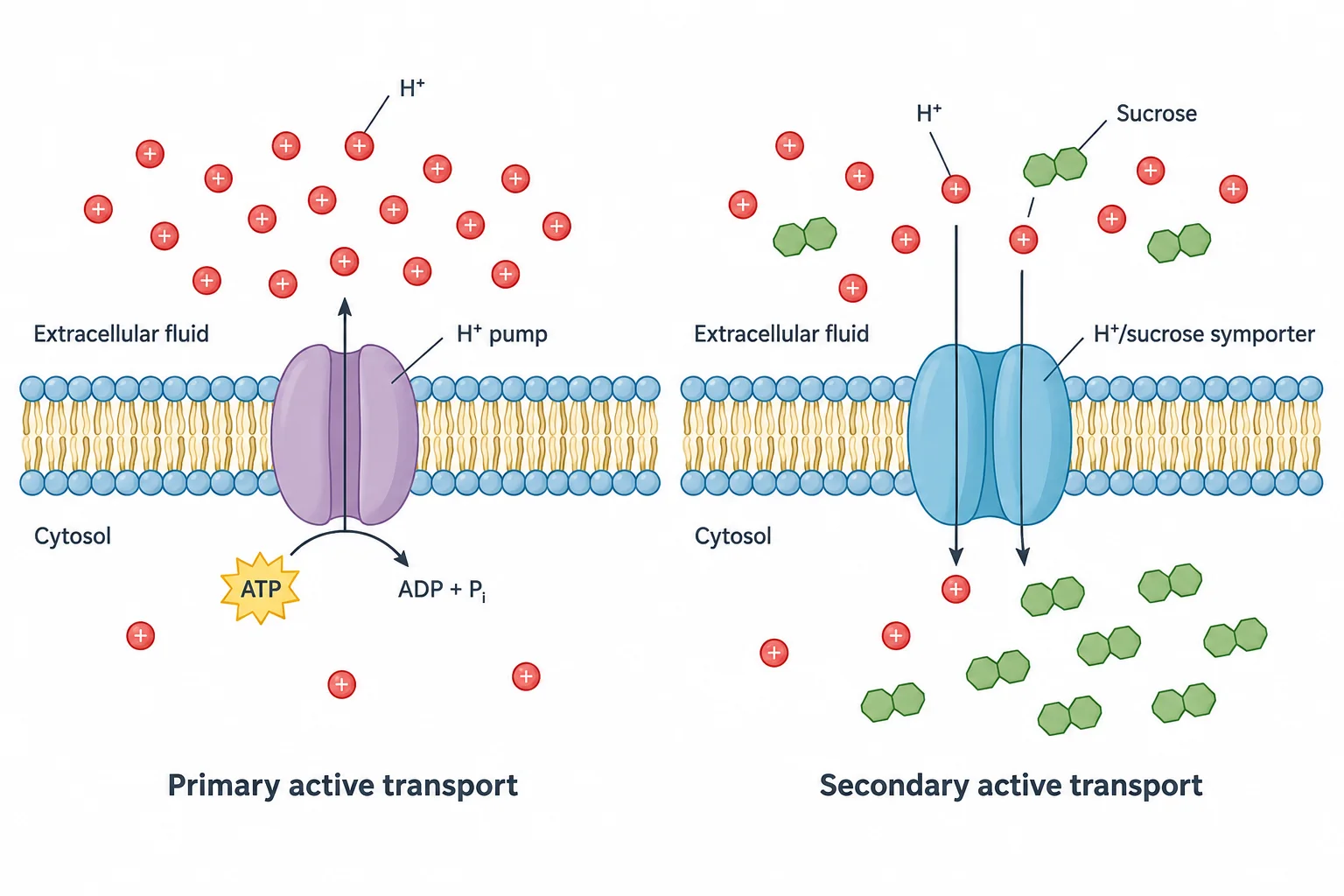
Active transport moves a solute against its concentration gradient, which is energetically unfavorable, so it needs an energy input. The most direct way is a transporter that spends energy itself, usually by splitting ATP, to push a solute uphill. Such a transporter is a pump, and transport driven directly by a pump is primary active transport.
One example is a pump that uses ATP to move hydrogen ions (H⁺) out of a cell. As H⁺ builds up on the outside, the pump creates an H⁺ electrochemical gradient across the membrane. That gradient is stored energy, like water held behind a dam, and cells can tap it.
Secondary active transport
When a transporter uses the downhill flow of one solute, down a gradient that already exists, to carry a second solute uphill, the process is secondary active transport.
The classic example is an H⁺/sucrose symporter. H⁺ flows through it into the cell, down the electrochemical gradient that the H⁺ pump built. The symporter uses that flow to carry sucrose in at the same time, even though sucrose is already more concentrated inside. Only sucrose is being actively transported; H⁺ is moving downhill.
H⁺/solute symporters are common in bacteria, fungi, algae, and plants, whose plasma membranes have H⁺ pumps. In animal cells, Na⁺ usually plays that role: a pump that exports Na⁺ keeps Na⁺ concentrated outside, and Na⁺/solute symporters use that gradient. Either way, symporters let cells gather sugars, amino acids, and other nutrients from their surroundings and stockpile them inside.
Since pH measures H⁺ concentration (the lower the pH, the more H⁺), an H⁺ gradient is also a pH difference. An H⁺/glucose symporter can accumulate glucose inside a compartment only if H⁺ is more concentrated outside that compartment (the pH outside is lower), whether that gradient is already there or an H⁺ pump builds it by pumping H⁺ out.
The sodium-potassium pump
Animal cells keep Na⁺ low inside and high outside, and K⁺ high inside and low outside. The pump that maintains these gradients is Na⁺/K⁺-ATPase, also called the sodium-potassium pump (an ATPase is an enzyme that splits ATP). A typical animal cell has thousands of them in its plasma membrane.
For each ATP it splits, the pump moves 3 Na⁺ out of the cell and 2 K⁺ into it, both against their gradients. Because it moves the two ions in opposite directions, it’s an antiporter. And because it sends out three positive charges for every two it brings in, each cycle exports one net positive charge, building an electrical gradient as well. A pump that generates an electrical gradient this way is an electrogenic pump.
How the pump works
The pump switches between two shapes. In the E1 shape, its ion-binding sites face the cytosol and grip Na⁺ tightly but K⁺ only weakly. In the E2 shape, the sites face the outside and grip K⁺ tightly but Na⁺ weakly.
- In the E1 shape, three Na⁺ from the cytosol bind to the pump.
- ATP is split into ADP and phosphate, and the phosphate attaches covalently to the pump, a step called phosphorylation.
- The pump switches to E2, which holds Na⁺ weakly, so the three Na⁺ are released outside the cell.
- Two K⁺ from outside bind to the pump.
- Binding K⁺ triggers release of the phosphate, and the pump switches back to E1.
- E1 holds K⁺ weakly, so the two K⁺ are released into the cytosol, and the pump is ready to start again.
Na⁺/K⁺-ATPase also illustrates evolution. Its gene and the gene for flippase are homologous, meaning both descend from one ancestral gene, which coded a transporter. As that gene was passed down and mutated over many generations, one descendant came to code a protein that moves Na⁺ and K⁺ and the other a protein that moves phospholipids between leaflets. It’s a molecular example of vertical descent with mutation.
What ion gradients are for
Cells spend a large share of their ATP keeping ion pumps running; neurons use up to 70% of theirs this way. The gradients that pumps build power many other processes:
| Process | How ion gradients drive it |
|---|---|
| Transport | Symporters and antiporters use H⁺ and Na⁺ gradients to take in nutrients and export wastes |
| Making ATP | Mitochondria and chloroplasts use H⁺ gradients to synthesize ATP |
| Regulating cell volume | Animal cells regulate their volume by adjusting ion gradients |
| Nerve signals | Na⁺ and K⁺ gradients let neurons send electrical signals called action potentials |
| Muscle contraction | Ca²⁺ gradients determine whether muscle fibers contract |
| Bacterial swimming | H⁺ gradients turn bacterial flagella, the whiplike tails bacteria swim with |
Check yourselfA drug blocks Na⁺/K⁺-ATPase in an animal cell. Why would the cell’s Na⁺/glucose symporters gradually stop importing glucose?
Without the pump, Na⁺ leaks back in and the Na⁺ gradient runs down. The symporters depend on Na⁺ flowing downhill to carry glucose in against its gradient, so as the Na⁺ gradient disappears, secondary active transport of glucose stops.
Practice questions
1 of 2
Besides concentration gradients, Na⁺/K⁺-ATPase builds an electrical gradient across the plasma membrane. What about its pumping cycle creates that electrical gradient?
2 of 2
Neurons spend up to 70% of their ATP on a single kind of task. What is it?