Osmosis and water balance
Water crosses membranes too. When solutes can’t cross a membrane to even out a difference in concentration, water crosses instead, and that movement can swell, shrink, or even burst a cell.
Comparing solute concentrations
To predict which way water will move, compare the total solute concentration on the two sides of the membrane. Three words describe the comparison:
- When both sides have equal solute concentrations, they’re isotonic.
- The side with the higher solute concentration is hypertonic.
- The side with the lower solute concentration is hypotonic.
The prefixes help: iso- means equal, hyper- means over or more (as in hyperactive), and hypo- means under or less (as in hypothermia). For a cell, the words usually describe the fluid outside compared with the cytosol. If the outside has more solute, the outside is hypertonic; if it has less, the outside is hypotonic.
Osmosis
If solutes can’t cross the membrane, water moves instead, toward the side with more solute. This movement of water across a membrane, from the hypotonic side to the hypertonic side, is osmosis. It tends to even out the solute concentrations on the two sides.
The direction makes sense once you think about the water itself. Dissolved solute particles take up room, so the side with more solute has a lower concentration of water. During osmosis, water is simply diffusing down its own concentration gradient, from where water is more concentrated to where it’s less concentrated.
What osmosis does to cells
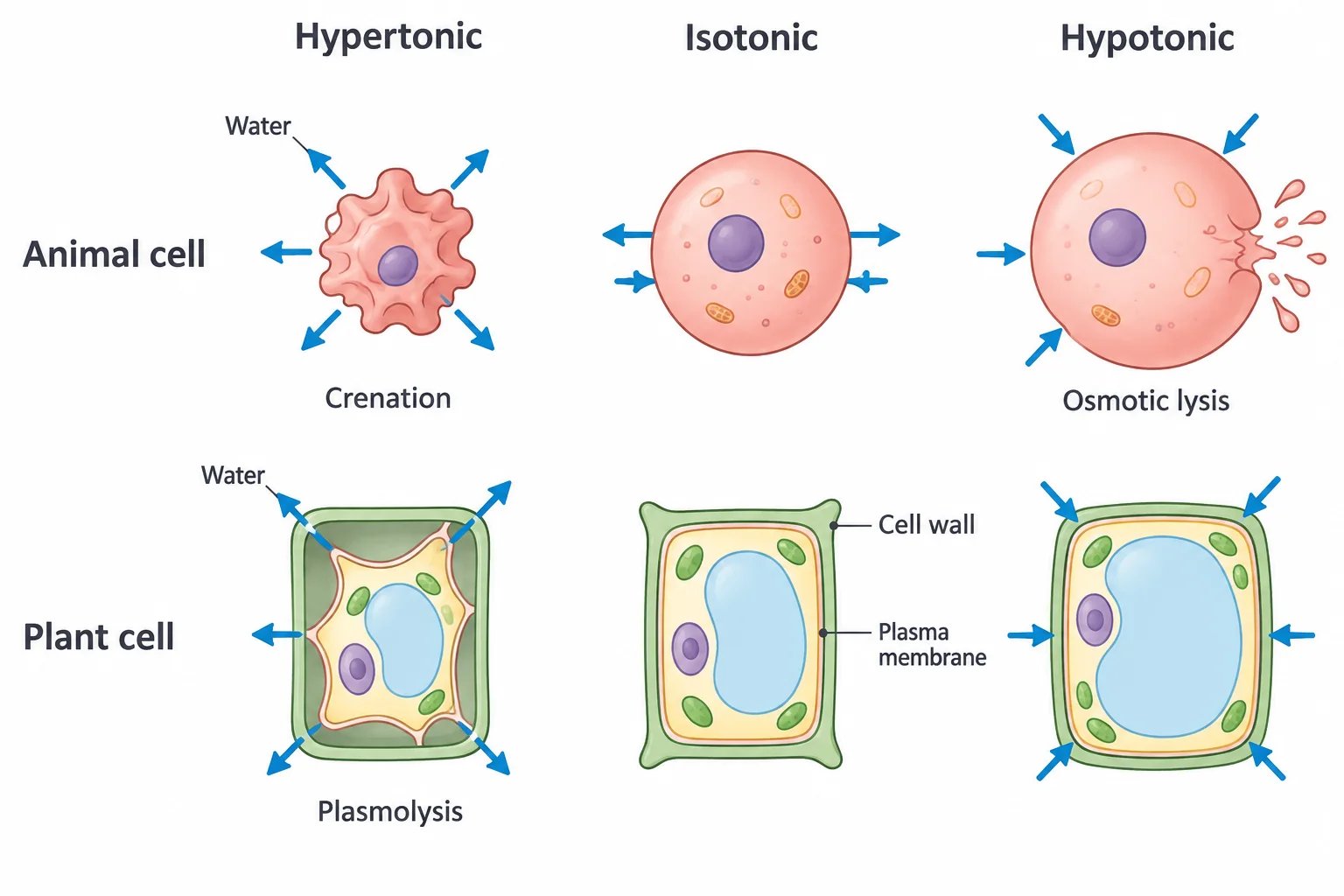
Animal cells have no cell wall, so they need the fluid around them to stay isotonic with the cytosol. They have transmembrane proteins that sense changes in cell volume and move solutes in or out to keep the cell’s normal shape. When the surroundings aren’t isotonic, osmosis takes over:
- In a hypotonic solution, water rushes in and the cell swells. If enough water enters, the cell bursts, which is called osmotic lysis. Red blood cells dropped into pure water burst this way, because their cytosol is hypertonic to the water.
- In a hypertonic solution, water leaves and the cell shrinks, which is called crenation.
Plant cells, like the cells of bacteria, fungi, and algae, are surrounded by a rigid cell wall, which changes the outcome:
- In a hypotonic solution, a plant cell takes up a little water and presses against its wall, but the wall keeps it from bursting.
- In a hypertonic solution, water leaves, and the plasma membrane pulls away from the cell wall, which is called plasmolysis.
| Surroundings | Net water movement | Animal cell | Plant cell |
|---|---|---|---|
| Isotonic | None | No change | No change |
| Hypertonic | Out of the cell | Shrinks (crenation) | Membrane pulls away from the wall (plasmolysis) |
| Hypotonic | Into the cell | Swells and may burst (osmotic lysis) | Swells slightly against the wall but doesn’t burst |
Contractile vacuoles
Some single-celled organisms that live in fresh water, such as amoebae and paramecia, face the hypotonic problem all the time. Pond water has far fewer solutes than their cytosol, so water flows in constantly. They cope by collecting the excess water from the cytosol in one or more compartments that periodically fuse with the plasma membrane and expel it, much like bailing out a leaky boat. These compartments are contractile vacuoles, and without them the cells would undergo osmotic lysis.
Check yourselfA cell whose cytosol has a solute concentration of 0.15 M (molar, a unit of concentration) is placed in fluid at 0.4 M, and the solutes can’t cross the membrane. Which way does water move, and what happens to the cell?
The outside has more solute, so it’s hypertonic to the cell, and water leaves the cell by osmosis. An animal cell would shrink (crenation). A plant cell would undergo plasmolysis, its plasma membrane pulling away from the wall.
Check yourselfAn amoeba lives comfortably in pond water, but a red blood cell dropped into the same water bursts. Explain the difference.
Pond water is hypotonic to both cells, so water enters both by osmosis. The amoeba’s contractile vacuoles collect the extra water and expel it. The red blood cell has neither a contractile vacuole nor a cell wall, so it swells until it undergoes osmotic lysis.
Practice questions
1 of 2
During osmosis, water moves from a hypotonic solution into a hypertonic one. In terms of water’s own concentration, which way is it moving?
2 of 2
Why do freshwater microorganisms such as amoebae and paramecia need contractile vacuoles?