How substances cross membranes
A cell has to take in nutrients such as glucose and amino acids, hold on to the molecules it’s still using, and get rid of its wastes. All of that traffic passes through membranes, and membranes don’t treat every substance the same way.
Selective permeability
The movement of ions and molecules across a membrane is membrane transport. A membrane is permeable to a substance if the substance can pass through it, and biological membranes let some substances through while blocking others. This is selective permeability. It lets a cell keep a favorable environment inside: nutrients come in, molecules partway through the cell’s chemical reactions stay put, and wastes go out.
Most of what crosses is dissolved in water. Salt water, for example, is a solution, a liquid with something dissolved in it: the salt is the solute, the substance that’s dissolved, and the water is the solvent, the liquid doing the dissolving. In and around cells, the solvent is water, and the solutes include ions, sugars, amino acids, and gases.
Two parts of the membrane make it selective. The phospholipid bilayer blocks most ions and polar molecules, and transport proteins embedded in the bilayer (channels and transporters, Section 5.5) open specific routes across it.
Three ways across
Solutes tend to spread out on their own, from where they’re concentrated to where they’re scarce, the way a drop of food coloring spreads through a glass of water. This spreading is diffusion. A difference in concentration between two regions is a concentration gradient, and diffusion always runs down the gradient, from higher to lower concentration. That direction is also called downhill.
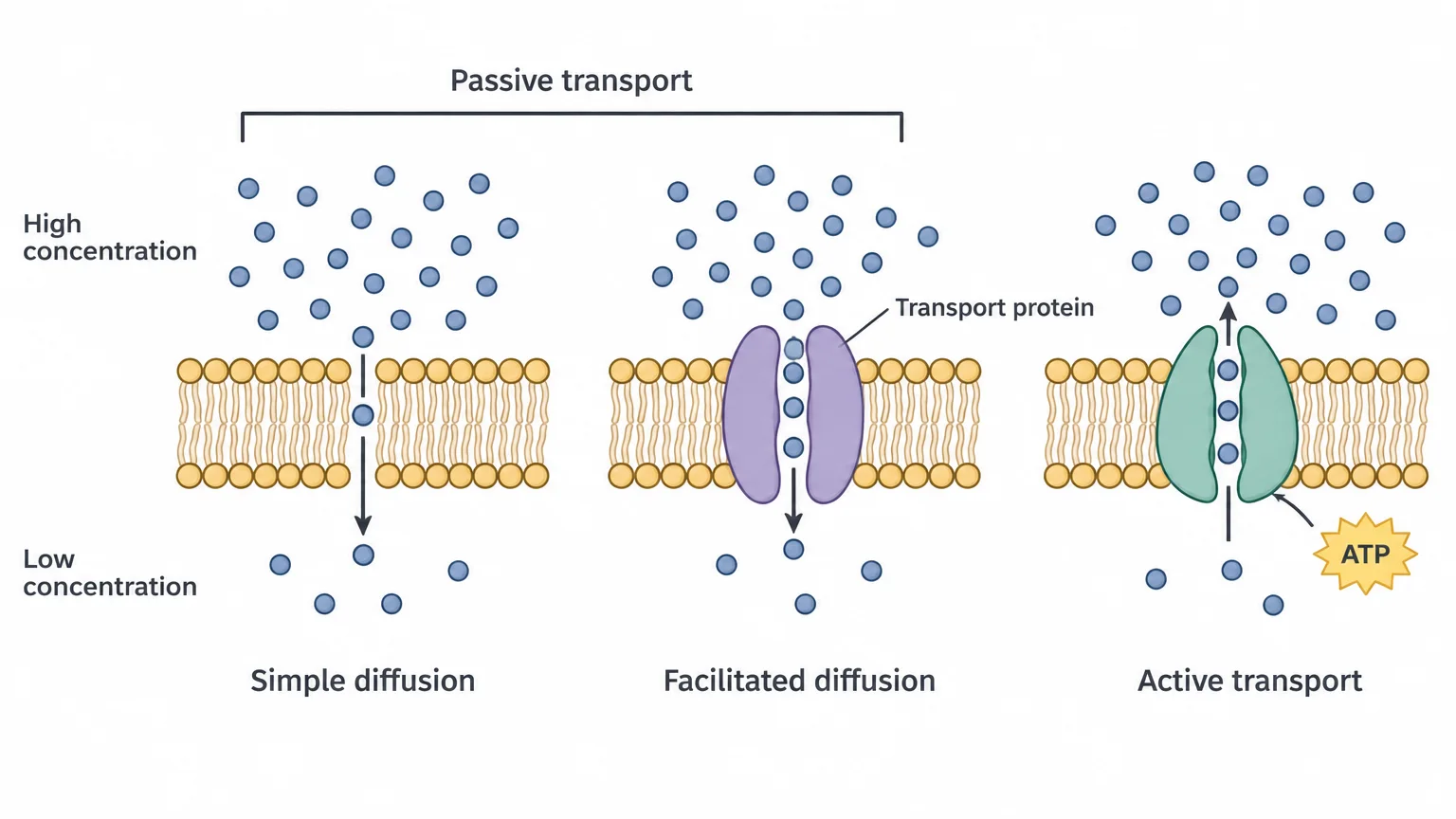
A substance can cross a membrane in three ways:
- Straight through the phospholipid bilayer, from higher to lower concentration. This is simple diffusion.
- Through a transport protein that provides a path, still from higher to lower concentration. This is facilitated diffusion.
- Through a transport protein that carries it from lower to higher concentration, against its gradient (uphill). This requires an input of energy, such as from ATP, and is called active transport.
Simple and facilitated diffusion together make up passive transport: movement down a gradient with no energy input.
| Simple diffusion | Facilitated diffusion | Active transport | |
|---|---|---|---|
| Direction | High → low | High → low | Low → high |
| Transport protein? | No | Yes | Yes |
| Energy input? | No | No | Yes, such as ATP |
| Category | Passive | Passive | Active |
The bilayer blocks hydrophilic solutes
The hydrophobic core of the bilayer is a barrier to ions and polar molecules. Four features decide how quickly a solute diffuses through a pure phospholipid bilayer:
- Size: small solutes cross faster than large ones.
- Polarity: nonpolar solutes cross faster than polar ones.
- Charge: solutes with no net charge cross faster than ions and other charged solutes.
- Concentration: the higher a solute’s concentration, the faster it crosses.
So in an artificial bilayer with no proteins, gases such as O₂ and CO₂ and a few other small molecules with no charge slip through easily. Water crosses too, but slowly. Ions and larger polar molecules such as sugars cross only slowly, and macromolecules such as proteins and polysaccharides cross even more slowly. The same logic applies to amino acids: leucine, whose side chain is nonpolar, crosses more readily than lysine, whose side chain is charged.
Gradients across membranes
Living cells keep their insides different from their surroundings, so a solute is often more concentrated on one side of a membrane than the other. A concentration gradient across a membrane is also called a transmembrane gradient, and every living cell maintains such gradients across its plasma membrane and its internal membranes. Right after a meal rich in carbohydrates, for example, glucose is more concentrated outside your cells than inside. That’s a chemical gradient, a difference in concentration only.
Ions carry an electric charge, so a gradient of an ion has two parts at once: a chemical part (a difference in concentration) and an electrical part (a difference in charge across the membrane). This double gradient is an electrochemical gradient. For Na⁺, there’s more Na⁺ outside an animal cell than inside, and there’s also more positive charge outside than inside, because ions such as Na⁺, K⁺, and Cl⁻ are unevenly distributed across the membrane.
Gradients also give you a second way to tell passive and active transport apart: look at what each one does to the gradient.
Check yourselfCO₂ leaves a cell by passing straight through the phospholipid bilayer, from high to low concentration. What kind of transport is this, and does it need energy?
Simple diffusion, a type of passive transport. CO₂ moves down its concentration gradient without a transport protein, so no energy input is needed.
Check yourselfWhy is a gradient of Na⁺ called an electrochemical gradient, while a gradient of glucose is only a chemical gradient?
Na⁺ carries a positive charge, so an uneven distribution of Na⁺ creates both a concentration difference and a charge difference across the membrane. Glucose has no charge, so only its concentration differs.
Practice questions
1 of 2
A solute crosses a membrane through a transport protein, and no energy from ATP or any other source drives it. What must be true?
2 of 2
In an animal cell after a meal, glucose is more concentrated outside the cell than inside, and so is Na⁺. Which of these gradients is electrochemical?