Organelle genomes and maternal inheritance
Mitochondria and chloroplasts descend from bacteria that moved into ancient cells, as the endosymbiosis theory from Chapter 4 explains. They still carry DNA of their own, and the genes on it are inherited by a different route than the genes in the nucleus.
Genomes outside the nucleus
A eukaryotic cell keeps most of its genes on the chromosomes in its nucleus, its nuclear genome. Mitochondria carry a small mitochondrial genome, and chloroplasts carry a chloroplast genome. Each is a single, circular DNA molecule. A typical mammal’s mitochondrial genome has 37 genes: 24 code the tRNAs and rRNAs the mitochondrion uses to translate its own mRNAs, and 13 code proteins for oxidative phosphorylation.
| Genome | Location | Size | Main roles |
|---|---|---|---|
| Nuclear | Chromosomes in the nucleus | Most of the cell’s genes | Nearly everything, including most organelle proteins |
| Mitochondrial | Each mitochondrion | 37 genes in most mammals | Translation inside the mitochondrion and oxidative phosphorylation |
| Chloroplast | Each chloroplast | 100–200 genes in flowering plants | Many code proteins needed for photosynthesis |
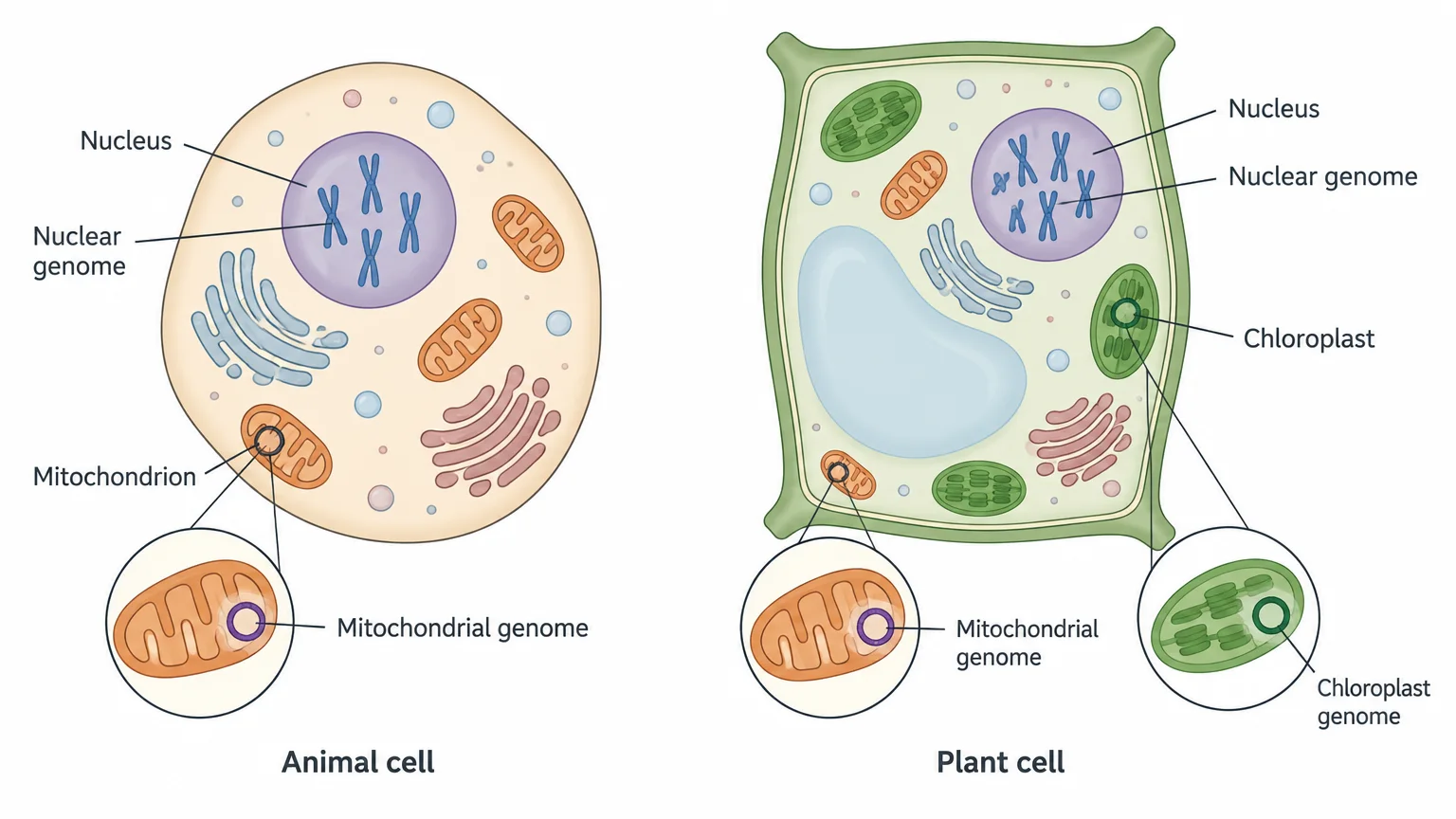
The transmission of genes located outside the nucleus is extranuclear inheritance. Because these organelles sit in the cytoplasm, it is also called cytoplasmic inheritance. It breaks the law of segregation: organelle genes aren’t on chromosomes that pair up and separate in meiosis, so they aren’t split one copy per gamete.
Maternal inheritance
An egg is large and packed with cytoplasm. A sperm, or a plant’s pollen, contributes little more than a nucleus. So in most species the organelles in a zygote come from the egg. When offspring get their organelles, and the organelle genes, only from the mother, the pattern is maternal inheritance.
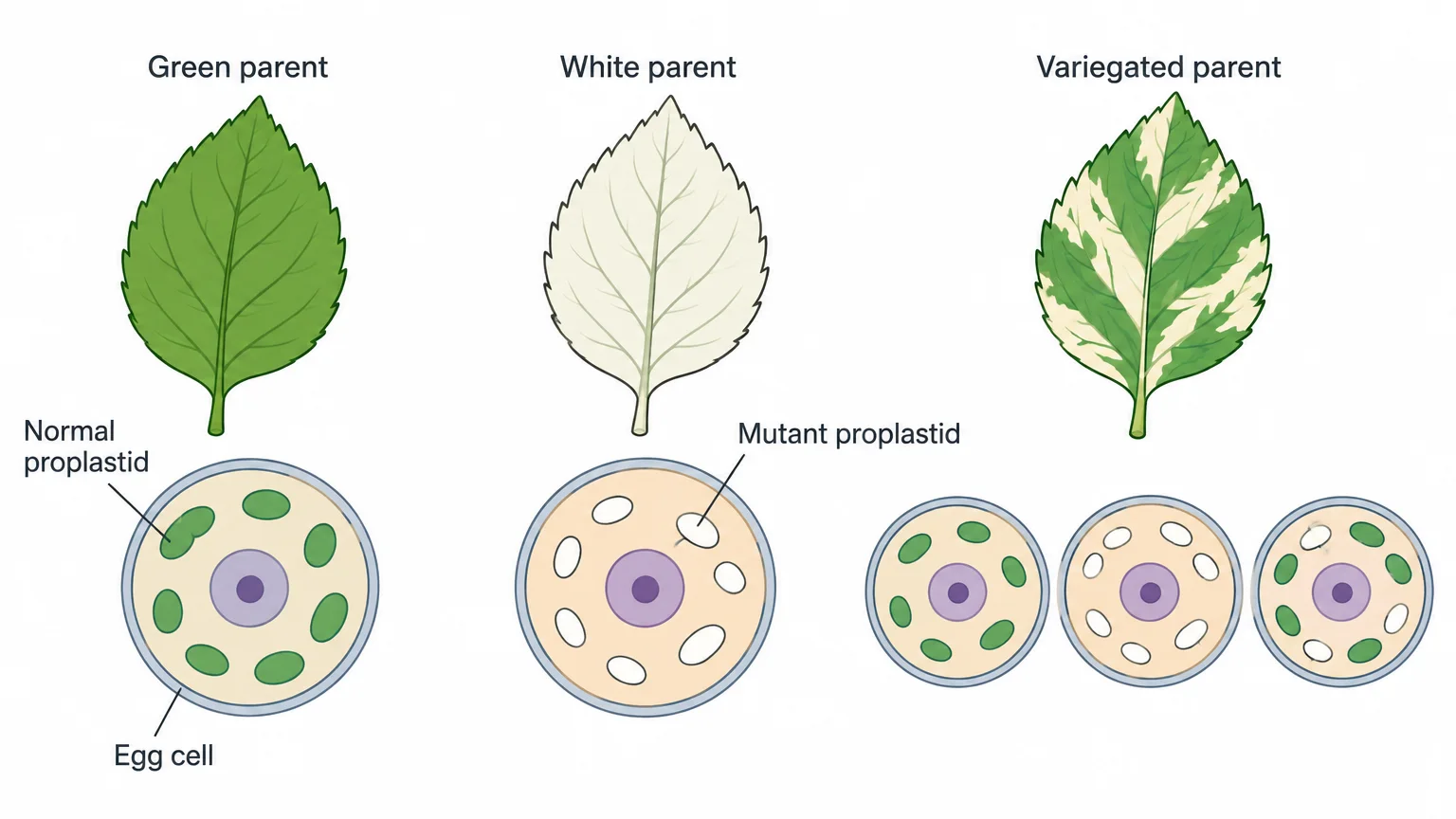
Leaf color in some flowering plants shows it clearly. Chloroplasts make chlorophyll, and some chlorophyll genes sit in the chloroplast genome. A mutation in one of them leaves a chloroplast nearly unable to make chlorophyll. A plant with only normal chloroplasts has green leaves, one with only mutant chloroplasts has white leaves (it makes just enough chlorophyll to survive), and one with a mix has variegated leaves, with green and white patches.
The way to detect this pattern is a reciprocal cross: a pair of crosses in which the phenotypes of the female and male parents are swapped. In one cross the white plant supplies the eggs; in the other it supplies the pollen. If the offspring always resemble the mother, the gene is maternally inherited.
| Egg from | Pollen from | Offspring |
|---|---|---|
| White plant | Green plant | All white |
| Green plant | White plant | All green |
| Variegated plant | Green plant | Green, white, or variegated |
| Green plant | Variegated plant | All green |
Chloroplasts develop from proplastids, small undeveloped plastids that the egg passes on. An egg holds several, and the pollen contributes none. An egg from a green plant carries only normal proplastids, and one from a white plant only mutant ones. An egg from a variegated plant can carry all normal, all mutant, or a mix.
Check yourselfReciprocal crosses of green and variegated plants give these results: variegated egg parent, offspring green, white, or variegated; green egg parent, all offspring green. Is the leaf-color gene nuclear or in an organelle?
In an organelle, most likely the chloroplast. The offspring always match the plant that supplied the egg, which is maternal inheritance. A nuclear gene would give the same result in both directions.
Other patterns in plants
Maternal inheritance is the most common pattern for chloroplasts in seed plants, but not the only one. In paternal inheritance, organelles come only from the pollen. In biparental inheritance, both the egg and the pollen contribute them.
| Pattern | Organelles come from | Example |
|---|---|---|
| Maternal inheritance | Egg only | Chloroplasts in most seed plants |
| Paternal inheritance | Pollen only | Chloroplasts in most pine trees |
| Biparental inheritance | Both egg and pollen | Chloroplasts in certain plant species |
Mitochondrial diseases in humans
Mitochondria are found in nearly all eukaryotes and are usually maternally inherited, as they are in humans. Mutations in human mitochondrial genes cause a set of rare diseases. Most are chronic and degenerative, and they hit organs whose cells need a lot of ATP: the brain, eyes, heart, muscles, kidneys, and hormone-producing glands.
Each disease traces back to a mitochondrial gene for part of the ATP-making machinery or for one of the mitochondrion’s own tRNAs:
- Leber’s hereditary optic neuropathy (LHON): a mutation in a gene for an electron transport chain protein. The optic nerve wastes away and vision is gradually lost.
- Neurogenic muscle weakness: a mutation in the gene for a subunit of ATP synthase. Nerve problems weaken muscles and affect the eyes.
- Maternal myopathy and cardiomyopathy: a mutation in a mitochondrial tRNA gene. Muscles, especially the heart, are abnormal.
- Myoclonic epilepsy and ragged-red muscle fibers: a mutation in another mitochondrial tRNA gene. Symptoms include epilepsy, dementia, blindness, deafness, and heart and kidney problems.
Check yourselfA man has a disease caused by a mutation in his mitochondrial DNA. Will his children inherit it?
No. Human mitochondria are inherited only from the mother, so his mitochondria don’t reach his children. An affected mother, by contrast, can pass the mutation to all of her children.
Practice questions
1 of 4
Besides the tRNAs and rRNAs used inside the mitochondrion, the mitochondrial genome of a mammal has 13 protein-coding genes. What process do those proteins take part in?
2 of 4
Why do the offspring of most species get their mitochondria from the mother?
3 of 4
Leber’s hereditary optic neuropathy, which causes gradual loss of vision, comes from a mutation in a mitochondrial gene. What does that gene code?
4 of 4
How many genes does the mitochondrial genome of a typical mammal contain?