Linked genes and crossing over
Independent assortment works because each pair of homologous chromosomes lines up and separates during meiosis without regard to how the other pairs do. Two genes on the same chromosome, though, ride on the same homolog, so they can’t sort independently that way.
Genes that travel together
A chromosome carries hundreds to thousands of genes. When two genes sit close together on the same chromosome, they tend to be passed on as a unit. That tendency is linkage, and such genes are said to be linked. A set of genes that usually stay together through meiosis is a linkage group.
Three ideas explain how linked genes behave:
- Genes on the same chromosome tend to be inherited together, which violates the law of independent assortment.
- Crossing over during meiosis swaps matching pieces between homologous chromosomes, which creates new combinations of alleles.
- A crossover is much more likely to happen between two genes that are far apart on a chromosome than between two that are close together.
Check yourselfWhy do linked genes break the law of independent assortment?
They’re on the same chromosome, so the alleles on that chromosome move into a gamete together. They separate only when a crossover happens between them.
Testing for linkage with a testcross
The testcross from Chapter 17, crossing an individual with a homozygous recessive partner, is the tool for detecting linkage. The partner’s gametes carry only recessive alleles, so each offspring’s phenotype reveals exactly which combination of alleles was in the other parent’s gamete.
Fruit flies give a classic example with two genes on the same chromosome. One controls body color: b⁺ for gray, which is dominant, and b for black. The other controls wings: c⁺ for straight, which is dominant, and c for curved. A plus sign marks the normal, wild-type allele.
- P generation: a gray, straight-winged female (b⁺b⁺ c⁺c⁺) is crossed with a black, curve-winged male (bb cc).
- F₁ generation: every offspring is b⁺b c⁺c, gray with straight wings. Each carries one chromosome with b⁺ and c⁺ together and one with b and c together.
- Testcross: F₁ females are mated with bb cc males.
- F₂ generation: if the genes assorted independently, the four possible phenotypes would appear in a 1:1:1:1 ratio. Instead, two phenotypes greatly outnumber the other two.
Check yourselfIf the body-color and wing-shape genes were on different chromosomes, what would the testcross offspring look like?
All four phenotypes (gray straight, gray curved, black straight, black curved) would appear in roughly equal numbers, a 1:1:1:1 ratio, because the genes would assort independently.
Nonrecombinants and recombinants
The two common F₂ classes have the same combinations of traits as the P generation: gray with straight wings, and black with curved wings. These offspring are nonrecombinants. The two rare classes have new combinations not seen in the P generation: gray with curved wings, and black with straight wings. These are recombinants.
Recombinants come from crossing over in the F₁ female while she makes eggs. By meiosis, each of her homologs has been copied into two chromatids, and a crossover swaps pieces between one chromatid of each. A single crossover between the two genes gives four kinds of eggs:
- b⁺ c⁺ and b c: nonrecombinant, the original combinations.
- b⁺ c and b c⁺: recombinant, produced by the crossover.
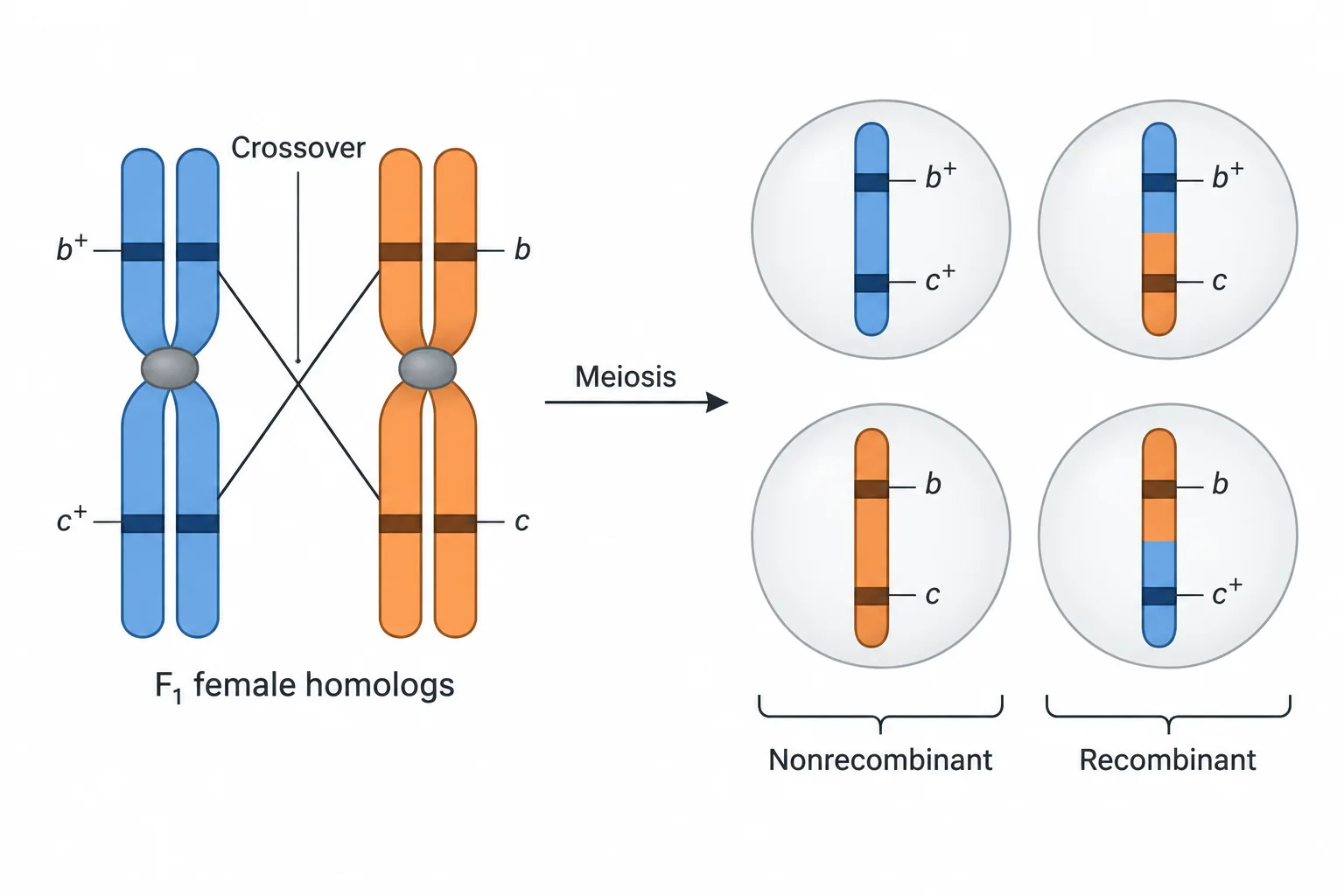
Every sperm from the testcross male carries b and c. So an egg with b⁺ c produces a gray fly with curved wings, and an egg with b c⁺ produces a black fly with straight wings.
To judge whether results like these depart too far from 1:1:1:1 to be random sampling error, geneticists use a statistical test called the chi square test. A large chi square value means the difference is unlikely to be chance alone, so the hypothesis of independent assortment is rejected and the genes are considered linked.
Practice questions
1 of 3
Why does crossing over separate two genes that are far apart on a chromosome more often than two genes that are close together?
2 of 3
A pea plant heterozygous for seed shape and flower color is testcrossed. The offspring are 45% round-purple, 45% wrinkled-white, 5% round-white, and 5% wrinkled-purple. What does this suggest?
3 of 3
In a two-gene testcross, a chi square test comparing the results with a 1:1:1:1 ratio gives a very large value. What does this suggest?