Genomic imprinting
You inherit two copies of most genes, one from each parent, and your cells usually use both. For some genes, though, a cell uses only the copy from one particular parent, because the other copy was marked as silent before you were conceived.
Only one parent’s copy is used
In genomic imprinting, a gene is marked while a parent is making gametes, and the offspring keeps that mark for life. Depending on the mark, the offspring expresses only the copy it got from its mother (the maternal allele) or only the copy from its father (the paternal allele), never both. For any one gene, the mark is made either in eggs or in sperm, not in both.
Imprinted genes don’t follow Mendel’s rules, because the offspring treats its two copies differently depending on which parent each came from. Its cells, in effect, remember something that happened in a parent’s gamete. Imprinting occurs in mammals, plants, and insects, and estimates put the number of imprinted human genes in the hundreds or more.
A growth gene that only fathers switch on
A well-studied case is Igf2, a gene in mice and other mammals that codes a growth hormone, insulin-like growth factor 2. A mouse that doesn’t express a working copy grows up small. A mutant allele, written Igf2⁻, makes a nonfunctional hormone.
In mice, only the paternal copy of Igf2 is transcribed, and the maternal copy stays silent. That one fact predicts every cross below, whatever the genotypes of the parents.
| Mother | Father | Offspring genotype | Offspring size |
|---|---|---|---|
| Igf2⁻ Igf2⁻ | Igf2 Igf2 | All Igf2 Igf2⁻ | All normal |
| Igf2 Igf2 | Igf2⁻ Igf2⁻ | All Igf2 Igf2⁻ | All small |
| Igf2 Igf2 | Igf2 Igf2⁻ | Half Igf2 Igf2, half Igf2 Igf2⁻ | Half normal, half small |
Check yourselfA heterozygous Igf2 Igf2⁻ female is crossed with a homozygous Igf2⁻ Igf2⁻ male. What sizes do the offspring have?
All are small. Every offspring gets a nonfunctional copy from the father, and that’s the only copy expressed, since the maternal copy is silent whether it works or not.
DNA methylation is the mark
For Igf2 and many other imprinted genes, the mark is DNA methylation. For most genes, methylation silences: it blocks transcription from starting or packs the chromatin more tightly. For a few imprinted genes it does the opposite, raising expression by attracting activator proteins to the promoter or keeping repressor proteins off.
Once an embryo forms, enzymes copy the methylation pattern every time a body cell (a somatic cell) divides. So the silent copy stays silent in every tissue for the animal’s whole life.
Erasing and resetting the mark each generation
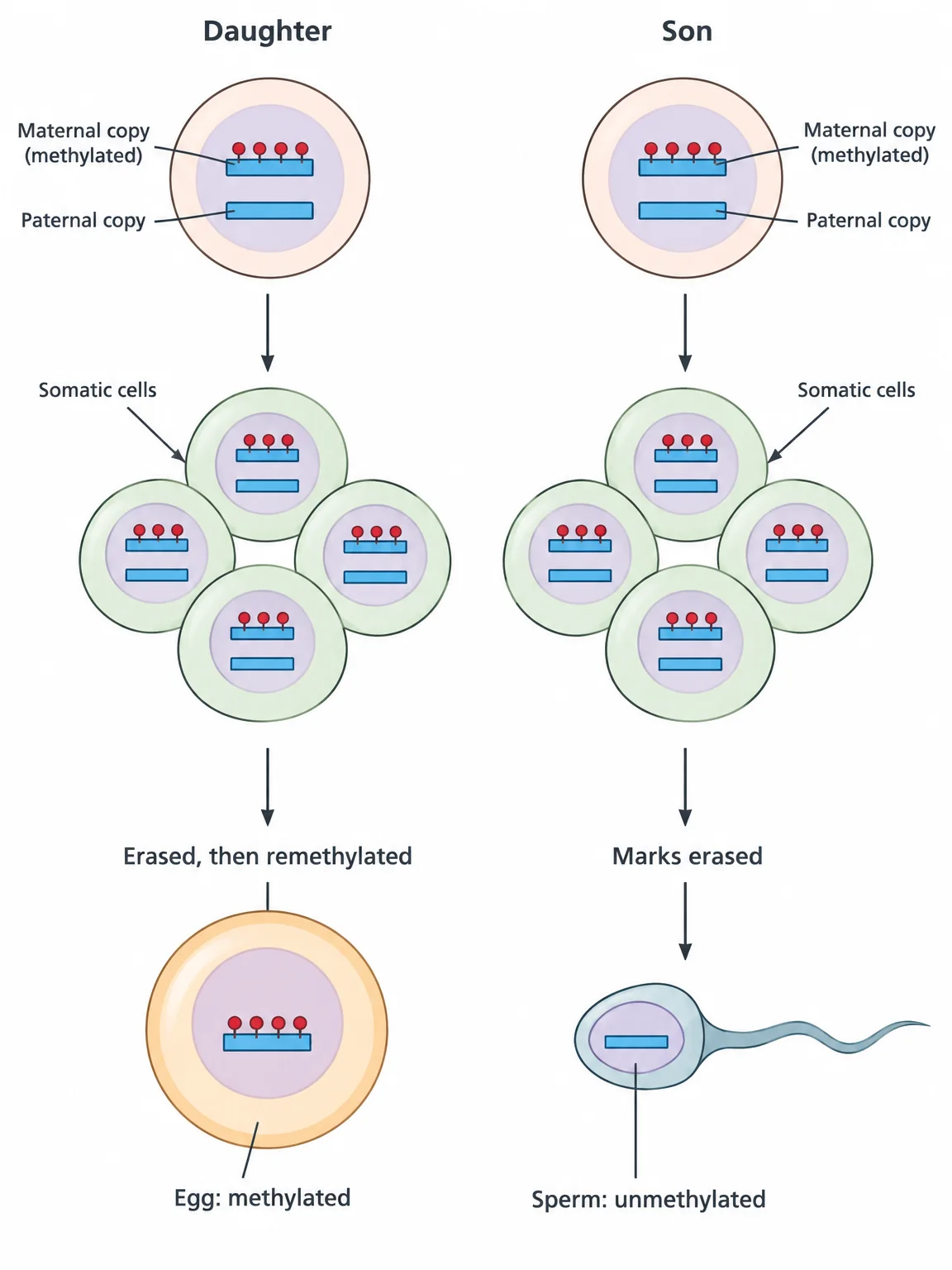
Here is how an imprint on a maternally silenced gene like Igf2 moves through two generations:
- The fertilized egg, or zygote, receives a methylated copy from the mother and an unmethylated copy from the father.
- As the embryo grows, its somatic cells keep that pattern, so only the paternal copy is transcribed, in sons and daughters alike.
- When the offspring grows up and makes gametes, the old methylation is erased from both copies.
- A female methylates both copies again while making eggs; a male leaves both unmethylated in his sperm.
- Every egg therefore carries a silent copy, and every sperm an active one, no matter which grandparent each copy came from.
The parent whose copy is silenced depends on the gene. For Igf2 it’s the mother’s copy, but for other imprinted genes the father’s copy is the silent one.
Practice questions
1 of 2
In mice, which copy of the imprinted Igf2 growth gene is expressed?
2 of 2
At what point are the old imprinting marks on a gene erased?